
Virtual Sales Rep vs In-House SDR: Real Cost Breakdown for 2026

On this page
- The Full Cost of an In-House US SDR
- The Full Cost of a Talent Surge Virtual Sales Rep
- The Apples-to-Apples Comparison
- Where Each Model Wins
- The Quality Question
- The Hidden Costs Nobody Models on the SDR Line Item
- Where the Quality Argument Actually Lands in 2026
- Building the Full Offshore Sales Team
- Migration Path: Replacing One US SDR With Offshore Capacity
- What "Managed" Actually Means in Practice
- Common Objections From Finance and How to Answer Them
- FAQ
The pitch for an in-house SDR sounds clean: $55K base, $20K variable, plus benefits. Call it $90K all-in. The pitch for a managed offshore virtual sales rep through Talent Surge: $9-$18/hr depending on tier. Looks like a 5-10x cost difference at face value.
But the actual cost gap is wider than that. This guide breaks down every cost line for both models, what each actually delivers, and where each model wins.
The Full Cost of an In-House US SDR
Here is the all-in annual cost most companies miss when they budget for a US-based SDR:
| Cost Component | Annual Amount |
|---|---|
| Base salary (mid-market) | $55,000 |
| Variable comp (OTE) | $20,000 |
| Employer payroll taxes (FICA, FUTA, SUI ~7.65%+) | $5,800 |
| Health, dental, vision benefits | $9,000-$14,000 |
| Paid time off (15-20 days) | $3,500-$4,500 |
| Equipment (laptop, dual monitor, headset) | $2,500 (year one) |
| Software licenses (CRM seat, dialer, sequencer, Sales Nav) | $3,000-$5,000 |
| Recruiting cost (agency or time) | $8,000-$15,000 |
| Ramp time (60-90 days at reduced output) | $10,000-$15,000 in opportunity cost |
| Management overhead (10-15% of sales leader time) | $10,000-$15,000 |
| Year One Total | $126,800 - $151,800 |
A "$55K SDR" actually costs $125K-$150K in year one. Year two improves to roughly $100K-$115K (no recruiting, no ramp, equipment amortised), but the SDR role has a median tenure of 16 months. Most US SDRs leave before year two ends, restarting the cycle.
The Full Cost of a Talent Surge Virtual Sales Rep
| Tier | Hourly Rate | Full-Time Monthly Cost | Annual Cost (All-In) |
|---|---|---|---|
| Trainee | $3/hr | $480/month | $5,760/year |
| Beginner (1-2 yrs sales) | $5/hr | $800/month | $9,600/year |
| Expert (3-5 yrs sales) | $9/hr | $1,440/month | $17,280/year |
| Pro (5+ yrs sales) | $16/hr | $2,560/month | $30,720/year |
All tiers include: HR management, company laptop, CISM-certified office, NDA, screen monitoring, BSE performance reviews, and free replacement guarantee. No recruiting cost. No benefits overhead. No payroll tax. No equipment purchase.
The Apples-to-Apples Comparison
Most companies hire a US SDR at the "Expert" experience level - 3-5 years of B2B sales experience. The Talent Surge Expert tier is the like-for-like comparison.
- US SDR (Expert level): $126,800-$151,800 year one
- Talent Surge Expert virtual sales rep (full-time): $17,280 year one, all-in
- Annual saving: $109,520-$134,520
- Saving percentage: 86-89%
For sales teams running 2-3 reps, the saving compounds. Three full-time Talent Surge Expert reps = $51,840/year. Three US Expert SDRs = $380,000-$455,000/year. Same output capacity if managed well, at 13% of the cost.
See your exact savings: Use the Cost Calculator - compare your current SDR cost against a Talent Surge equivalent in real time.
Where Each Model Wins
In-house US SDR wins when:
- You sell enterprise deals ($100K+ ACV) where buyer relationships favour same-country reps
- You sell in highly regulated industries (defence, government, healthcare) where US citizenship matters
- Your sales motion requires frequent in-person meetings or events
- You have an existing sales culture that requires in-office presence
Talent Surge Virtual Sales Rep wins when:
- You sell SMB or mid-market ($5K-$50K ACV) where call quality matters more than nationality
- Your motion is high-volume outbound (50-100+ calls/day)
- You want to scale headcount fast without proportional budget growth
- You have tested in-house SDRs and the unit economics did not work
- You need US business hours coverage but not US location
The Quality Question
The standard objection: "But offshore reps are not as good." This was true 10 years ago. It is largely false in 2026, for two reasons:
First, the talent pool. Cities like Lahore, Karachi, Manila, and Cebu now produce thousands of native or near-native English speakers with B2B sales experience selling into US markets. The top quartile is indistinguishable from US SDRs on the phone.
Second, the management layer. Talent Surge wraps each rep with a Business Success Executive who tracks performance, escalates issues, and replaces underperformers under guarantee. A solo offshore freelancer is risky; a managed offshore rep is structurally similar to a US employee from your accountability standpoint.
The Hidden Costs Nobody Models on the SDR Line Item
The salary-and-benefits line is just the visible part of an in-house SDR cost. The hidden line items that quietly add another 20-30% on top:
- Ramp inefficiency. 60-90 days at reduced output is roughly $10K-$15K in lost pipeline value, depending on territory and ACV. Most finance teams never charge this against the role.
- Manager attention tax. US SDR management consumes 10-15% of a sales manager or VP's time. At $150K-$220K manager salary, that is $15K-$33K per direct report per year.
- Tooling per-seat costs. Outreach or Salesloft ($150/month), Sales Navigator ($100/month), ZoomInfo or Apollo ($100-$300/month), Gong ($120/month). That is $5K-$8K per seat per year just on software.
- Turnover replacement. Median US SDR tenure is 16 months. Replacement cycle includes recruiting fees ($8K-$15K), ramp inefficiency again, and lost momentum on territory. Average company hires the same SDR role 2-3 times in 4 years.
- PTO and unpaid leave. 15-20 days PTO plus sick leave is 8-10% of working days the seat is unproductive but still paid.
Loaded together, the true year-one cost of a $55K base SDR is closer to $145K-$165K. Year two improves to $115K-$130K. By contrast, a Talent Surge Expert virtual sales rep stays flat at $17,280/year, with replacement under guarantee at no additional cost.
Where the Quality Argument Actually Lands in 2026
The "but offshore quality" objection has shifted in the past three years. The top-quartile offshore talent now equals or beats average US SDR performance on three measurable dimensions:
- Daily activity volume. Offshore reps consistently log 30-50% higher dials, emails, and LinkedIn touches per day, partly because the role economics support it and partly because the management model holds them to it.
- CRM hygiene. Activity logging, opportunity stage updates, and disposition codes are more consistent because the BSE layer enforces them. Most US SDR teams have notorious CRM hygiene problems.
- Tool fluency. Specialists are matched on prior experience with your specific stack. The default expectation of a US SDR is "we will train them on Outreach/Salesloft/Apollo." With offshore matching, the expectation is "they have already used it for 18-24 months."
Where US SDRs still win: enterprise relationship selling ($100K+ ACV), regulated industries requiring citizenship verification, and in-person field-based motions. Below that ACV threshold, the case for offshore is structurally stronger every year.
Building the Full Offshore Sales Team
Companies that build the full sales engine offshore through Talent Surge typically run three to five seats: 1 Lead Generation Specialist, 1-2 SDRs, optionally 1 Cold Calling Agent for high-volume outbound, and a part-time Customer Support Agent for post-sale handoff. Total cost: $60K-$100K/year all-in versus $400K-$600K for a US-equivalent build.
For role-specific deep dives, see Lead Gen vs SDR, Cold Calling vs Inbound SDR, and Lead Generation Specialist role page. For an end-to-end look at the managed model, the Offshore Hiring Guide covers role mix, contract structure, and onboarding. Model your specific team build in the Cost Calculator.
Migration Path: Replacing One US SDR With Offshore Capacity
Most companies do not replace their full SDR team in one move. The transition that works without disrupting pipeline runs over 90 days:
Weeks 1-3: Hire one offshore SDR. Onboard alongside your existing US team. They run a smaller territory or specific lead segment so output is measurable in isolation. US SDRs continue as-is.
Weeks 4-8: Measure the offshore rep against the US team on identical KPIs - dials, meetings booked, meeting-to-opportunity conversion, show rate, pipeline value generated. By week 8, you have an honest read.
Weeks 9-12: If results are at or above US benchmark (and in most engagements they are), expand offshore capacity to 2-3 reps. As US reps churn naturally (median tenure is 16 months), do not backfill - reallocate the territory to offshore.
Within 9-12 months, the team has migrated organically without firings, lost pipeline, or morale shocks. Cost base drops 60-75% while output holds or improves. The companies that do this well treat it as a phased operational change, not a single hiring decision.
What "Managed" Actually Means in Practice
The word "managed" gets used loosely. In the Talent Surge model it specifically means: a Business Success Executive is responsible for the seat's output, not just the seat's attendance. Weekly 1:1s with the rep, monthly KPI reviews with you, quarterly business reviews on the engagement direction, replacement under guarantee if KPIs slip and coaching does not recover them within an agreed window. That is structurally different from a freelance arrangement where the contractor manages themselves and you discover problems too late. See how team management works for the operating detail.
Common Objections From Finance and How to Answer Them
The CFO conversation often stalls outbound migration even when the operational team is convinced. Three objections come up consistently and all have clean answers. "We will lose institutional knowledge if a rep leaves." Counter: replacement guarantee with structured handoff and documentation is built into the engagement, which is more protection than an at-will US employee provides. "Offshore is a regulatory or data risk." Counter: Talent Surge specialists work from managed office environments with CISM-aligned controls, company-provided laptops, and screen monitoring - tighter than most home-office US SDRs. "What if quality really is worse?" Counter: run a 60-day pilot with one offshore rep alongside the existing team on identical KPIs. Decision becomes data-driven rather than narrative-driven, and the data almost always supports expansion.
One additional CFO objection worth pre-empting: "Won't we still need US headcount for enterprise deals?" Answer: yes, and offshore SDR capacity is what frees the US-based team to focus on enterprise relationships rather than getting buried in mid-market prospecting. The two layers compound rather than compete - offshore reps feed top of funnel volume, US reps own the high-ACV relationships that need in-region presence.
A useful framing for finance is total cost per qualified meeting rather than cost per seat. Once meetings booked become the unit of comparison, the offshore advantage is no longer abstract - it shows up directly in the pipeline economics every CFO already tracks. Migrate the conversation to that metric early and the rest of the discussion gets easier.
FAQ
How is accent neutrality verified?
Every candidate goes through accent and English fluency screening before shortlist. Clients can request voice samples or live call recordings during the matching process.
What is the typical ramp time?
2-4 weeks to productive output for an Expert-tier rep. Slightly longer for Beginner tier. Compare to 60-90 days for a US SDR.
Do they use my CRM and tools?
Yes. HubSpot, Salesforce, Outreach, Salesloft, Apollo, RingCentral, Aircall - all standard. Specialists are matched on existing tool experience.
What about timezone coverage?
Reps work your designated US hours. Pacific, Mountain, Central, Eastern - all supported. Most reps work 9 AM - 6 PM in your chosen timezone.
What if my US prospects ask where the rep is calling from?
That is up to you to disclose or not. Most clients use a US phone number through their VoIP system (RingCentral, Aircall) and the rep operates as part of your team. No deception required - just standard remote-work positioning.
Ready to fix the sales math? Hire a Virtual Sales Rep from $3/hr or book a discovery call to design the right structure.
Take action today
Stop comparing. Start saving.
US businesses save 60-70% vs local hires. Get 3 pre-vetted offshore specialists matched to your exact role delivered in 14 days, free with no commitment.
Keep reading

Why Managed Remote Hiring Beats Freelancers Every Time
Freelancers disappear. Managed remote staff don't. Here's the real difference for US businesses.
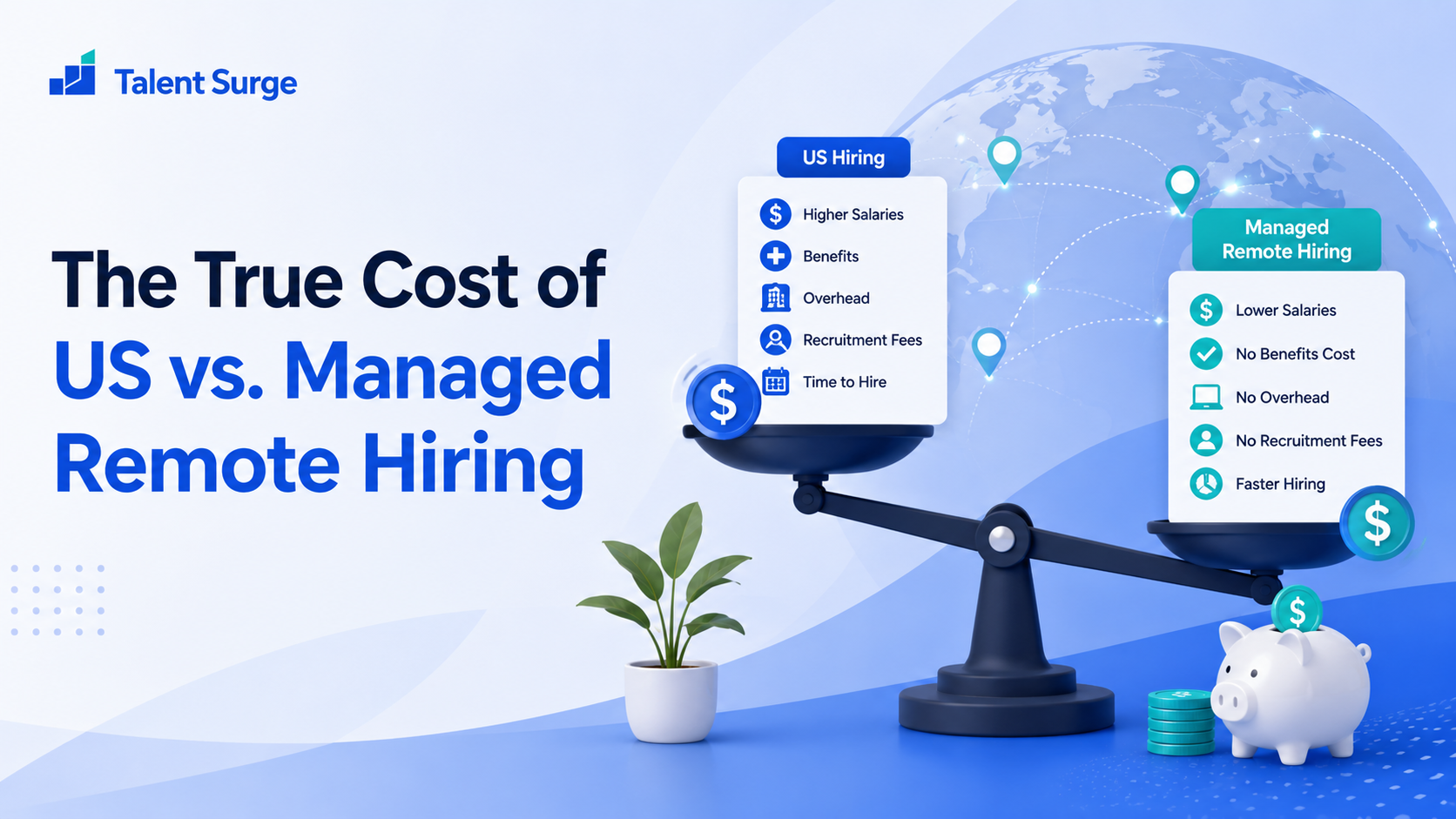
The True Cost of US vs. Managed Remote Hiring
The real cost of a US hire is salary plus benefits, taxes, recruiting, ramp, and management overhead. Here is the full math against a managed remote specialist.

Talent Surge vs. Upwork: Why Agencies Are Switching to Managed Offshore Talent
Upwork is built for sourcing one-off work fast. Talent Surge is built for dedicated, managed specialists who stay. Here is the honest comparison of marketplace freelancers vs managed offshore talent, with cost math, risk, and when each one wins.