
Offshore Hiring Guide: Everything US Businesses Need to Know (2026)
On this page
- What Is Offshore Hiring?
- Offshore vs Freelance vs In-House: Key Differences
- The 24 Roles You Can Hire Offshore Today
- What Does Offshore Hiring Cost? (2026 Data)
- How to Vet Offshore Specialists
- Onboarding a Remote Offshore Team Member
- Time Zones, Communication, and Daily Workflows
- Security and Data Protection for Offshore Teams
- Frequently Asked Questions
Offshore hiring has shifted from a cost-cutting tactic to a strategic growth lever for US businesses of all sizes. The companies that get it right build teams that operate at the same quality as local hires at a fraction of the cost. The companies that get it wrong end up cycling through freelancers, losing months to bad fits, and concluding that "offshore doesn't work." The difference between those outcomes is almost always process, not talent.
This guide covers everything you need to make offshore hiring work: what it actually is, how it compares to freelancing and in-house hiring, which roles translate well, what it costs, how to vet candidates, how to onboard effectively, and how to manage day-to-day operations across time zones. If you are considering offshore hiring for the first time or have tried it before with mixed results, this is the reference you need.
What Is Offshore Hiring?
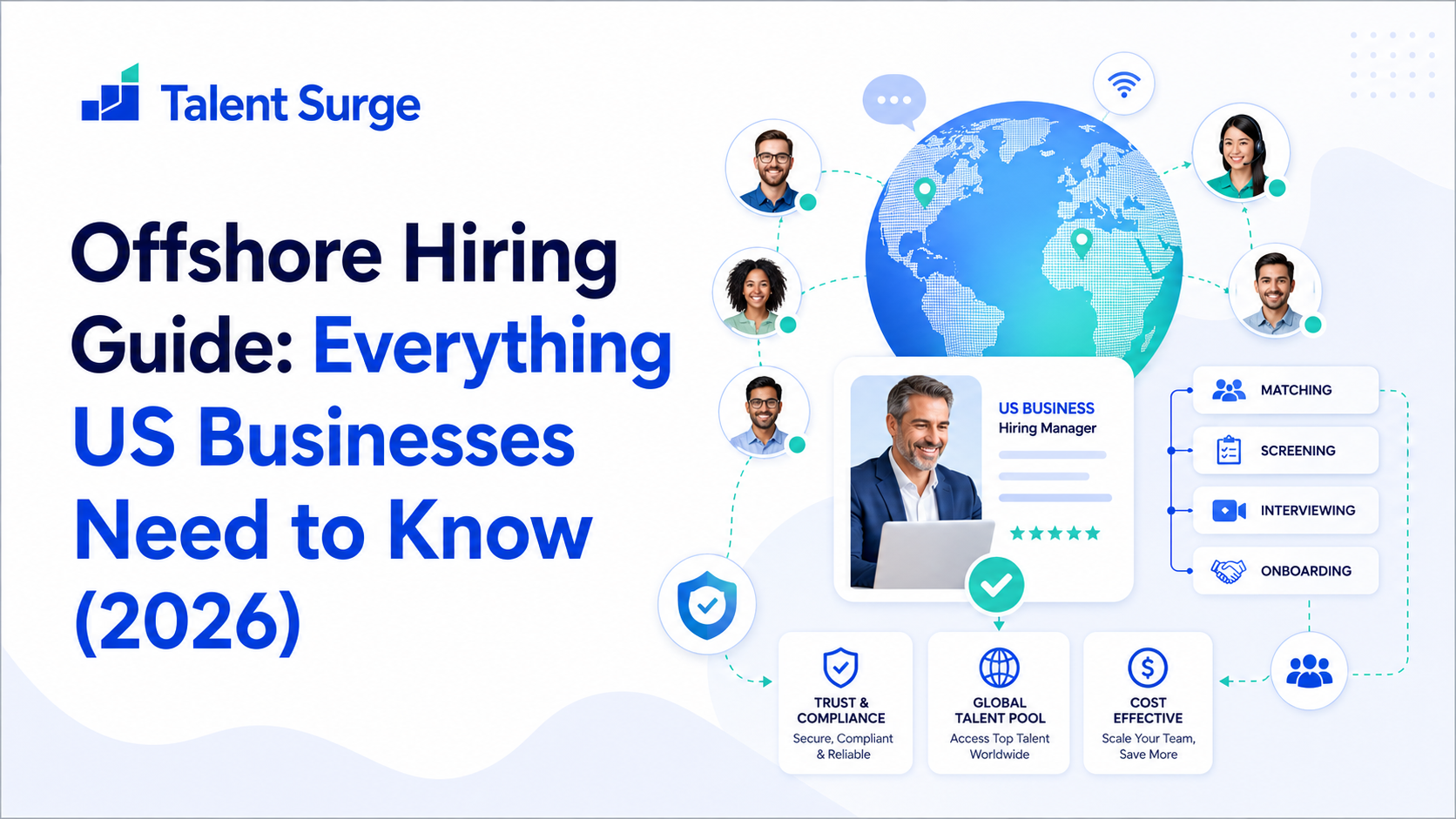
Offshore hiring means employing full-time or part-time workers who are located in a different country from your business headquarters. For US companies, this typically means hiring specialists in regions like Pakistan, the Philippines, India, or Eastern Europe where talent costs are significantly lower but skill levels are comparable.
The key distinction is between direct offshore hiring (you find, hire, and manage someone yourself) and managed offshore hiring (a staffing partner handles recruitment, vetting, placement, HR, payroll, and ongoing management). Most US businesses that succeed with offshore hiring use a managed model because it removes the operational complexity of cross-border employment. See how the managed placement process works step by step.
Managed offshore hiring is not outsourcing in the traditional sense. You are not sending work to a faceless agency. You are hiring a dedicated specialist who works exclusively for your business, on your schedule, using your tools, managed by a structure that keeps them accountable.
Offshore vs Freelance vs In-House: Key Differences
Understanding where managed offshore hiring sits relative to freelancing and in-house hiring is critical for setting the right expectations.
Freelancers are independent contractors who typically juggle multiple clients. They set their own hours, use their own equipment, and have no accountability structure beyond the contract. When a higher-paying client appears, your work gets deprioritized. When they disappear, you start over from zero. For a detailed breakdown of why this model fails for recurring roles, read why managed remote hiring beats freelancers.
In-house hires give you maximum control but at maximum cost. A US-based marketing specialist costs $55,000 to $85,000 in total compensation (salary plus benefits, taxes, equipment, and office space). Hiring takes 45 to 90 days. If the hire doesn't work out, you absorb the full cost of replacement.
Managed offshore specialists combine the dedication of in-house with the cost efficiency of offshore labor markets. Your specialist works exclusively for you during contracted hours, from a managed office, on a company-provided device, with a dedicated manager tracking output and quality. If the fit is not right, you get a free replacement. For a full cost comparison, see the true cost of US hiring vs managed remote hiring.
The 24 Roles You Can Hire Offshore Today
Not every role translates well to offshore hiring. The roles that work best share a few characteristics: they are execution-heavy, they can be managed through clear KPIs, and they do not require physical presence. Talent Surge offers placement across 24 specialist categories, covering marketing, design, technical, support, and operations functions.
Marketing and growth roles include SEO experts, Google Ads specialists, Meta Ads managers, PPC managers, digital marketing experts, social media managers, content strategists, and copywriters. Design roles cover graphic designers and UI/UX designers. Technical and platform roles include GoHighLevel experts, funnel engineers, and automation specialists. Support and operations roles span chat support agents, customer support agents, cold calling agents, lead generation specialists, admin assistants, executive assistants, project managers, technical project managers, virtual marketing assistants, bookkeepers, and virtual sales reps.
Browse the full list with detailed role descriptions, responsibilities, tools, and experience tiers on the specialist roles page.
What Does Offshore Hiring Cost? (2026 Data)
Managed offshore hiring through Talent Surge starts at $3/hr for intern-level talent and scales to $16-$18/hr for senior specialists with 5+ years of experience. Standard roles (marketing, admin, support) follow the $3/$5/$9/$16 tier structure. Technical and revenue-driving roles (Google Ads, GoHighLevel, PPC) follow $3/$6/$11/$18.
Compare this to US market rates: a mid-level marketing specialist costs $30 to $45/hr fully loaded. A senior SEO expert runs $50 to $80/hr. An executive assistant is $25 to $40/hr. The offshore rate includes the specialist's compensation, office space, equipment, IT infrastructure, management layer, and health insurance. There are no hidden costs, no setup fees, and no long-term contracts.
Run your own side-by-side comparison using the pricing page or the detailed cost calculator.
How to Vet Offshore Specialists
Vetting is where most offshore hiring attempts fail. Businesses that hire directly from job boards or freelance platforms rely on self-reported skills and portfolio samples that may not reflect actual ability. The result is a high failure rate in the first 30 days.
A proper vetting process includes resume and background screening, skills-specific assessments (not generic aptitude tests), live task simulations using the actual tools the role requires, English communication evaluation (written and verbal), and cultural fit interviews focused on work style and accountability.
At Talent Surge, every candidate goes through a multi-stage process before they are presented to you. By the time you see candidates, they have already been filtered from a pool of hundreds of applicants. See the full vetting process breakdown.
Onboarding a Remote Offshore Team Member
The first two weeks of an offshore engagement determine whether the relationship succeeds or fails. Effective onboarding is not about handing someone a login and hoping for the best. It requires structured knowledge transfer, clear expectations, defined communication rhythms, and early wins that build mutual confidence.
Key onboarding steps include: granting tool and platform access on day one, providing brand guidelines and SOPs (or creating them together during the first week), setting clear KPIs and reporting cadence, scheduling daily check-ins for the first two weeks (then reducing to weekly), and assigning a real deliverable within the first 48 hours.
For a complete onboarding framework, read how to onboard a remote team member. With a managed partner like Talent Surge, your Business Success Executive handles the onboarding structure so you can focus on knowledge transfer.
Time Zones, Communication, and Daily Workflows
Time zone management is the most commonly cited concern about offshore hiring, and it is also the most overblown. The reality: most offshore specialists work US business hours. If you are hiring through a managed partner, your specialist's working hours are aligned to your schedule from day one.
For teams in US Eastern or Central time zones, specialists in Pakistan (PKT, UTC+5) work a shifted schedule that overlaps with your full business day. Philippines-based specialists (PHT, UTC+8) overlap well with US West Coast hours. The key is not geographic proximity but schedule alignment and communication discipline.
Daily workflows should include a start-of-day check-in (async via Slack or Loom), task management through a shared tool (Asana, ClickUp, Monday, or Trello), and an end-of-day summary of completed work and blockers. Weekly video calls replace the hallway conversations you would have with an in-house team.
Security and Data Protection for Offshore Teams
Data security is a legitimate concern when your business data is accessed from another country. The answer is not to avoid offshore hiring but to ensure the right infrastructure and controls are in place.
Managed offshore partners like Talent Surge operate from secured office environments with company-provided devices (no personal laptops), network monitoring, NDA coverage for all client data, CISM-certified security protocols, and full access revocation at offboarding. This is significantly more secure than hiring a freelancer who works from a coffee shop on their personal device with no access controls.
Review the full security infrastructure and protocols that protect your data when working with Talent Surge specialists.
Frequently Asked Questions
Is offshore hiring legal for US businesses?
Yes. When you hire through a managed staffing partner, the specialist is employed by the offshore entity, not by your US business directly. This eliminates cross-border employment compliance issues, tax withholding obligations, and misclassification risk. You pay the staffing partner a service fee. They handle employment, payroll, benefits, and compliance locally.
How fast can I get someone started?
With Talent Surge, you receive 3 vetted candidates within 14 days of your discovery call. Once you select a candidate, onboarding and tool access setup typically takes 1-2 business days.
What if the hire does not work out?
Free replacement within 30 days. Your Business Success Executive manages the transition, and SOPs created during the first engagement carry over so the replacement does not start from zero.
Do offshore specialists speak fluent English?
English fluency is assessed during the vetting process for every role. Specialists placed through Talent Surge have demonstrated professional-level English communication, both written and verbal, before they reach your shortlist.
Can I hire for part-time or just full-time?
Both. Talent Surge offers three engagement packages: 40 hours/month (Starter), 80 hours/month (Part-Time), and 160 hours/month (Full-Time). Most businesses start with Part-Time and scale to Full-Time as the relationship proves out.
How is this different from traditional outsourcing?
Traditional outsourcing sends a project to a team you never meet and hopes the deliverable comes back acceptable. Managed offshore hiring gives you a dedicated individual who works exclusively for your business, on your tools, on your schedule, with a management layer that tracks quality and output. It is closer to hiring an employee than outsourcing a project. For a deeper comparison, see in-house vs offshore marketing teams.
Take action today
Stop comparing. Start saving.
US businesses save 60-70% vs local hires. Get 3 pre-vetted offshore specialists matched to your exact role delivered in 14 days, free with no commitment.
Keep reading
Why Managed Remote Hiring Beats Freelancers Every Time
Freelancers disappear. Managed remote staff don't. Here's the real difference for US businesses.
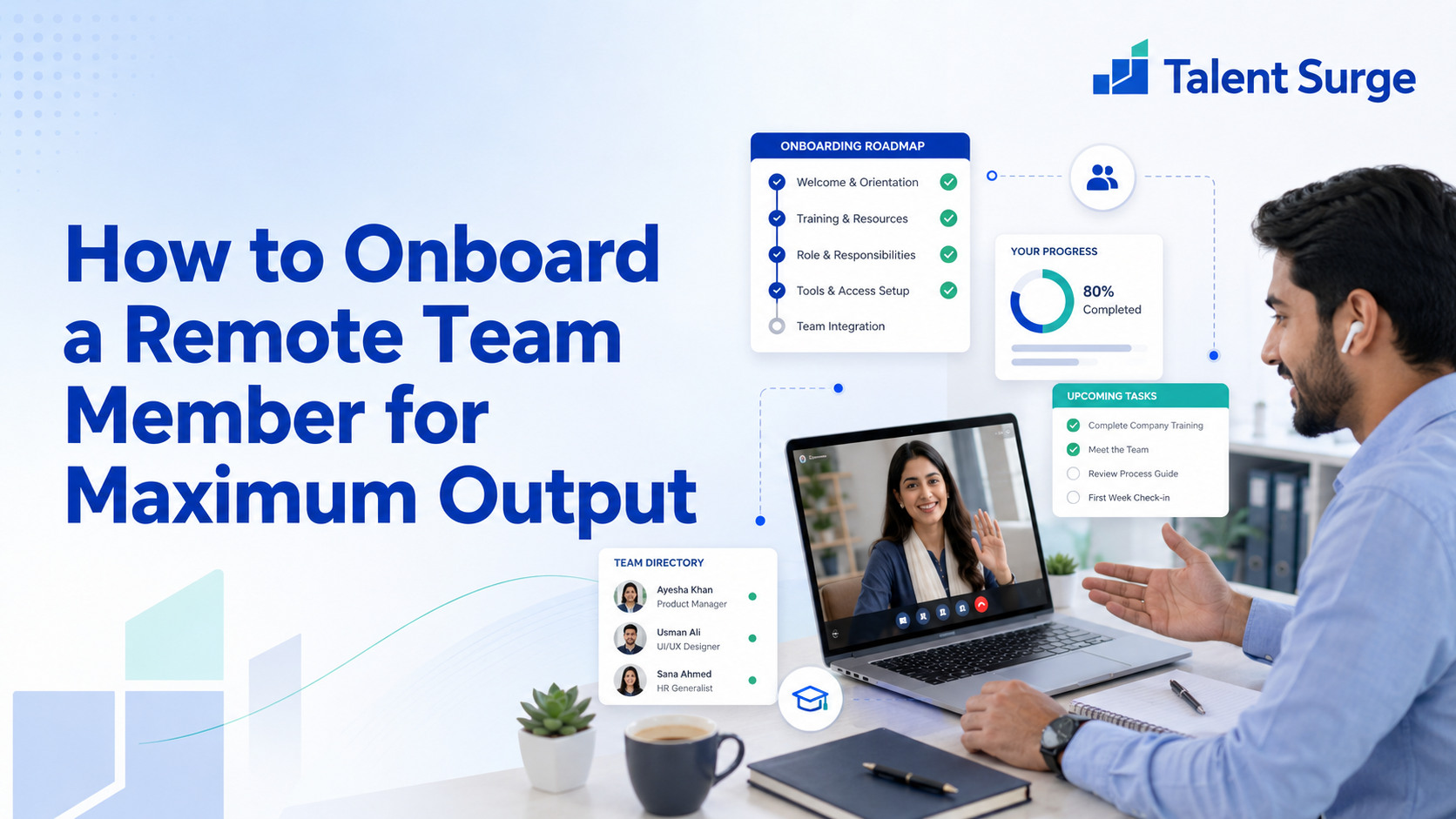
How to Onboard a Remote Team Member for Maximum Output
The first two weeks determine everything. Here's a framework that works.
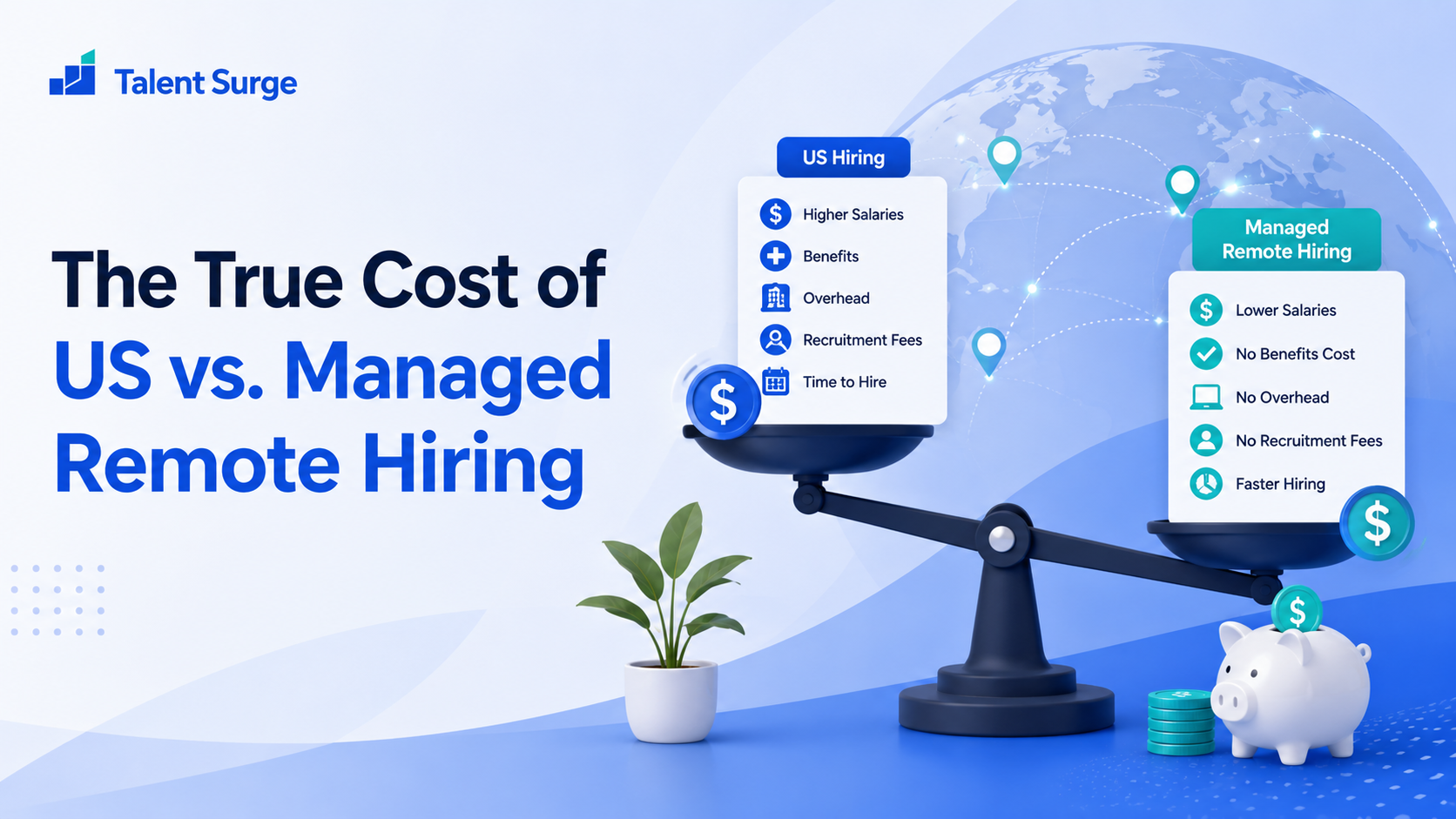
The True Cost of US vs. Managed Remote Hiring
The real cost of a US hire is salary plus benefits, taxes, recruiting, ramp, and management overhead. Here is the full math against a managed remote specialist.