
Talent Surge vs. Upwork: Why Agencies Are Switching to Managed Offshore Talent
On this page
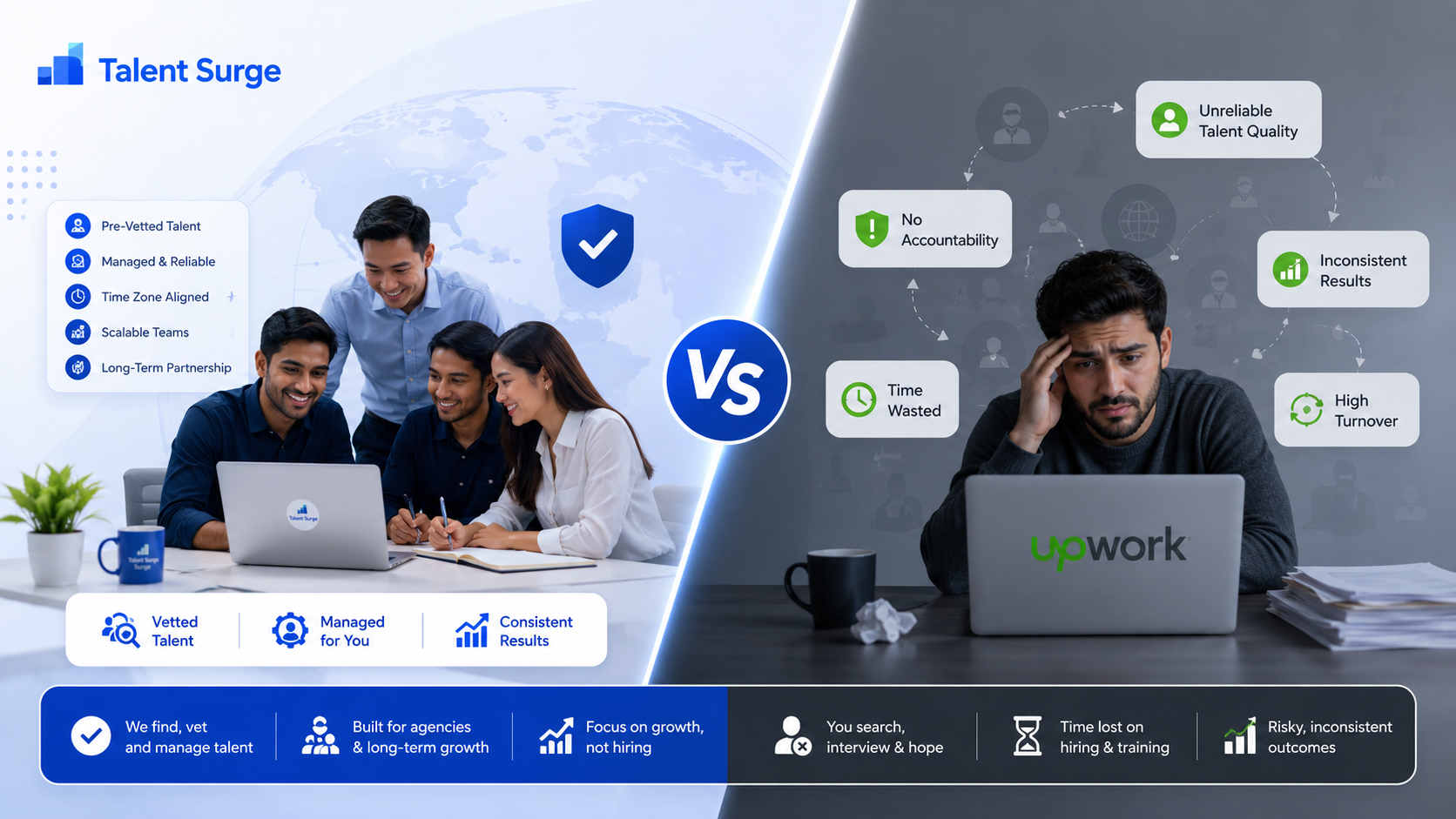
If you run an agency or a lean marketing team, you have almost certainly hired off Upwork. It is fast, the catalog is enormous, and the cost per hour looks great on the invoice. The question is not whether Upwork works. It is whether a marketplace is the right way to staff a role you need filled every single week for the next two years.
This guide compares three ways to fill a recurring marketing role: an Upwork freelancer, an independent freelancer you manage directly, and a managed offshore specialist through Talent Surge. We cover real cost, quality and risk, speed, and the management overhead nobody puts on the quote, so you can match the model to the job instead of defaulting to the cheapest hourly rate.
The quick answer
For genuinely one-off work (a logo, a single landing page, a one-time audit), Upwork or a freelancer is the right tool and you should not overthink it. For a recurring, relationship-dependent role where consistency, security, and accountability matter, a managed specialist wins because the management, vetting, and replacement risk are carried by the partner instead of by you. The break-even is usually around the point where you would re-hire the same skill more than twice in a year.
Upwork vs freelancer vs Talent Surge at a glance
| Factor | Upwork freelancer | Direct freelancer | Talent Surge specialist |
|---|---|---|---|
| Model | Marketplace bidding | Private contract | Managed offshore partner |
| Dedicated to your account | No, serves many clients | No, serves many clients | Yes, full-time and exclusive |
| Vetting | Self-reported ratings | Whatever you do yourself | Skills tests, portfolio, interviews |
| Accountability layer | None, you manage | None, you manage | Named Business Success Executive |
| Replacement if it fails | Re-post and re-hire | Start from zero | Free replacement guarantee |
| Security and NDA | Platform-mediated, informal | Often none | Signed NDA, CISM-certified office, company laptop |
| Billing | Dispute-prone hourly, plus platform fee | Variable, scope creep | Fixed tiers from $3/hr, all-in |
How the Upwork marketplace model breaks down
The Upwork model is a bidding marketplace. You post a job, freelancers bid, you check ratings and portfolios, and you pick someone. That flow is excellent for sourcing speed and terrible for sustaining a role. For recurring work, one of three patterns shows up within the first 30 to 60 days:
- Quiet decline. The first deliverable is solid, then quality and responsiveness slip as the freelancer takes on more clients and your account drops down the priority list.
- Scope creep and billing friction. Hourly contracts have limited oversight, so a "20-hour" task quietly becomes 35 billed hours with no real accountability mechanism to push back on.
- Disappearance. The freelancer goes unresponsive, pauses the contract, or closes their account mid-engagement, and you restart sourcing from scratch.
Agencies delivering SEO, paid media, or content for paying clients cannot run on a model that produces those outcomes a few times a year. Client commitments need reliable output, not a marketplace lottery.
The real cost: hourly rate is not the price
The headline rate is the cheapest part of any freelancer relationship. The expensive part is the management cycle: posting jobs, screening bids, interviewing, onboarding, reviewing work, requesting revisions, and restarting when someone leaves. For a recurring role that turns over three times a year, that overhead typically runs 8-15 hours per cycle, or roughly 24-45 hours annually on a single seat.
At an agency owner's effective billing value of $150-$200/hr, that hidden management load alone is worth thousands of dollars before you count a single deliverable. A managed specialist removes most of it: the Business Success Executive owns performance, a replacement is handled for you, and your job shrinks to briefing and approving work. Model your own numbers against fixed tiers with the cost calculator, and see the full method in our true cost of US vs managed remote hiring breakdown.
Quality, security, and risk
On a marketplace, vetting is self-reported and gameable. Five-star ratings tell you a freelancer kept past clients happy enough, not that they can pass a technical assessment or handle your specific stack. Talent Surge runs proprietary skills tests, portfolio reviews, and structured interviews before a candidate ever reaches your shortlist, which is why you interview pre-qualified people instead of sorting cold applications. See exactly how that works on the vetting process page.
Security is the other gap. A freelancer on a personal laptop, on home wifi, juggling several clients is a real data-exposure surface. Managed specialists work from a supervised, CISM-certified office on company-issued laptops with signed NDAs and screen monitoring. For agencies handling client logins, ad accounts, and CRM data, that difference is the whole conversation. Read more on the security page.
When each option actually fits
- Upwork or a direct freelancer: one-off projects, experimental work, or a skill you need once and may never need again.
- A managed specialist: any recurring role where consistency, institutional knowledge, security, and accountability compound over time, such as ongoing SEO, paid media, content, or operations.
- A hybrid: many agencies keep a marketplace bench for spiky one-off needs and run their core recurring roles on managed specialists. That is usually the most resilient setup.
Where Talent Surge fits
Talent Surge is not another marketplace. It places pre-vetted, office-based offshore specialists who work exclusively on your account on company laptops, delivered in about 14 days from $3/hr, with a named Business Success Executive handling HR and reviews and a free replacement guarantee if the fit is wrong. It is the right tool when you want one accountable person who stays, not a rotating cast of contractors. For agency SEO and paid media in particular, start with the remote SEO expert role, then get 3 matched candidates for your first seat.
FAQ
Can I trial a Talent Surge specialist before committing long-term?
Yes. Engagements are flexible with no long lock-in. A part-time engagement (80 hours/month) lets you trial a role and a specialist before scaling to full-time. See the options on the pricing page.
How does Talent Surge vetting compare to Upwork ratings?
Upwork ratings are self-reported and easy to inflate. Talent Surge runs technical assessments, portfolio reviews, and interviews for every candidate before you see them, so your shortlist is already pre-qualified.
Is Talent Surge suitable for short-term projects?
It is optimised for ongoing, recurring roles. For a single one-off deliverable, a marketplace freelancer is the better fit. For repeatable execution where accountability matters, the managed model wins.
Do I still manage the day-to-day work?
You direct the work, priorities, and feedback. Talent Surge manages the person: HR, attendance, performance reviews, and escalations. See the split on the team management page.
Related Reading
- Managed remote hiring vs freelancers
- Talent Surge vs freelancers for marketing teams
- Why marketing agencies fail with freelancers
- Talent Surge vs an in-house team
- The true cost of US vs managed remote hiring
- Why Talent Surge
Ready to move from the marketplace to the managed model? Get 3 matched candidates for your first role.
Take action today
Stop comparing. Start saving.
US businesses save 60-70% vs local hires. Get 3 pre-vetted offshore specialists matched to your exact role delivered in 14 days, free with no commitment.
Keep reading
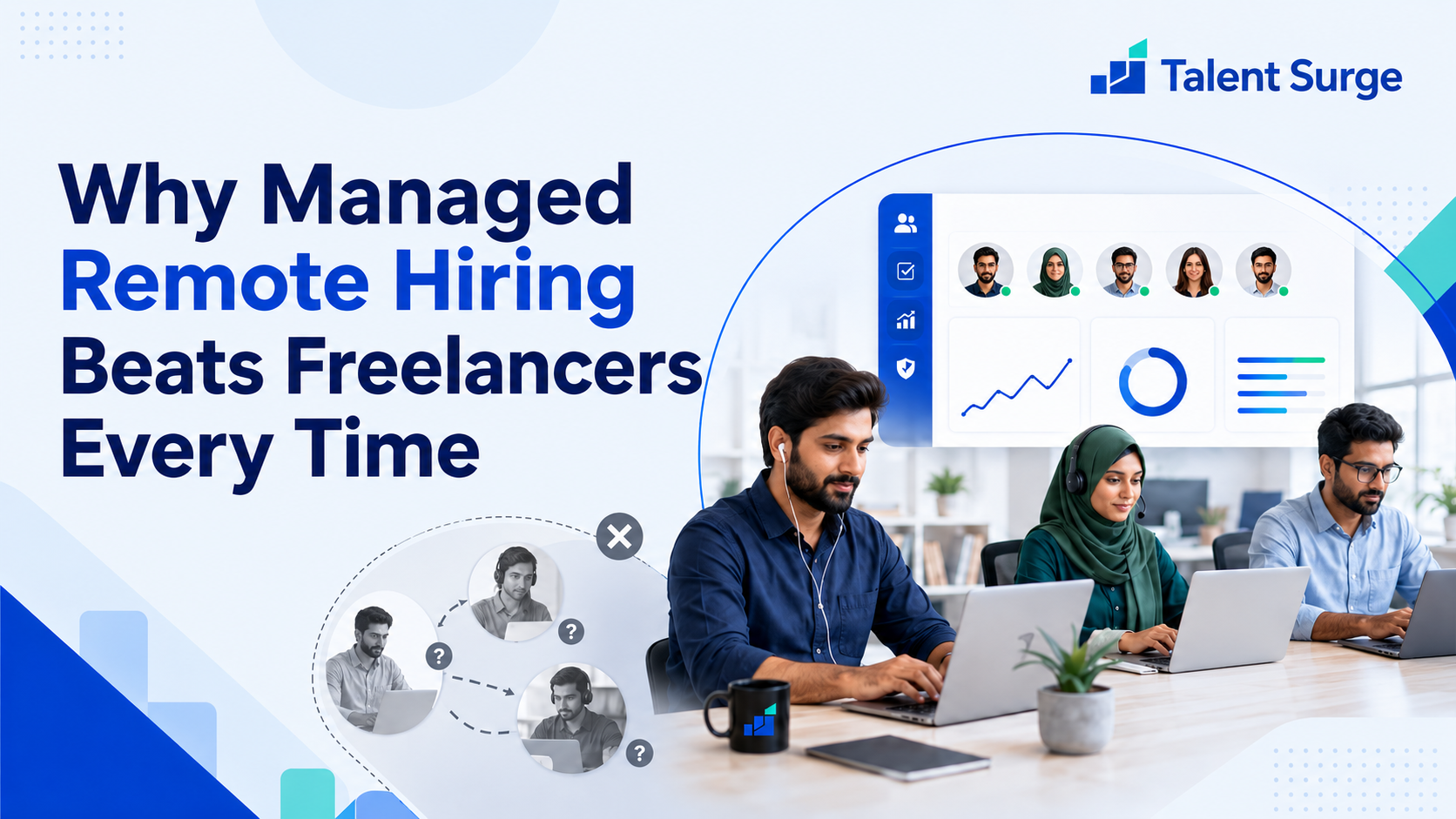
Why Managed Remote Hiring Beats Freelancers Every Time
Freelancers disappear. Managed remote staff don't. Here's the real difference for US businesses.
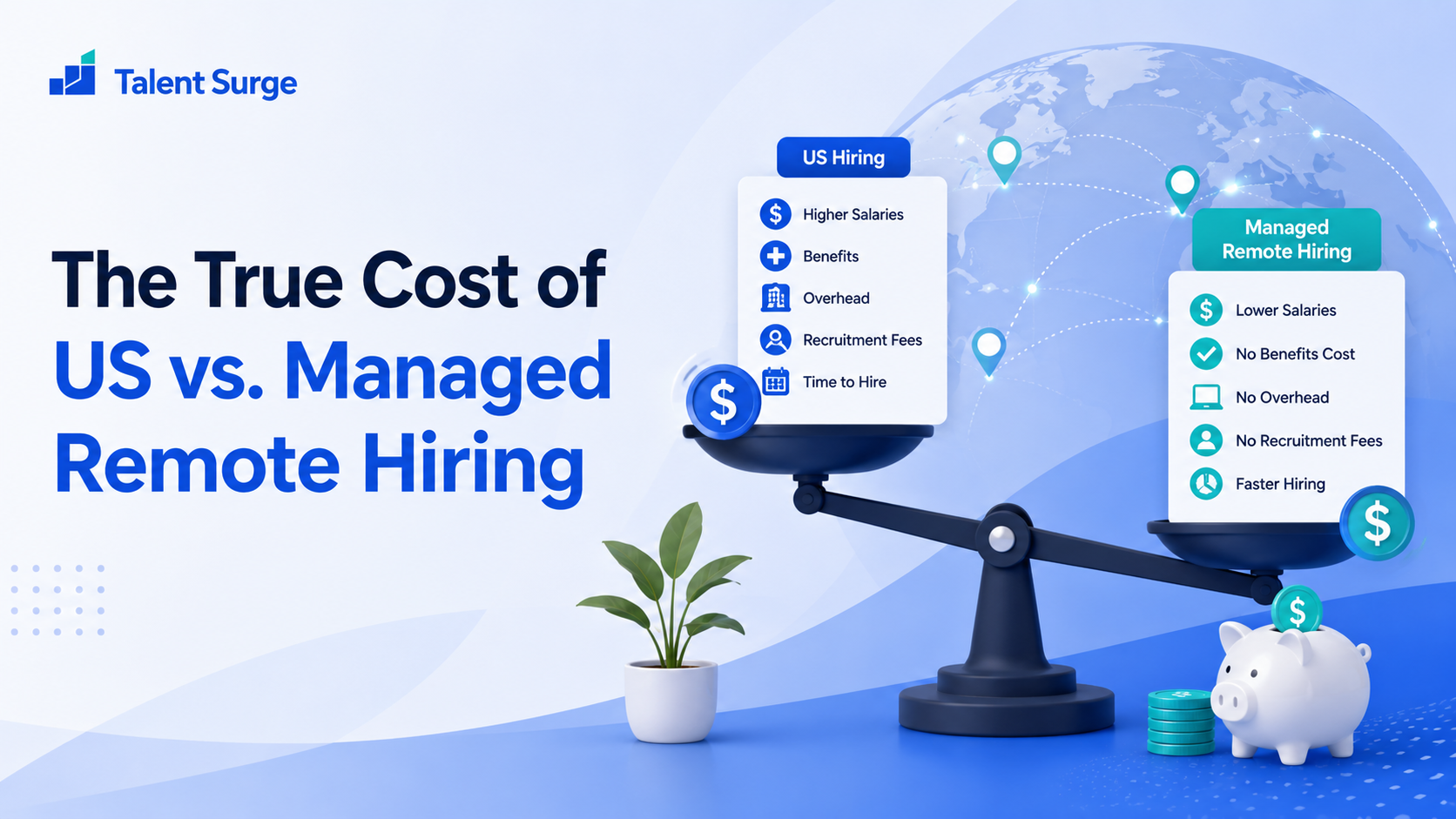
The True Cost of US vs. Managed Remote Hiring
The real cost of a US hire is salary plus benefits, taxes, recruiting, ramp, and management overhead. Here is the full math against a managed remote specialist.
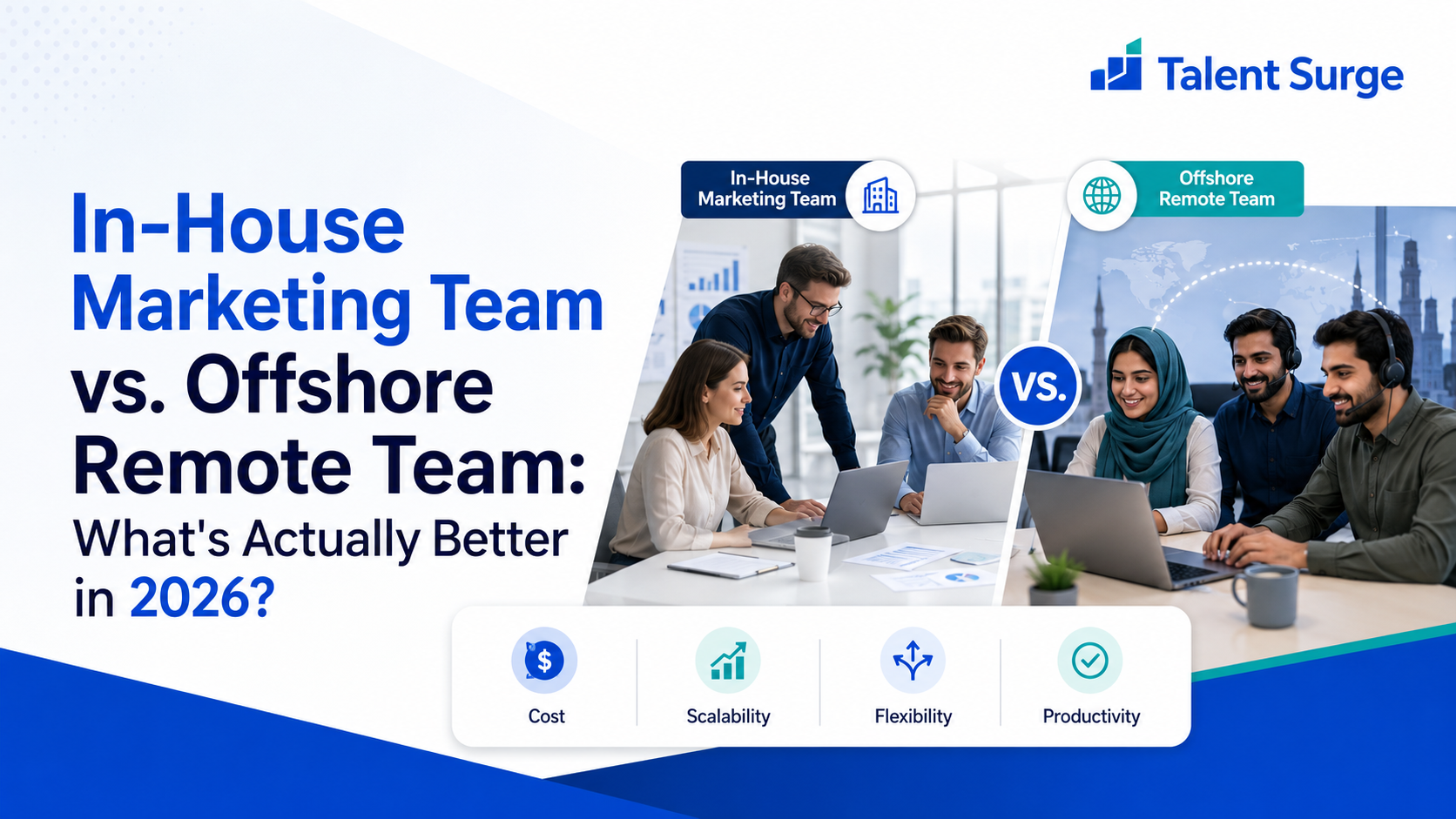
In-House Marketing Team vs. Offshore Remote Team: What's Actually Better in 2026?
In-house or offshore is the wrong question. The real one is which roles belong local, which belong offshore, and what hybrid structure gives you the best output per dollar. Here is the role-by-role answer with real cost math.