
Lead Generation Specialist vs SDR: Which Does Your Sales Team Actually Need?

On this page
- The Real Difference Between Lead Gen and SDR
- When You Need a Lead Generation Specialist
- When You Need an SDR
- Side-by-Side Comparison
- The Common Mistake: Hiring an SDR Before You Have Leads
- The Combined Stack for Most Growing B2B Companies
- Why Managed Offshore Works for Both Roles
- The Right Sequence for Building Your Outbound Engine
- The Tooling Stack Both Roles Should Be Trained On
- Where Outbound Sales Fits in a Full Revenue Team
- KPIs That Tell You Which Role Is Actually Performing
- How to Run the First Interview for Each Role
- FAQ
Most sales teams use "lead gen" and "SDR" interchangeably. They should not. The two roles look similar on a job description but solve completely different problems. Hiring the wrong one is one of the most common reasons B2B pipelines stay empty even after a "new sales hire."
This guide breaks down the real difference, when each role fits, and how managed offshore changes the math for both.
The Real Difference Between Lead Gen and SDR
The simplest way to think about it: a Lead Generation Specialist finds leads. An SDR qualifies them.
What a Lead Generation Specialist Does
- Prospect research: building target lists from LinkedIn Sales Navigator, Apollo, ZoomInfo, industry databases
- Data enrichment: filling in missing emails, phone numbers, company info, decision-maker hierarchy
- CRM hygiene: deduplication, cleanup, segmentation, list management
- Outbound email campaign setup (sequences in Lemlist, Smartlead, Instantly)
- LinkedIn outreach automation setup and management
- Inbound lead routing and triage
- Reporting on list size, contact validity rate, response rate
A Lead Gen Specialist fills the top of your funnel with contactable prospects. They rarely talk to leads directly. Their output is a pipeline of qualified accounts and contacts your SDR or AE then works.
What an SDR Does
- Outbound calling to prospects already in the CRM
- Cold email response handling and qualification conversations
- Meeting booking with qualified prospects
- BANT or MEDDIC qualification
- Handoff documentation to Account Executives
- CRM activity logging and pipeline updates
- Daily call/email/meeting metrics reporting
An SDR converts leads into qualified meetings. Their output is booked sales calls with prospects who fit your ICP and have indicated buying intent.
When You Need a Lead Generation Specialist
- Your CRM is empty or full of stale contacts
- Your AEs are wasting time researching prospects instead of selling
- You have a defined ICP but no systematic way to find more matching accounts
- You want to launch outbound but do not have lists, sequences, or infrastructure
- Your inbound leads are landing in chaos and not being routed to the right rep
When You Need an SDR
- You have lists and sequences running but no one to handle responses and conversations
- Your AEs are spending too much time on early-stage qualification calls
- You need 10-30 qualified meetings per month booked for the sales team
- You have a CRM full of warm or cold-warm leads that need re-engagement
- Your conversion from list to meeting is too low because nobody is following up by phone
Side-by-Side Comparison
| Factor | Lead Generation Specialist | SDR |
|---|---|---|
| Primary output | Contactable prospect lists in CRM | Booked qualified meetings |
| Primary tools | Sales Navigator, Apollo, ZoomInfo, Lemlist | RingCentral, Aircall, HubSpot, Salesforce |
| Daily activity | Research, list building, enrichment, sequence setup | Calls, emails, qualification conversations, meeting booking |
| Requires phone skills | No - mostly written and research | Yes - daily outbound and inbound calls |
| Best Talent Surge tier | Beginner or Expert | Beginner or Expert with strong English |
| Hourly rate (Talent Surge Expert) | From $9/hr | From $9/hr |
| Reports to | Marketing or RevOps | Sales Manager or VP Sales |
Not sure which role fits your stage? A discovery call can map your current funnel and recommend the right hire. Book a free 30-minute call.
The Common Mistake: Hiring an SDR Before You Have Leads
This is the most expensive sales-hire mistake we see. A company hires an SDR (US-based or offshore), then gives them an empty CRM and tells them to "go find leads." Within 60 days, the SDR has built a few small lists, made a handful of calls, and produced 1-2 meetings. The company concludes "outbound does not work" and lets them go.
The actual problem: an SDR is a closer of conversations, not an opener of databases. They need lists to work. Without a Lead Gen Specialist (or a marketing engine producing inbound), an SDR has nothing to convert.
The right sequence: build the lead engine first (Lead Gen Specialist or marketing automation), then add the conversion engine (SDR).
The Combined Stack for Most Growing B2B Companies
For companies under $5M ARR, a single Lead Gen Specialist plus a single SDR is usually the right structure. Total cost on Talent Surge Expert tier (both full-time): $34,560/year for both roles. Compare to two US SDRs at $70K base + commission and benefits: $200K-$240K total.
For larger teams, the ratio is typically 1 Lead Gen Specialist supporting 2-3 SDRs.
Why Managed Offshore Works for Both Roles
Both roles are well-suited to offshore execution because:
- The work is structured and measurable (lists built, calls made, meetings booked)
- Tools (Apollo, RingCentral, HubSpot) are cloud-based and work the same anywhere
- US business hours can be matched - Talent Surge specialists work your timezone
- The cost difference is dramatic: 75-85% saving vs US equivalents
For more on the offshore sales model, see our admin assistant comparison - the same managed model applies.
The Right Sequence for Building Your Outbound Engine
Most sales leaders try to add SDR capacity first because that is where the "missing meetings" pain shows up. But the math only works if the inputs are in place. The right sequence for building an outbound engine from scratch looks like this:
Phase 1 (weeks 1-6): Lead Gen Specialist + tooling. Get the list-building, enrichment, sequencing infrastructure in place. Apollo or Sales Navigator subscription, email warmup tools (Mailwarm, Lemwarm), domain authentication (SPF, DKIM, DMARC). The Lead Gen Specialist builds the first 1,000-3,000 prospect contacts and launches the first cold email sequences. This alone produces 5-15 inbound replies and 2-5 booked meetings in week 4-6.
Phase 2 (weeks 6-12): Add the SDR. Once response volume exceeds what your AEs or you can personally handle, bring in an SDR to handle the conversations, qualification, and meeting booking. The Lead Gen Specialist becomes the SDR's supply line. Output ramps to 10-25 qualified meetings per month per SDR.
Phase 3 (weeks 12+): Scale by ratio. A single Lead Gen Specialist can supply 2-3 SDRs at full output. Hire your second SDR when the first one is consistently booking 20+ qualified meetings per month and your AE close rate justifies more pipeline.
Doing this in reverse (SDR first, then Lead Gen) is the most common mistake. The SDR has nothing to convert in months 1-2, output looks weak, and the role gets unfairly judged before the engine even exists.
The Tooling Stack Both Roles Should Be Trained On
- Lead Generation Specialist: Apollo, Sales Navigator, ZoomInfo, Lusha, Clearbit, Lemlist, Smartlead, Instantly, Phantombuster, Bouncer (email validation), HubSpot or Salesforce.
- SDR: Outreach.io, Salesloft, Apollo dialer, RingCentral, Aircall, Salesforce or HubSpot, Gong or Chorus (call recording), Calendly or HubSpot Meetings.
Tool fluency is the single best predictor of ramp time. A specialist who has used your exact stack ramps in 2-3 weeks; one starting from scratch on your stack takes 6-8 weeks. When matching candidates, Talent Surge filters on tool experience first.
Where Outbound Sales Fits in a Full Revenue Team
Lead Gen and SDR work best inside a broader revenue stack. The full team for a B2B company doing $1-5M ARR usually looks like:
- 1-2 AEs (in-house in most cases) closing the meetings booked
- 1 Lead Generation Specialist supplying contacts
- 1-2 SDRs working the contacts and inbound leads
- 1 Customer Support Agent handling post-sale onboarding and renewal-risk signals
- Optional: 1 Cold Calling Agent for high-volume outbound dial campaigns
- Optional: 1 Automation Expert for CRM hygiene, lead routing, and reporting infrastructure
Run that team offshore through Talent Surge and the all-in cost is roughly $90K-$130K per year, versus $500K-$700K for the US-equivalent build. Use the Cost Calculator to model your specific team. For a deeper breakdown of the cost gap on a single SDR seat, see Virtual Sales Rep vs In-House SDR.
KPIs That Tell You Which Role Is Actually Performing
Both roles are easy to misjudge if you only look at top-line activity. The KPIs that actually predict revenue impact are different for each.
Lead Generation Specialist KPIs:
- Verified contacts added per week (target: 200-400)
- Email deliverability rate per domain (target: >95%)
- Sequence reply rate (target: 3-8% depending on ICP and offer)
- Cost per qualified inbound reply (track monthly)
- List accuracy spot-checks (target: <5% bounce rate)
SDR KPIs:
- Qualified meetings booked per month (target: 15-25 depending on motion)
- Meeting-to-pipeline conversion rate (target: >60%)
- Speed to lead on inbound (target: <5 minutes)
- Show rate (target: >70%)
- AE feedback score on lead quality (collect monthly)
Both roles should also be measured on CRM hygiene - opportunity stage accuracy, activity logging completeness, and disposition discipline. Without that, the surface metrics drift away from reality within 60 days.
How to Run the First Interview for Each Role
The interview screens that predict performance look different for each role. For Lead Gen, run a live task: hand them a brief ICP and 30 minutes to produce a 25-contact list with verified emails, sources, and a brief sequence draft. You will see research skill, tool fluency, written English, and pace in one screen. For SDR, run a live roleplay: you play a skeptical prospect, they handle the first 5 minutes of a discovery call. You will see voice quality, qualification discipline, objection handling, and meeting-ask confidence. Skip whiteboard puzzles and culture-fit chats - both roles are operational and the interview should match the work. Talent Surge runs these screens automatically in the matching process, so candidates presented to you have already passed live-task vetting.
One pattern worth flagging: candidates who ask thoughtful questions about your ICP, current sales motion, and target metrics during the interview almost always outperform candidates who only answer questions. The first group thinks like operators; the second group thinks like job applicants. The difference shows up in week-one output. Use the interview to surface that distinction explicitly, and weigh it heavily against polished-but-passive candidates.
FAQ
Can one person do both Lead Gen and SDR work?
For low-volume needs (under 200 contacts/month and under 5 meetings/month), yes. Past that, the cognitive switch between research mode and conversation mode kills both functions. Split the roles.
Do offshore SDRs sound American on the phone?
Talent Surge vets every SDR candidate for accent neutrality and English fluency. Many clients run blind tests where their US prospects cannot identify the SDR as offshore. We can share recordings during the matching process.
What CRMs do specialists work with?
HubSpot, Salesforce, Pipedrive, GoHighLevel, Close, and most cloud CRMs. Specialists are matched based on tool experience.
How fast can I see meetings booked?
Lead gen output (list growth, sequence launches) appears within 2-3 weeks. SDR meeting bookings typically start in weeks 3-4 once lists and scripts are dialed in. Steady-state output by week 6-8.
What if my market is highly regulated (finance, healthcare)?
Compliance training is part of onboarding for regulated industries. CISM-certified security, signed NDAs, and access controls are standard for Talent Surge specialists. See our security page.
Ready to build the pipeline engine? Hire a Lead Generation Specialist or book a discovery call to map the right structure for your sales team.
Take action today
Stop comparing. Start saving.
US businesses save 60-70% vs local hires. Get 3 pre-vetted offshore specialists matched to your exact role delivered in 14 days, free with no commitment.
Keep reading
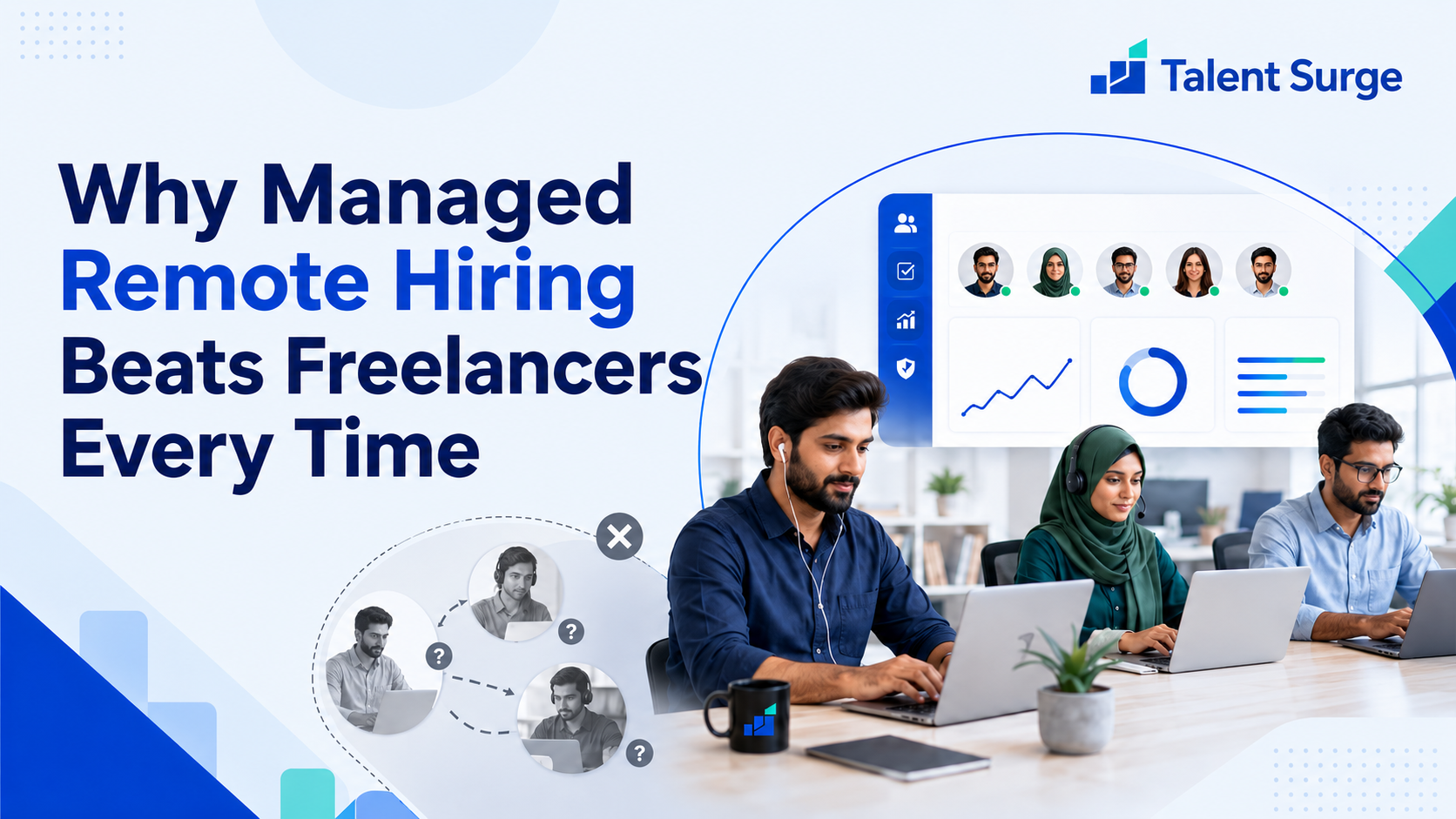
Why Managed Remote Hiring Beats Freelancers Every Time
Freelancers disappear. Managed remote staff don't. Here's the real difference for US businesses.
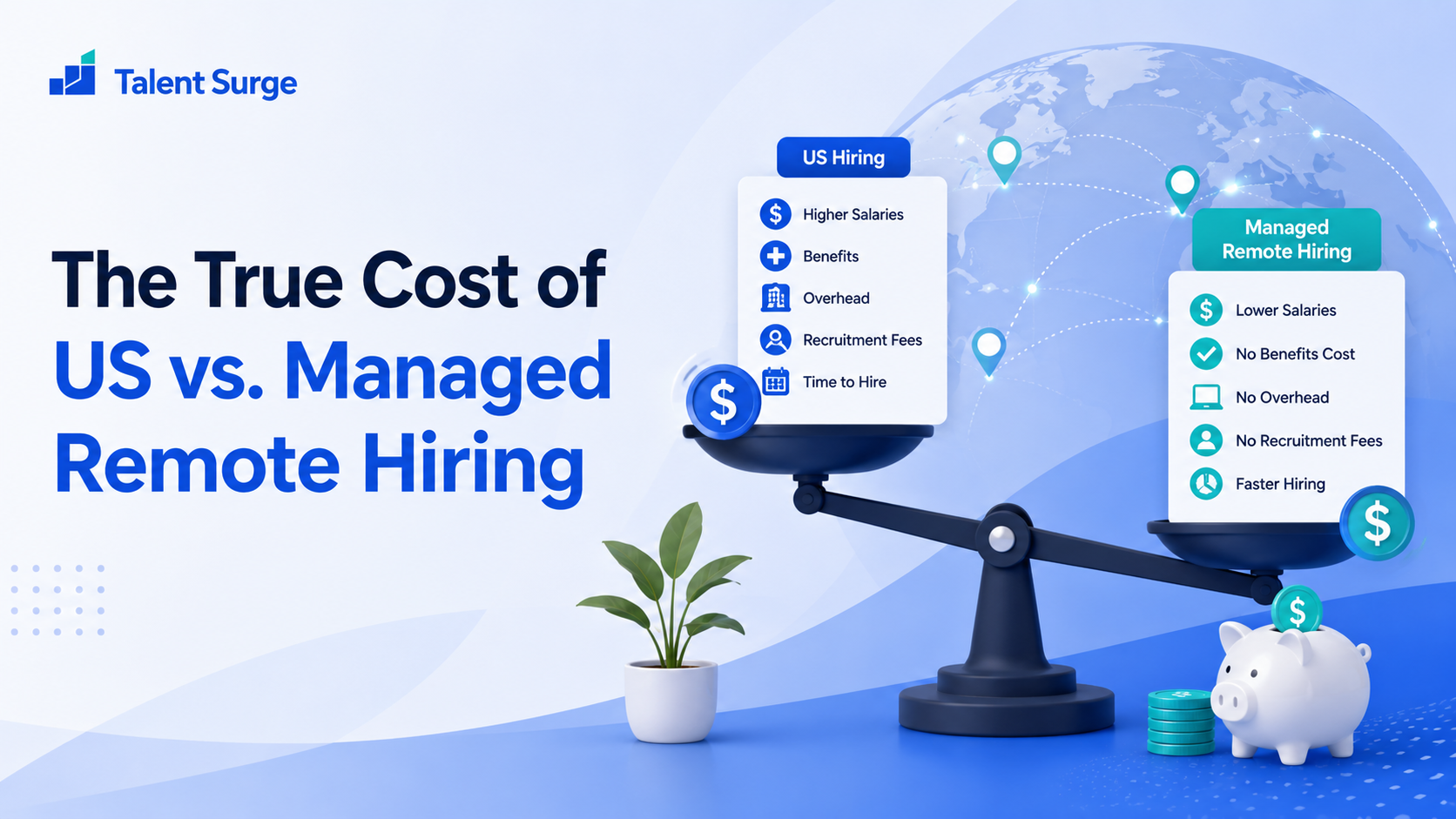
The True Cost of US vs. Managed Remote Hiring
The real cost of a US hire is salary plus benefits, taxes, recruiting, ramp, and management overhead. Here is the full math against a managed remote specialist.
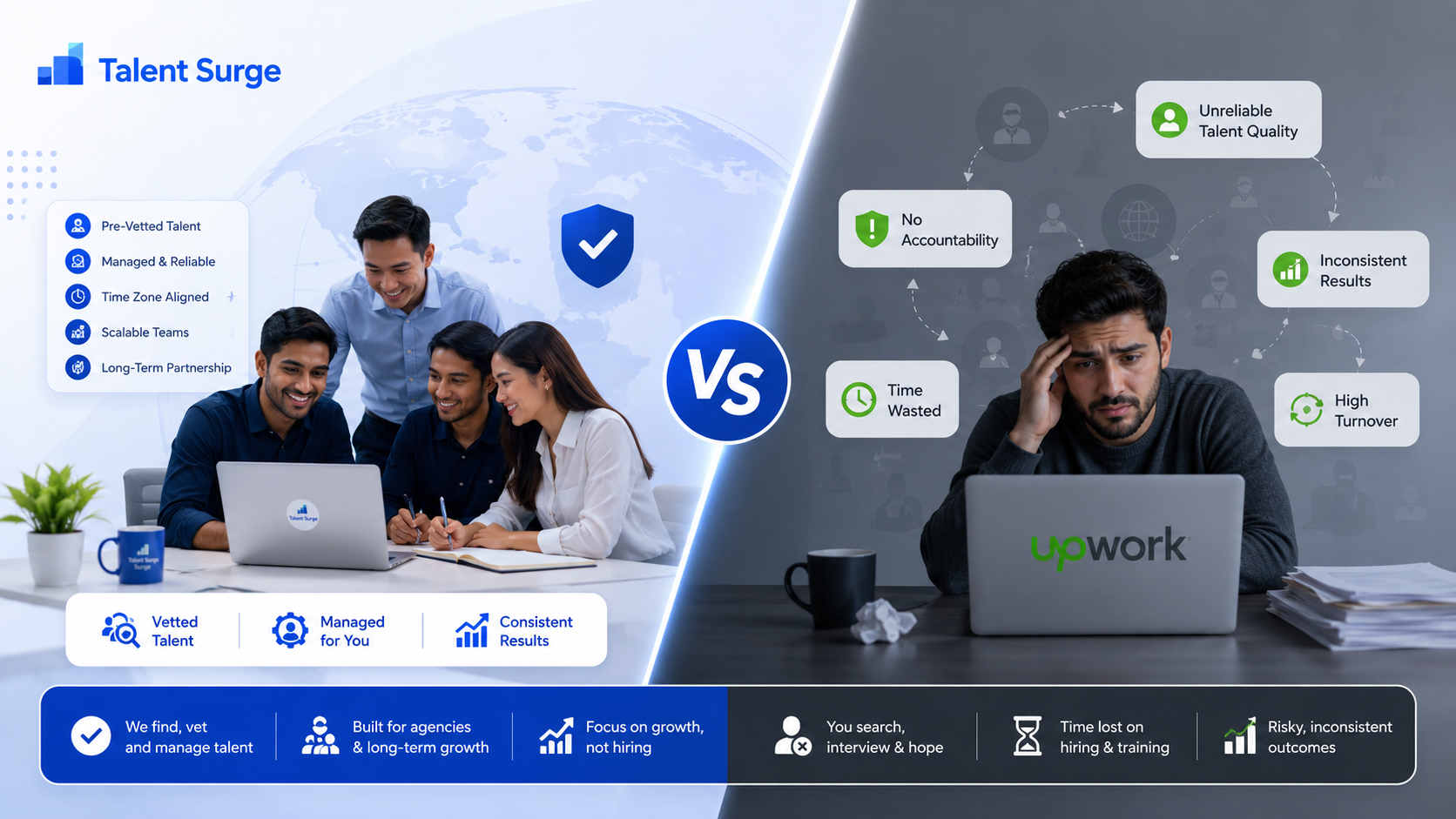
Talent Surge vs. Upwork: Why Agencies Are Switching to Managed Offshore Talent
Upwork is built for sourcing one-off work fast. Talent Surge is built for dedicated, managed specialists who stay. Here is the honest comparison of marketplace freelancers vs managed offshore talent, with cost math, risk, and when each one wins.