
When Should You Outsource Customer Support? (5 Clear Signs)

On this page
- What "Customer Support" Actually Covers
- The 5 Signs You Are Ready to Outsource
- In-House vs Outsourced vs Hybrid: Which Fits?
- What to Look For When Hiring Outsourced Support
- The 90-Day Outsourcing Playbook
- Channel-Specific Patterns That Determine Hiring Mix
- Common Mistakes That Hurt CSAT Post-Outsourcing
- Stacking Support With Adjacent Roles for Higher Leverage
- Coverage Models and How They Affect Hiring Math
- How Tier Maps to Channel and Complexity
- The Macros and Templates Library Every Outsourced Team Needs
- FAQ
Most companies outsource customer support at the wrong moment. Some outsource too early, before they have documented processes - the result is bad CSAT and angry customers. Others wait too long, until the founder or ops team is drowning in tickets - the result is missed responses, churn, and burnout.
This guide lays out the five concrete signals that mean you have hit the right outsourcing moment, what to look for in a partner, and how to get the first 90 days right.
What "Customer Support" Actually Covers
Before you can decide if outsourcing makes sense, define what you are outsourcing. Customer support is not one job - it is several:
- Tier 1 reactive support: Order status, returns, basic troubleshooting, account questions, password resets
- Tier 2 technical support: Product configuration, integration issues, advanced troubleshooting
- Live chat: Real-time chat on your website or in-app
- Email ticket management: Zendesk, Help Scout, Freshdesk, Intercom inboxes
- Phone support: Inbound calls for support issues
- Social media support: DMs and public mentions on Twitter/X, Facebook, Instagram
- Community management: Discord, Slack community, forum moderation
Most companies outsource Tier 1 reactive support, live chat, and email ticket management first. Tier 2 technical support stays in-house longer because it requires product depth.
The 5 Signs You Are Ready to Outsource
1. Your first response time is slipping past 4 hours
First response time is the single biggest CSAT driver. If your team is consistently taking more than 4 hours to acknowledge tickets, you are losing trust and likely losing customers. Once response time slips, recovering it requires either more headcount or smarter workflows.
2. Your founders or operators are answering tickets
If the CEO, CTO, or VP of Operations is regularly clearing the support queue, the unit economics have already broken. At their hourly value (often $200-$500/hour), every ticket they personally handle costs the business 50-200x what an outsourced rep would cost.
3. Ticket volume has grown 2-3x in the past 12 months
Ticket volume scales roughly linearly with customer count. If you have 2-3x'd customers, you need 2-3x support capacity. Hiring in-house at that pace is expensive and slow. Outsourced support scales in 14 days, not 90.
4. You have documented SOPs and a knowledge base
This is the test most companies skip. If you cannot hand a new rep a written SOP for "how we handle a refund" or "how we troubleshoot login issues," outsourcing will fail. Documentation has to exist before delegation. If it does not yet, build it first.
5. You need timezone or 24/7 coverage
If your customers expect responses outside US business hours, in-house staffing gets expensive fast. Multiple shifts, overtime, holiday coverage - the costs compound. Offshore support naturally fills off-hours coverage at a fraction of US wage rates.
If three or more of these apply, you are at the outsourcing point. Hire a Customer Support Agent from $3/hr and stop watching CSAT slide.
In-House vs Outsourced vs Hybrid: Which Fits?
| Model | Best For | Cost (per rep, annual) | Speed to Scale |
|---|---|---|---|
| In-house US support | Complex Tier 2/3 technical support, regulated industries | $60K-$85K all-in | 60-90 days to hire |
| Outsourced Tier 1 only | High-volume reactive support, simple workflows | $5,760-$17,280 (Talent Surge Trainee to Expert) | 14 days |
| Hybrid (in-house lead + outsourced Tier 1) | Companies scaling support while maintaining quality control | $60K + $17K per outsourced rep | 14 days for the outsourced layer |
What to Look For When Hiring Outsourced Support
- Written English fluency: Most support is written - emails, chat, ticket notes. Test their writing in interview, not just their speech.
- Tool experience: Zendesk, Intercom, Help Scout, Freshdesk, Gorgias - they should know at least two from your stack
- SOP discipline: Outsourced support thrives when reps follow your playbook. Test how they handle a sample ticket using your documentation.
- CSAT track record: Ask for previous CSAT scores. Reps who have hit 90%+ at prior roles will hit it again.
- Empathy in writing: Reading their sample customer responses tells you 80% of what you need to know.
The 90-Day Outsourcing Playbook
Days 1-14: SOP review, tool access, shadowing your team or reviewing past ticket archives. Rep starts handling tier 1 tickets with full review by your team.
Days 15-30: Rep handles tier 1 independently. Spot-checks on 10-20% of tickets to verify quality. CSAT measured separately for outsourced rep.
Days 31-60: Rep expands to live chat. Begin measuring against benchmarks: first response time, resolution rate, CSAT. BSE conducts first performance review.
Days 61-90: Full ownership of tier 1 reactive. Possible expansion to social DMs or community moderation. Second BSE review with formal performance assessment.
Channel-Specific Patterns That Determine Hiring Mix
Different support channels stress different rep skills. Hiring the wrong profile for the wrong channel is the most common reason outsourcing underperforms even when the SOPs are in place.
Email and ticketing (Zendesk, Help Scout, Freshdesk, Intercom). The dominant skill is written empathy and structured problem-solving. Reps work at their own pace through queues, with reviewable output. This is the easiest channel to outsource and where most teams should start. Quality is measured on first-response time, full-resolution time, and CSAT per ticket.
Live chat (Intercom, Drift, native chat). Higher cognitive load - reps handle 2-4 conversations at once, switching contexts every 30-60 seconds. Requires faster typing, better tooling shortcuts, and stronger product knowledge. Hire Expert tier or above for serious chat workloads.
Phone support. Voice quality, accent neutrality, and de-escalation skills matter more than written ability. A specific subset of customer support specialists thrives here. Vet with live call samples during the matching process.
Social DMs and community (Twitter/X, Instagram, Discord, Slack community). Brand voice consistency and judgment on what to escalate vs handle publicly are critical. Often best paired with a Social Media Manager who owns the broader brand voice.
Most companies stage their outsourcing channel-by-channel rather than all at once. Email and ticketing first, live chat second, phone or social last.
Common Mistakes That Hurt CSAT Post-Outsourcing
- Outsourcing before documenting. "We will document as they go" never works. New reps without SOPs invent responses that drift from your brand. Build the SOP first - even a 20-page doc covering the top 30 ticket types is enough to start.
- No escalation rules. Reps need a clear "who do I ping when X happens" path. Without it, edge-case tickets either stall or get answered badly. Document escalation rules per ticket type.
- Mixing tier 1 and tier 2 in one queue. Tier 1 reps drown in complex tier 2 tickets that they cannot solve, while tier 2 work goes slow. Route by complexity from the start.
- Skipping CSAT separation by rep. If you only track team-level CSAT, you cannot identify the specific reps who need coaching or replacement. Track per-rep CSAT from day one.
- Treating outsourcing as set-and-forget. CSAT drift starts in month 3-4 when initial onboarding energy wears off. The Business Success Executive layer in the managed offshore model is specifically designed to catch this drift before it shows up in your CSAT numbers.
Stacking Support With Adjacent Roles for Higher Leverage
Customer support does not exist in isolation. Three adjacent hires usually compound the value of an outsourced support team:
- A Automation Expert who can build ticket-deflection workflows, smart routing rules, and AI-assisted reply drafts. A well-built automation layer cuts ticket volume 20-35% before any rep touches the queue.
- A Virtual Marketing Assistant to maintain the help center, knowledge base, and self-service content. Most companies under-invest here - the knowledge base is the highest-ROI CSAT improvement nobody prioritizes.
- A dedicated Virtual Executive Assistant for the support lead, freeing them to focus on quality reviews, team coaching, and process improvement instead of admin work.
To model the full stack against your current US hiring or in-house spend, the Cost Calculator compares Talent Surge tiers against US and other offshore market rates. For a broader view of the managed offshore model and where it fits, see the Offshore Hiring Guide.
Coverage Models and How They Affect Hiring Math
Most companies under-spec their coverage requirements before outsourcing, which leads to surprise gaps within 60 days. The three coverage models worth thinking through before you hire:
Business-hours single-region coverage. One offshore region (Pakistan or Philippines) staffed during your US business hours. Lowest cost, simplest management, fine for B2B SaaS and most ecommerce. Two Expert tier agents (160 hours each) covers a typical $1-3M revenue brand at acceptable response times.
Extended-hours single-region coverage. Two shifts in the same region covering ~16 hours of the day. Useful for ecommerce brands with concentrated evening traffic or B2B with global customer bases. Costs roughly 1.8x business-hours coverage but eliminates most overnight ticket backlogs.
Follow-the-sun 24/7 coverage. Reps across two or three regions for true round-the-clock coverage. Necessary for global SaaS, fintech, and infrastructure products. Typically 4-6 reps minimum to maintain quality without burnout.
Underspeccing here is the most expensive scoping mistake we see. Companies who buy "business hours coverage" then expect overnight response times burn the relationship within a quarter. Scope honestly upfront.
How Tier Maps to Channel and Complexity
Match the rep tier to the channel and ticket complexity, not just budget:
- Trainee/Beginner tier: Email and ticketing on well-documented products with high tier 1 volume. Not appropriate for live chat or escalation handling.
- Expert tier: Live chat, multi-channel, mid-complexity products. The default tier for most mid-market SaaS and ecommerce support.
- Pro tier: Phone support, tier 2 troubleshooting, technical products, accounts handling renewal-risk customers or high-touch enterprise relationships.
The Macros and Templates Library Every Outsourced Team Needs
The single biggest productivity lift inside an outsourced support team comes from a well-maintained macros and templates library. Reps using macros for the top 30 ticket types respond in roughly half the time of reps writing from scratch, with more consistent voice and fewer escalations. The library should be living: macros reviewed monthly, retired when product changes break them, expanded when new ticket patterns emerge. A weekly 30-minute review with the team lead surfaces what macros are missing and which are being overused. Pair the library with a knowledge base aimed at customer self-service and ticket volume drops 20-30% before any rep touches the queue.
FAQ
Will outsourced support hurt CSAT?
Not if you outsource correctly. CSAT slips happen when companies skip the SOP documentation step or hire reps without proper vetting. With SOPs in place and a vetted rep, CSAT typically holds steady or improves (because response times drop).
Can the same rep do chat, email, and phone?
Yes, depending on volume. For under 50 tickets/day across channels, one Expert-tier rep is fine. Above that, split into chat/email and phone specialists.
What about timezone coverage?
Talent Surge reps work your specified timezone. For 24/7 coverage, hire reps across multiple shifts. The cost is still 70-80% lower than US-equivalent shift coverage.
How do I monitor quality remotely?
CSAT surveys after each ticket. Random ticket sampling and review by your team weekly. Your Business Success Executive tracks rep performance against agreed benchmarks monthly. Screen monitoring during work hours confirms active engagement.
What if the rep does not fit?
Free replacement within 30 days. Your SOPs and ticket history carry over, so the replacement rep ramps quickly.
Stop letting tickets pile up. Book a free discovery call and we will design a support structure that fits your volume and budget.
Take action today
Stop comparing. Start saving.
US businesses save 60-70% vs local hires. Get 3 pre-vetted offshore specialists matched to your exact role delivered in 14 days, free with no commitment.
Keep reading

Why Managed Remote Hiring Beats Freelancers Every Time
Freelancers disappear. Managed remote staff don't. Here's the real difference for US businesses.
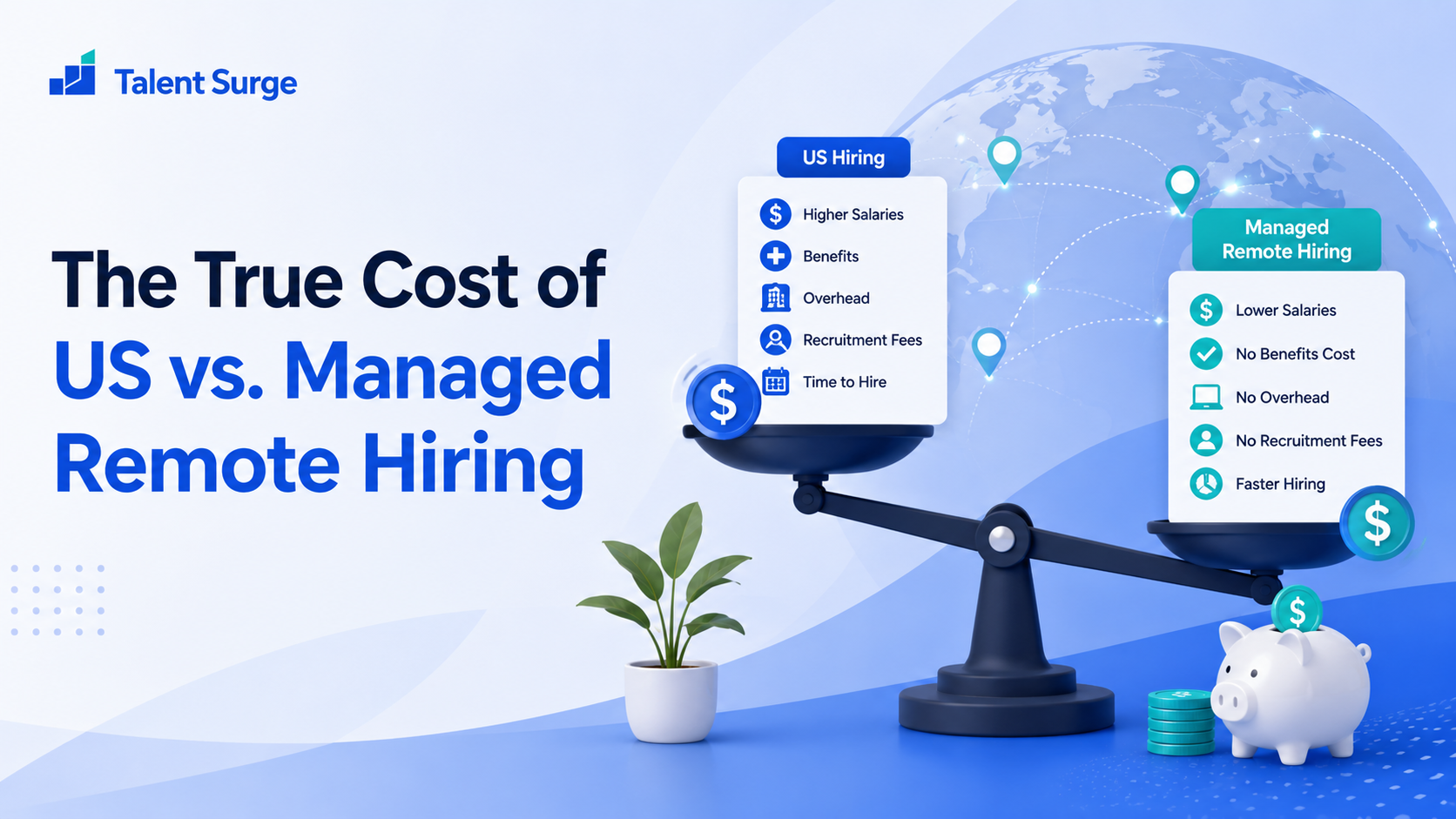
The True Cost of US vs. Managed Remote Hiring
The real cost of a US hire is salary plus benefits, taxes, recruiting, ramp, and management overhead. Here is the full math against a managed remote specialist.
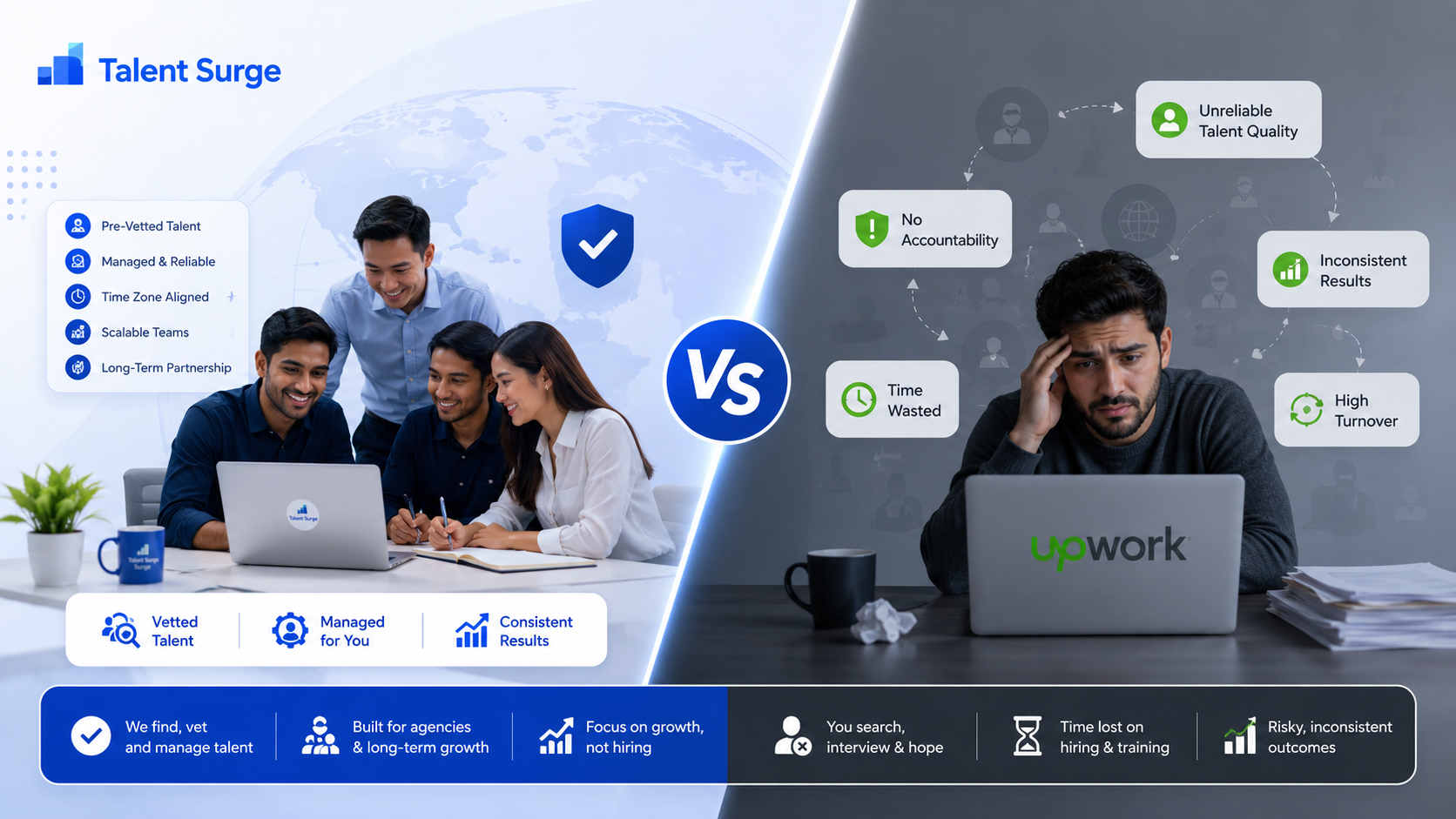
Talent Surge vs. Upwork: Why Agencies Are Switching to Managed Offshore Talent
Upwork is built for sourcing one-off work fast. Talent Surge is built for dedicated, managed specialists who stay. Here is the honest comparison of marketplace freelancers vs managed offshore talent, with cost math, risk, and when each one wins.