
What Is a Remote Staffing Agency? (And How to Find the Right One)
On this page
- What Does a Remote Staffing Agency Actually Do?
- Remote Staffing Agency vs. Freelance Platform (Upwork, Fiverr)
- Remote Staffing vs. Traditional Staffing Agency
- What Roles Can You Fill?
- What Does a Remote Staffing Agency Cost?
- What to Look For in a Remote Staffing Agency
- Is a Remote Staffing Agency Right for You?
- FAQ
The way companies hire has changed permanently, and most business owners know it. What they don't know is how to navigate the mess of options in front of them. Upwork? A BPO? A traditional staffing firm? Some new "remote staffing agency" that promises offshore talent at a fraction of the cost?
These are all different models with different tradeoffs. Conflating them is how founders waste months cycling through bad hires. This post breaks down what a remote staffing agency actually does, how it compares to the alternatives, what it costs, and how to pick one that won't waste your time.
Hiring AI talent specifically? See our dedicated AI Talent hub with 8 specialist roles including AI Engineer and AI Chatbot Developer.
What Does a Remote Staffing Agency Actually Do?
A remote staffing agency sources, vets, and places full-time remote professionals into your business. The key word is dedicated. Unlike freelance platforms where workers split attention across multiple clients, a remote staffing agency delivers someone who works exclusively for you during contracted hours.
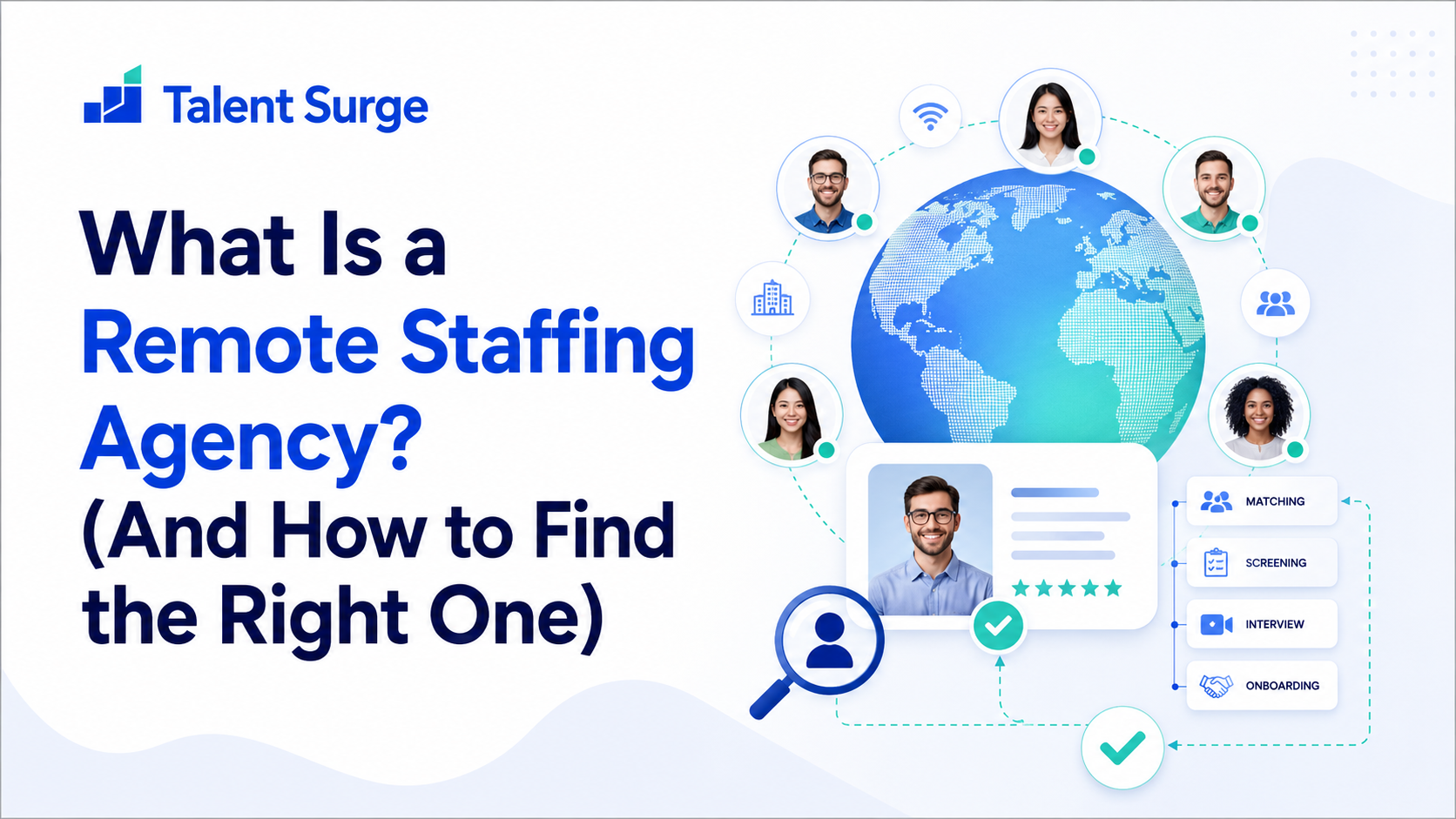
The process follows a predictable sequence. First, you share your requirements: role, skills, experience level, working hours. The agency searches its existing talent pool and recruits additional candidates if needed, typically from regions with deep professional talent and favorable cost structures like Pakistan, the Philippines, and Eastern Europe.
Next comes vetting. Good agencies run multi-stage evaluations covering skills assessments, English proficiency, background checks, and trial tasks. This is the step most businesses can't replicate on their own without burning weeks of time. You can see how the full hiring process works at Talent Surge as a reference for what this looks like end to end.
After vetting, you interview the top 2-3 candidates yourself. You make the final call. The agency then handles onboarding logistics: hardware, IT setup, communication tools, employment contracts, payroll, and compliance. Your specialist shows up on day one ready to work.
The relationship doesn't end at placement. A managed remote staffing agency continues handling HR, performance management, and replacement coverage for the duration of the engagement.
Remote Staffing Agency vs. Freelance Platform (Upwork, Fiverr)
Freelance platforms are marketplaces. You post a job, receive proposals from independent contractors, evaluate profiles, and hire someone who is simultaneously serving 3 to 8 other clients. The platform provides the infrastructure for finding talent, but zero accountability for outcomes.
A remote staffing agency is the opposite model. You get a single point of accountability for the hire. The agency vetted the person, the agency manages the employment relationship, and the agency replaces them if things don't work out. Your specialist works only on your account.
Neither model is universally better. Freelance platforms work well for one-off projects: a logo design, a single audit, a one-time data migration. But the moment a role becomes recurring, the freelancer model creates structural problems. Shared attention, no performance oversight, and zero continuity when the person moves on. We covered this breakdown in detail in our analysis of why marketing agencies fail with freelancers.
For full-time execution roles like SEO management, ad operations, executive support, or bookkeeping, the remote staffing agency model wins on consistency and total cost of ownership.
Remote Staffing vs. Traditional Staffing Agency
Traditional staffing agencies and remote staffing agencies deliver the same core value: here's a vetted professional, ready to work. The economics, however, are completely different.
A traditional staffing firm places local or national candidates into W-2 roles at domestic market rates. For a digital marketing specialist in the US, that means $60,000 to $90,000 in base salary alone, before you factor in payroll taxes, benefits, equipment, and office space. Total loaded cost often exceeds $90,000 to $120,000 per year.
A remote staffing agency places offshore professionals into dedicated roles at $800 to $2,500 per month for experienced talent. That's not because the workers are less skilled. It's purchasing power parity across different labor markets. A senior SEO specialist in Lahore or Manila has the same technical capabilities as one in Austin or Chicago, but the cost of living that drives salary expectations is fundamentally different.
For a detailed cost comparison, our breakdown of US hiring vs. managed offshore hiring lays out the real numbers including hidden costs most businesses forget to calculate.
What Roles Can You Fill?
Remote staffing agencies cover any role that runs on a laptop and doesn't require physical presence. The most common categories break down across four pillars.
In marketing and growth, agencies place dedicated specialists for organic search, paid media, social channels, and content production. A remote SEO expert handles your on-page, off-page, and technical SEO. A PPC manager runs your Google and Meta campaigns full-time. Social media managers, copywriters, and content strategists round out the growth team.
Operations and admin roles are equally common. Executive assistants manage calendars, inboxes, and projects. Admin assistants handle data entry, scheduling, and document processing. Project managers keep teams on track across time zones. Cold calling agents build your outbound pipeline.
Finance roles are growing fast in the remote staffing world. Bookkeepers and accountants handle daily transactions, reconciliations, and financial reporting using the same cloud tools (QuickBooks Online, Xero) that US-based professionals use. If you're specifically looking to hand off your bookkeeping, we wrote a detailed guide on how to outsource bookkeeping that covers what to look for, what it costs, and how to set the relationship up for success.
Creative and technical roles fill out the remaining demand. Graphic designers, UI/UX designers, GoHighLevel specialists, automation experts, and funnel engineers all operate fully remotely.
If it runs on a laptop, it can be done remotely. You can browse the full list of available specialist roles to see the complete range.
What Does a Remote Staffing Agency Cost?
Pricing has two components: what the worker earns and what the agency charges for management, infrastructure, and support.
Worker compensation varies by role and experience level. For experienced professionals across marketing, operations, and finance roles, expect $800 to $2,500 per month. Senior specialists with 5+ years of experience and niche skills (technical SEO, Google Ads at scale, financial modeling) fall toward the higher end.
Agency fees vary by provider. Some charge a flat monthly management fee. Others mark up the worker's salary by 30-50%. Transparent agencies will tell you exactly what the worker earns versus what you pay. If an agency won't share this breakdown, that's a red flag.
For context, a US-based digital marketing hire costs $6,000 to $9,000 per month before you add benefits, payroll taxes, equipment, and management overhead. The same caliber of work through a remote staffing agency costs $1,200 to $3,000 per month, fully managed.
This isn't about cutting corners. It's about accessing the same skills at different price points because salary expectations are set by local cost of living, not by the quality of the work. Run your own numbers in the cost calculator to see exactly what you'd save for your specific roles.
What to Look For in a Remote Staffing Agency
A rigorous vetting process
This is the single most important factor. The entire value proposition of a remote staffing agency rests on the quality of their vetting. Ask specifically: how many applicants do they screen for each placement? What does the assessment process include? Skills tests, English proficiency evaluations, background checks, and trial tasks are the minimum. If an agency can't walk you through their process in detail, they likely don't have one worth discussing. See Talent Surge's vetting process for what a thorough approach looks like.
Dedicated vs. shared workers
Some agencies offer shared workers who split time across 2-3 clients. This is cheaper but defeats the purpose for roles requiring deep context. If you're hiring a bookkeeper who needs to know your chart of accounts inside and out, or a social media manager who needs to internalize your brand voice, shared workers create the same continuity problems as freelancers. Always confirm whether your hire is exclusively dedicated to your account.
Support after placement
Placement is day one, not the finish line. Ask about replacement guarantees, performance monitoring, and who you contact when something isn't working. Good agencies provide a dedicated account manager who handles performance reviews and HR issues so you don't have to. Learn how post-placement team management works to understand what ongoing support should look like.
Transparent pricing
Know what the worker earns versus what the agency takes. If pricing is presented as a single blended rate with no visibility into the split, you can't evaluate whether you're paying for value or padding. View Talent Surge's pricing tiers for an example of transparent rate structures.
Track record in your specific role category
A remote staffing agency that excels at placing executive assistants may have no experience with technical SEO specialists. Ask for case studies or client references in the exact role category you're hiring for. Depth matters more than breadth.
Is a Remote Staffing Agency Right for You?
A remote staffing agency is the right fit if you need someone working consistently on your business, 20 to 40+ hours per week, in a role that requires institutional knowledge and ongoing context. Marketing execution, financial operations, administrative support, and client-facing roles all fall squarely in this category.
It's less ideal if you need one-off project work (use a freelancer), on-site physical presence (hire locally), or highly regulated roles requiring specific domestic licenses (certain legal or medical functions).
For most US businesses in the $500K to $10M revenue range, the decision comes down to a simple question: do you want to spend $80,000+ per year on a US hire, $30,000+ managing freelancers who come and go, or $15,000 to $30,000 per year for a dedicated, managed specialist who shows up every day?
FAQ
How long does it take to hire through a remote staffing agency?
Most agencies deliver a shortlist of vetted candidates within 7 to 14 days. At Talent Surge, you receive 3 pre-vetted candidates within 14 days of submitting your role brief. Final interviews, selection, and onboarding typically take another 1 to 2 weeks. From initial request to a productive specialist working on your account, expect 3 to 4 weeks total.
Do remote staffing agencies handle payroll and taxes?
Yes. The specialist is employed by the agency, not by you. The agency handles payroll, tax compliance, benefits, and employment law in the worker's country. You pay a single monthly fee to the agency. This eliminates the cross-border compliance headaches that stop most businesses from hiring offshore independently.
What's the difference between a remote staffing agency and a BPO?
A BPO (Business Process Outsourcing) company handles entire business functions as a black box. You hand off a process and get results back. You typically don't manage the individual workers. A remote staffing agency places individual specialists who integrate directly into your team. You direct their work daily, they attend your standups, and they use your tools. It's an extension of your team, not outsourcing a function.
Can I replace a hire if it's not working out?
With a reputable remote staffing agency, yes. Replacement guarantees are standard. At Talent Surge, if a specialist isn't the right fit after documented feedback, a free replacement is provided. You're never locked into a hire that isn't delivering. This is one of the core advantages over hiring independently, where a bad hire means starting the search from scratch.
What time zones do remote hires typically work in?
Most remote staffing agencies offer flexible timezone alignment. Specialists from Pakistan and the Philippines commonly work US business hours (EST or PST overlap). Eastern European professionals overlap naturally with EST. When you submit your role requirements, specify the working hours you need and the agency will match accordingly.
The remote staffing agency model exists because the economics of hiring changed faster than most businesses adapted. If you need consistent, high-quality execution work and you're tired of cycling through freelancers or can't justify US-level salaries for roles that can be done remotely, this is the model built for you. Tell Talent Surge what you need and get matched with 3 pre-vetted candidates within 14 days.
Take action today
Stop comparing. Start saving.
US businesses save 60-70% vs local hires. Get 3 pre-vetted offshore specialists matched to your exact role delivered in 14 days, free with no commitment.
Keep reading
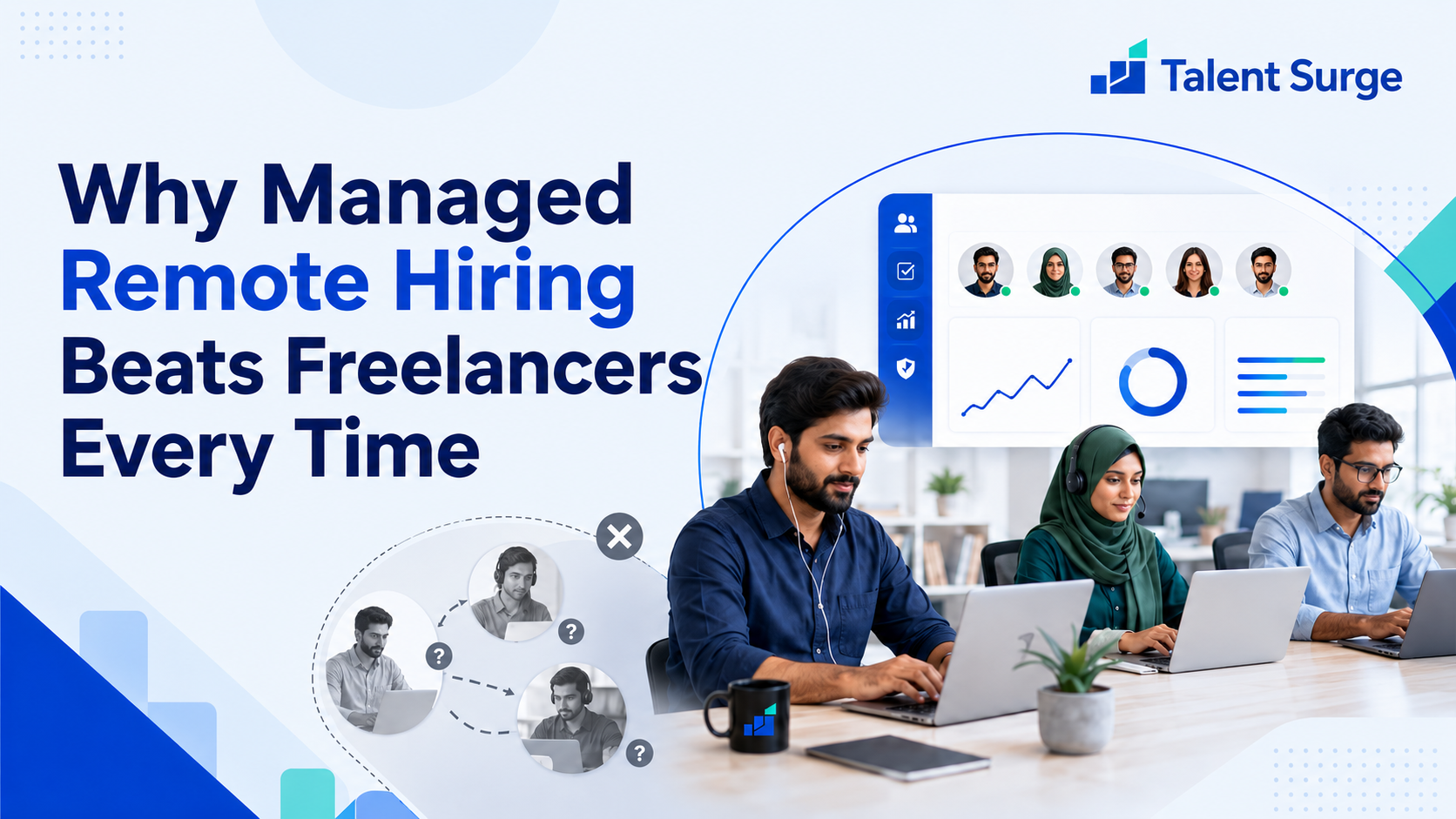
Why Managed Remote Hiring Beats Freelancers Every Time
Freelancers disappear. Managed remote staff don't. Here's the real difference for US businesses.
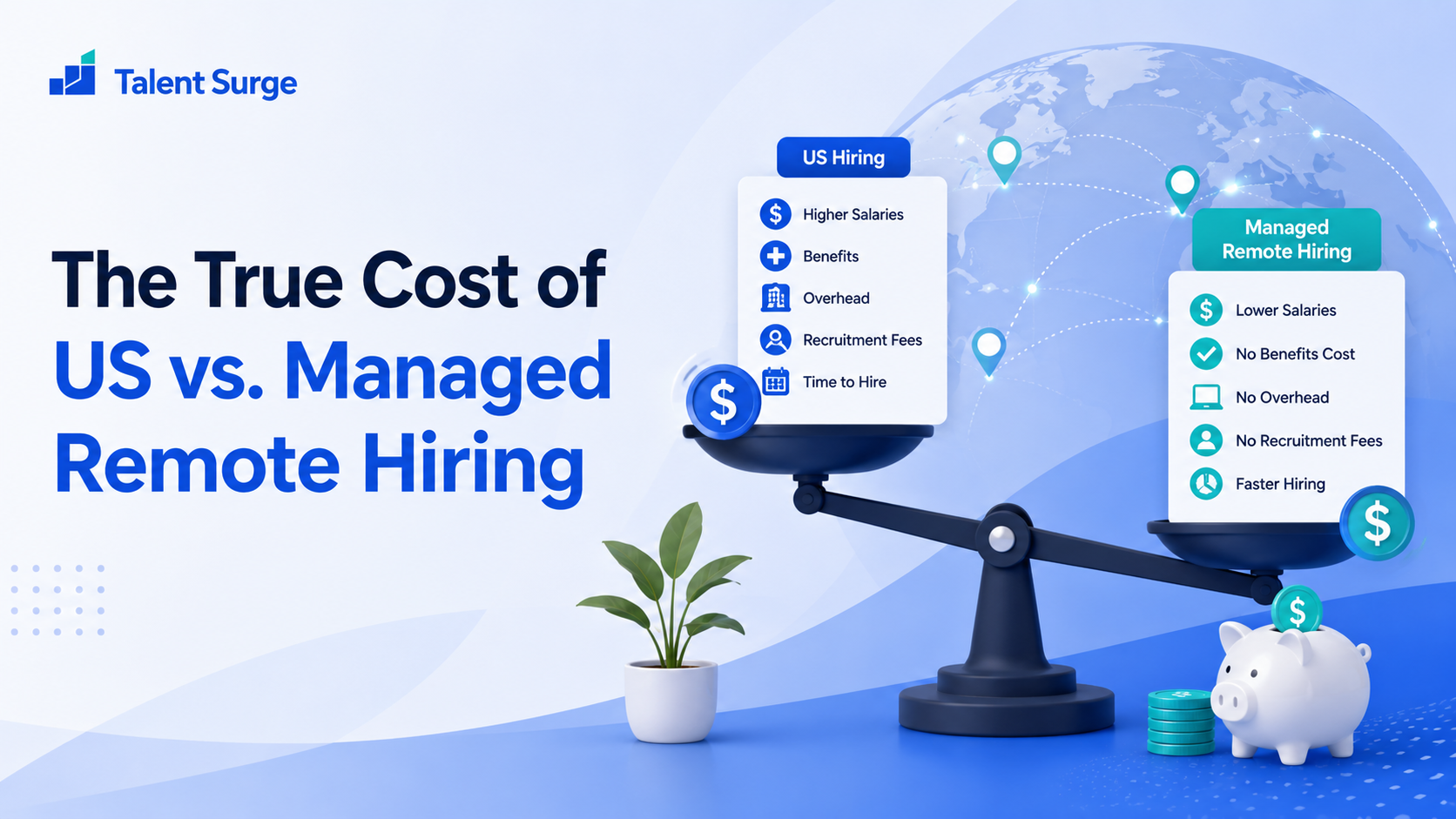
The True Cost of US vs. Managed Remote Hiring
The real cost of a US hire is salary plus benefits, taxes, recruiting, ramp, and management overhead. Here is the full math against a managed remote specialist.
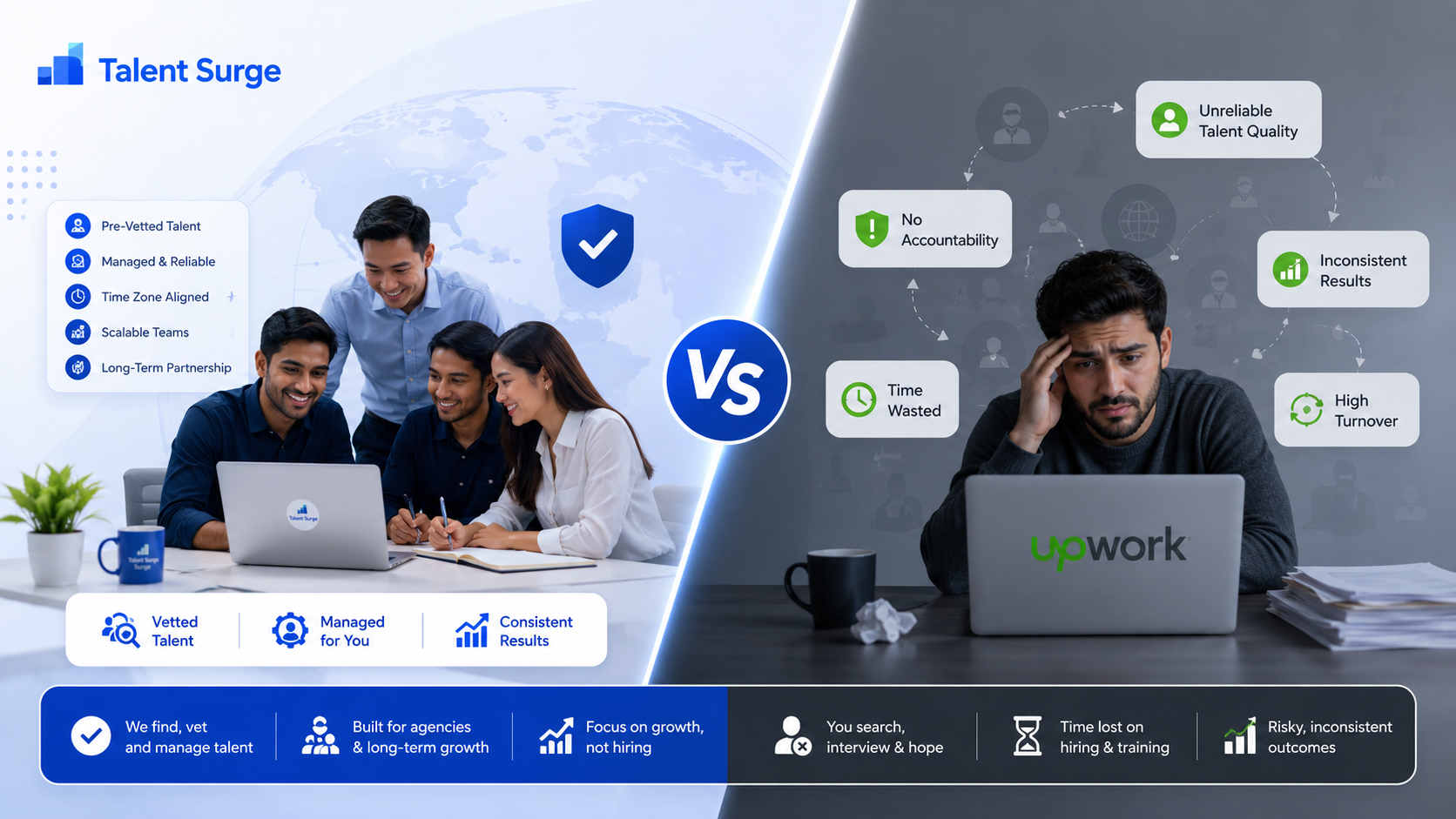
Talent Surge vs. Upwork: Why Agencies Are Switching to Managed Offshore Talent
Upwork is built for sourcing one-off work fast. Talent Surge is built for dedicated, managed specialists who stay. Here is the honest comparison of marketplace freelancers vs managed offshore talent, with cost math, risk, and when each one wins.