
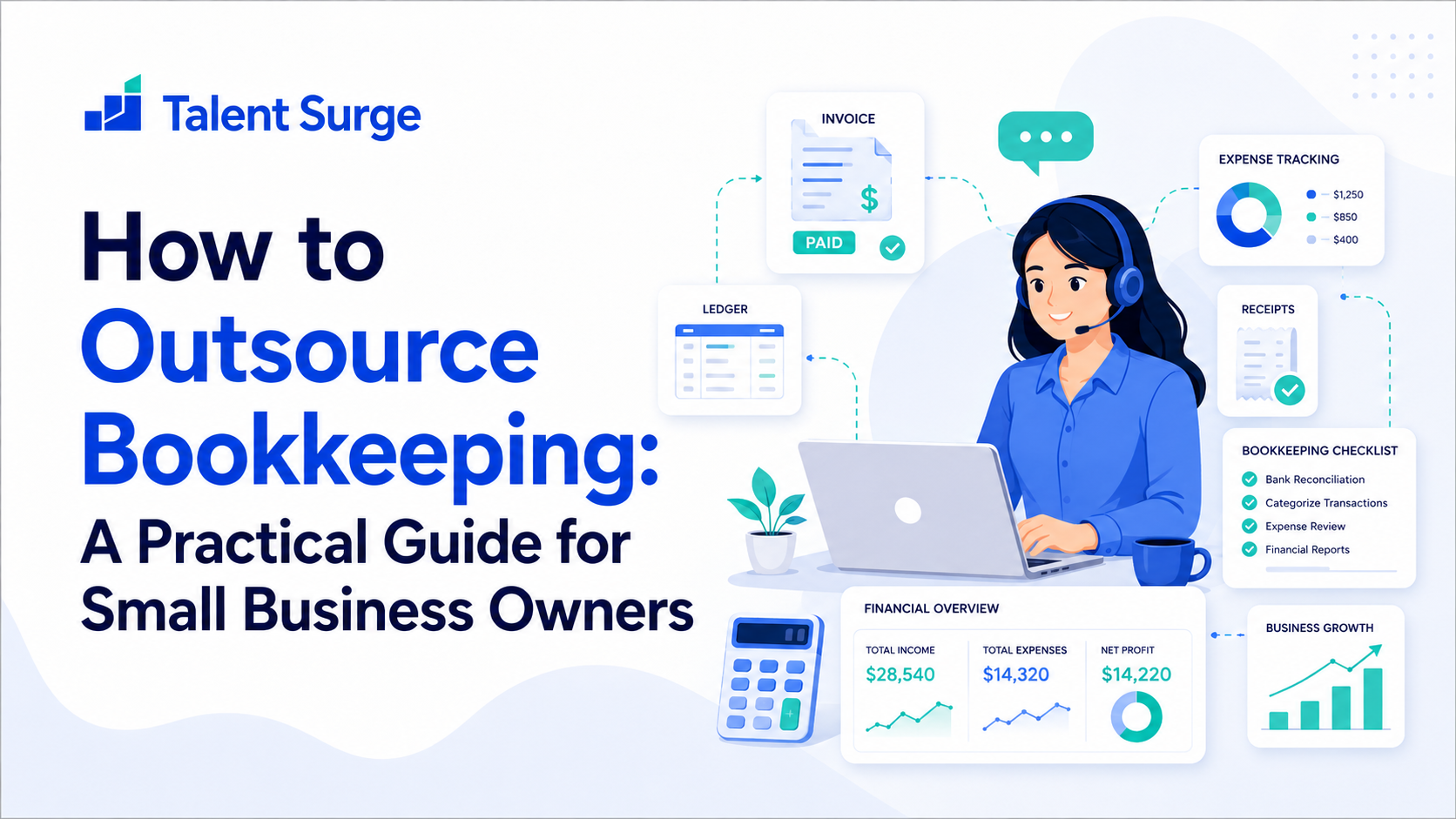
How to Outsource Bookkeeping: A Practical Guide for Small Business Owners
On this page
- What Does Outsourced Bookkeeping Actually Include?
- Why Outsource Instead of Hiring In-House?
- What to Prepare Before You Outsource
- How to Find a Good Remote Bookkeeper
- What to Look For in a Remote Bookkeeper
- How to Set Up the Relationship for Success
- What Should Outsourced Bookkeeping Cost?
- Common Mistakes to Avoid
- FAQ
Most small business owners handle their own bookkeeping for far too long. It starts as a manageable task when revenue is low, maybe an hour each weekend categorizing transactions and reconciling one bank account. Then the business grows. Revenue lines multiply. A second credit card appears. Contractor payments pile up. Suddenly you're spending 10 hours a month on books you're not confident are accurate, and the only reason you haven't outsourced is because you never stopped to figure out how.
This is the guide for figuring it out. Not a sales pitch, not a listicle of "top 10 bookkeeping services." A practical walkthrough of what outsourced bookkeeping includes, what it costs, how to find the right person, and how to set the relationship up so it actually works. If you're newer to the idea of offshore staffing, our guide on what a remote staffing agency is and how to find one covers the full model, including vetting, pricing, and what to expect.
What Does Outsourced Bookkeeping Actually Include?
Before you outsource bookkeeping, it helps to know what you're actually outsourcing. The biggest source of confusion is the gap between bookkeeping and accounting. They're related but different jobs.
A bookkeeper handles the daily and weekly financial record-keeping. Transaction categorization, bank and credit card reconciliations, accounts receivable, accounts payable, and producing your core financial statements: profit and loss (P&L) and balance sheet. This is the operational layer of your finances. It needs to happen consistently, usually weekly or biweekly, to keep your numbers current.
An accountant works at a higher level. Tax preparation, tax strategy, financial forecasting, audit support. Accountants need clean books to do their job, which is exactly why the bookkeeper role exists. Most small businesses need both, but at very different frequencies. Bookkeeping is weekly or monthly. Accounting is quarterly and at tax time.
When you outsource bookkeeping, you're handing off the operational layer so your accountant (and you) always have accurate, up-to-date financials to work with.
Why Outsource Instead of Hiring In-House?
The math makes the case on its own. A US-based in-house bookkeeper costs $45,000 to $65,000 in base salary. Add payroll taxes, health insurance, PTO, equipment, and management overhead, and the real cost is $55,000 to $80,000 per year.
A remote offshore bookkeeper through a managed staffing arrangement costs $800 to $1,500 per month, which works out to $10,000 to $18,000 per year. That's the same work: same QuickBooks reconciliations, same monthly P&L reports, same chart of accounts management. The cost difference exists because salary expectations are set by local cost of living, not by the complexity of the work.
Beyond cost, there's a talent pool advantage. Managed staffing agencies maintain pre-vetted pools of bookkeepers with verified experience across US accounting software. If your bookkeeper leaves or underperforms, the agency provides a replacement, often within days. Try replacing an in-house bookkeeper in a week.
Run your own comparison in the cost calculator to see exactly what you'd save based on your specific needs.
What to Prepare Before You Outsource
Know what software you use
If you're already on QuickBooks Online, Xero, FreshBooks, or Wave, you're set. Your bookkeeper will work inside your existing system. If you're not using any cloud accounting software yet, start with QuickBooks Online or Xero before you hire. Both are industry standard, both integrate with virtually every bank and payment processor, and both are what your bookkeeper will expect to use.
Estimate your transaction volume
Count your bank accounts, credit cards, and payment processors. Estimate how many transactions flow through them monthly. A business with one bank account and 100 transactions per month needs fewer hours than one with three bank accounts, two credit cards, a Stripe account, and 800 monthly transactions. This estimate directly affects how many hours per week your bookkeeper needs.
Get clear on reporting needs
At minimum, you need a monthly P&L and balance sheet. Beyond that, consider whether you need cash flow statements, accounts receivable aging reports, department-level or project-level tracking, or custom reports for investors or lenders. Define this upfront so your bookkeeper knows exactly what to deliver and when.
Gather access credentials
Your bookkeeper needs access to your accounting software and bank feeds. Modern platforms like QuickBooks Online and Xero connect to banks through secure feed integrations, so you're not sharing raw banking passwords. Set up a dedicated user login with appropriate permissions in your accounting software before onboarding starts.
How to Find a Good Remote Bookkeeper
Three realistic paths exist, each with different tradeoffs.
Option 1: Hire independently. Post on LinkedIn, remote job boards, or niche accounting forums. You'll find bookkeepers at the lowest per-hour cost, but you're responsible for vetting, managing, handling payroll compliance across borders, and replacing them if they leave. If you have the time and expertise to manage this, it can work. Most small business owners don't.
Option 2: Use a bookkeeping service. Companies like Bench or Bookkeeper360 offer team-based bookkeeping at $500 to $2,000+ per month. The upside is turnkey setup. The downside is you may not get the same person month to month. Team models work for straightforward books but create friction when your finances have complexity that requires consistent context.
Option 3: Use a remote staffing agency. A dedicated, full-time or part-time bookkeeper who works exclusively for your business. The agency handles vetting, placement, payroll, compliance, and replacement coverage. Rates run $800 to $1,500 per month for experienced professionals. A dedicated remote bookkeeper placed through a managed staffing agency gives you the consistency of an in-house hire without the local salary overhead. See how the placement process works for a step-by-step breakdown.
For most businesses in the $500K to $5M revenue range, Option 3 wins on the combination of consistency, accountability, and cost. The bookkeeper knows your chart of accounts, your vendors, your reporting rhythm. That institutional knowledge compounds over time. For additional context on why the managed model outperforms ad hoc hiring, our comparison of managed remote hiring vs. freelancers covers the structural differences in detail.
What to Look For in a Remote Bookkeeper
Software proficiency
Don't just ask "do you know QuickBooks?" Everyone says yes. Ask them to walk you through how they reconcile a bank account, how they handle undeposited funds, or how they set up a new vendor with recurring bills. Hands-on proficiency shows up in the specifics, not in the claim.
Attention to detail
Bookkeeping mistakes are individually small but they compound. A miscategorized expense throws off your P&L. A missed reconciliation hides a bank error. Ask candidates about a time they caught an error someone else missed. The answer tells you whether they're meticulous or just adequate.
Communication style
Your bookkeeper will see things in your financials that need your input: an unusual charge, a missing invoice, a vendor payment that doesn't match a PO. You need someone who flags questions proactively rather than guessing or ignoring them. During the interview, pay attention to how they ask clarifying questions. That's exactly how they'll communicate on the job.
Verifiable experience
References from past clients or employers are non-negotiable. If you're going through a remote staffing agency, ask how they vet bookkeepers specifically. Talent Surge's vetting process includes role-specific skills assessments for finance roles, covering reconciliation accuracy, reporting standards, and software proficiency under timed conditions.
How to Set Up the Relationship for Success
Establish a clear weekly and monthly routine
Define when your bookkeeper logs in, when bank reconciliations happen, when reports are due to you. A simple cadence works: daily transaction categorization, weekly reconciliation, monthly financial statements delivered by the 5th of the following month. Write it down. Ambiguity is where outsourced relationships break down.
Set up a communication channel
Slack, Microsoft Teams, or even a standing weekly video call. The channel matters less than having one. Questions need to get answered within hours, not days. When your bookkeeper hits an ambiguous transaction, a fast answer from you means clean books. A slow answer means guesswork that needs to be corrected later.
Review reports monthly
This sounds obvious, but it's where most business owners drop the ball. You outsource bookkeeping to free up your time, and then never look at the reports the bookkeeper produces. The entire value of accurate books is the insight they give you into your business. Block 30 minutes each month to review your P&L and balance sheet. If something looks off, ask about it immediately.
Give clear category guidance
Spend 30 minutes at the start of the engagement mapping your chart of accounts with your bookkeeper. Walk through your common expense types, your revenue categories, how you want contractor payments classified. This single conversation eliminates weeks of back-and-forth corrections down the road.
What Should Outsourced Bookkeeping Cost?
| Arrangement | Monthly Cost | Best For |
|---|---|---|
| DIY (your time) | "Free" but 5-15 hrs/month | Bootstrapped startups |
| Freelance bookkeeper | $300-$700/mo | Very low transaction volume |
| Remote staffing agency | $800-$1,500/mo | Growing businesses needing consistent support |
| US bookkeeping service | $500-$2,500/mo | Businesses wanting a local team feel |
| In-house hire | $4,000-$6,000+/mo | Larger companies with complex needs |
For most SMBs doing $500K to $5M in revenue, the remote staffing agency option hits the sweet spot: dedicated attention at a fraction of in-house cost, with management and replacement coverage built in. View Talent Surge's pricing tiers for specific rate breakdowns across experience levels.
Common Mistakes to Avoid
- Not granting proper access upfront. Delayed bank feed connections or missing software logins waste the first week of the engagement. Have everything ready before your bookkeeper starts.
- Expecting immediate perfection. Give 30 to 60 days for ramp-up. Your bookkeeper needs to learn your chart of accounts, your vendors, and your preferences. Month two will be significantly smoother than month one.
- Confusing bookkeeping with tax prep. Your bookkeeper maintains the books. Your accountant files taxes. Expecting one person to do both is how corners get cut on both sides.
- Skipping the monthly review. If you're not reading the financial reports your bookkeeper produces, you've lost the main benefit of having accurate books. The reports exist so you can make better decisions.
FAQ
How many hours per week does a remote bookkeeper typically work?
It depends on transaction volume. A business with under 200 monthly transactions usually needs 10 to 15 hours per week. Businesses with higher volume, multiple entities, or complex revenue recognition may need 20 to 30 hours. Start with a realistic estimate of your transaction count and reporting requirements, then adjust after the first month.
Is it safe to give a remote bookkeeper access to my financial accounts?
Yes, when set up properly. Use your accounting software's built-in user permissions to grant role-appropriate access. Bank feeds connect through your software's secure integrations, not through shared banking credentials. A managed staffing agency adds additional security layers: NDAs, monitored work environments, and CISM-certified office infrastructure. Your bookkeeper sees your transactions inside the accounting platform, not your raw bank login.
What accounting software do most remote bookkeepers use?
QuickBooks Online and Xero dominate. Both are cloud-based, both integrate with major banks and payment processors, and both have robust multi-user permission systems. FreshBooks and Wave are common for very small businesses. If you're starting from zero, go with QuickBooks Online. It has the largest ecosystem of integrations and the widest pool of experienced bookkeepers.
Can a remote bookkeeper also do my payroll?
Some bookkeepers handle payroll processing through platforms like Gusto, ADP, or QuickBooks Payroll. However, payroll involves compliance obligations (tax filings, W-2s, state registrations) that go beyond standard bookkeeping. If payroll is a need, specify it upfront when hiring so the agency matches you with a bookkeeper who has payroll experience specifically.
What if I'm behind on my books, can they catch up?
Yes. Catch-up bookkeeping is one of the most common first tasks for an outsourced bookkeeper. Expect it to take longer than ongoing maintenance: cleaning up 6 to 12 months of backlog might take 2 to 4 weeks of focused work depending on transaction volume and how messy things are. After the catch-up, ongoing maintenance is significantly faster.
Outsourced bookkeeping works when you find the right person and set the relationship up with clear expectations from day one. The cost savings are real, but the bigger win is getting accurate financial visibility into your business every month without spending your own hours producing it. See how Talent Surge places dedicated remote bookkeepers matched to your software, your industry, and your reporting needs.
Take action today
Stop comparing. Start saving.
US businesses save 60-70% vs local hires. Get 3 pre-vetted offshore specialists matched to your exact role delivered in 14 days, free with no commitment.
Keep reading
Executive Assistant Outsourcing: The Complete Guide (2026)
Everything you need to know about outsourcing your executive assistant in 2026. Benefits, costs, what to delegate, how to choose a partner, and what to expect from the transition.
Virtual Assistant for Small Business: The Complete 2026 Guide
Everything small business owners need to know about hiring a virtual assistant in 2026. What they do, what it costs, and how to find the right one fast.