
What Does a Virtual Marketing Assistant Actually Do? (Full Task List)

On this page
- The Real Definition of a Virtual Marketing Assistant
- The Full Task List a VMA Actually Handles
- What a VMA Should NOT Do
- VMA vs Generalist Marketer vs Specialist: Where Each Fits
- How to Brief a VMA So They Actually Deliver
- What to Look For When Hiring
- How to Structure VMA Hours for Maximum Output
- Common Failure Modes (And How to Avoid Them)
- Stacking the VMA With Specialists for Higher Leverage
- The Weekly Operating Rhythm That Makes VMAs Actually Productive
- What Not to Ask a VMA to Own
- FAQ
The Virtual Marketing Assistant (VMA) role gets defined badly by 90% of companies that hire one. Job descriptions list everything from "content strategy" to "paid ad management" to "Photoshop" - which means the role is doomed before the first day. A VMA is not a generalist marketer. They are an execution multiplier for a marketer who already has direction.
This guide breaks down what a VMA actually does well, what they should not do, and how to brief one so they produce real output instead of busywork.
The Real Definition of a Virtual Marketing Assistant
A VMA executes marketing tasks defined by someone else. They are not a strategist. They are not a senior marketer. They are the operational hands that turn your marketing plan into shipped work.
The right way to think about it: if you have a marketing lead (you or another hire) who can plan, brief, and review, the VMA executes 80% of the work that lead would otherwise do themselves. That frees the marketing lead to do strategy, partnerships, and high-leverage work.
The Full Task List a VMA Actually Handles
Content operations
- Scheduling blog posts in WordPress, Webflow, Ghost
- Formatting and uploading content with internal links, alt tags, meta descriptions
- Image sourcing and basic editing in Canva
- Repurposing long content into social posts, email snippets, and LinkedIn carousels
- Content calendar maintenance and deadline tracking
Email marketing execution
- Building email campaigns in Mailchimp, Klaviyo, HubSpot, ActiveCampaign
- List segmentation and list cleanup
- A/B test setup (subject lines, send times) following your direction
- Email template creation from your brand guidelines
- Send scheduling and post-send reporting
Social media execution
- Scheduling posts in Buffer, Hootsuite, Later
- Writing post captions from your content briefs or repurposed long-form
- Sourcing or creating post graphics in Canva
- Hashtag research and platform-specific tag application
- Basic community management (likes, simple responses)
Paid ads support (not management)
- Uploading creative assets to Meta Ads Manager or Google Ads
- Setting up campaigns from your spec sheet
- Pulling weekly performance reports
- Tagging and organising creative variants
Marketing operations
- CRM data entry, contact tagging, list imports
- Lead routing setup in HubSpot or Salesforce
- Webhook and Zapier maintenance for marketing flows
- Form embedding and tracking pixel verification
- UTM tagging and campaign URL builder maintenance
Research and reporting
- Competitor monitoring (content, ads, social posting)
- Influencer and partnership research
- Compiling monthly KPI dashboards from GA4, platform analytics, CRM
- Industry trend tracking and weekly digest creation
What a VMA Should NOT Do
Asking a VMA to do these jobs is where companies fail with the role:
- Marketing strategy: Channel selection, positioning, audience definition - these require senior judgment
- Brand voice creation: A VMA can apply a defined voice. They should not invent it.
- Paid ads optimisation: Hire a Meta Ads Expert or Google Ads Expert for actual campaign management
- SEO strategy: A VMA can execute keyword research given direction, but a SEO Expert sets the strategy
- Copywriting for high-stakes assets: Sales pages, ad copy, lead magnet copy - hire a Copywriter
- Design work beyond Canva templates: Real design work belongs to a Graphic Designer
The right way to deploy a VMA: pair them with senior judgment. Hire a Virtual Marketing Assistant from $3/hr and unlock 80-120 hours/month of execution capacity.
VMA vs Generalist Marketer vs Specialist: Where Each Fits
| Role | Strategy | Execution | Cost (Talent Surge Expert) | Best Used For |
|---|---|---|---|---|
| Virtual Marketing Assistant | No - executes only | High volume across channels | From $9/hr | Multiplying an existing marketer's capacity |
| Digital Marketing Expert (generalist) | Yes - cross-channel | Medium volume | From $9/hr | Sole marketer for SMB |
| Channel Specialist (SEO/PPC/etc) | Deep in one channel | High in one channel | From $9-$11/hr | Companies investing seriously in one channel |
How to Brief a VMA So They Actually Deliver
VMAs fail when they get vague briefs. They succeed when briefs are specific. Compare:
Bad brief: "Help with our social media this month."
Good brief: "Schedule 12 LinkedIn posts and 16 Instagram posts this month following the attached calendar. Use Canva templates from our brand kit. Caption tone is conversational, not corporate. Hashtag research per platform. Schedule all posts by Friday for the following week's publishing."
The good brief produces output. The bad brief produces questions. A VMA cannot read your mind - and should not have to.
What to Look For When Hiring
- Tool fluency: Ask which marketing tools they have used. The right answer covers at least 8-10 (CMS, email platform, social schedulers, CRM, analytics, Canva, ads manager familiarity)
- Execution speed: Give a sample task during interview. Measure how fast and how cleanly they execute
- Written English: They will write captions, emails, and internal updates. Their writing should be professional
- Brief comprehension: Give a written brief and have them summarise back what they would deliver. Misunderstanding here predicts ongoing friction
- Time management: VMAs juggle multiple campaigns. Ask how they organise their week
How to Structure VMA Hours for Maximum Output
The companies that get the most from a Virtual Marketing Assistant are the ones who structure their hours into focused blocks rather than reactive "as-needed" support. A reactive VMA waits for tickets; a structured VMA executes against a rolling plan.
The pattern that works at 80 hours/month (Part-Time) typically looks like:
- 30-35 hours: Content production (blog formatting, social scheduling, email building)
- 15-20 hours: Asset creation (Canva templates, repurposing, basic graphics)
- 10-15 hours: Marketing operations (CRM tasks, lead routing, automation maintenance)
- 10-15 hours: Research and reporting (competitor monitoring, KPI dashboards, weekly digests)
At 160 hours/month (Full-Time), scale each block proportionally and add room for project-based work: launch coordination, webinar production, partner campaign management. The VMA who works against a defined weekly cadence produces 2-3x more usable output than one who waits for ad hoc assignments.
Common Failure Modes (And How to Avoid Them)
VMA hires fail in predictable ways. Catching them early saves the engagement:
- The "do everything" trap. The VMA gets dragged into customer support, sales follow-ups, and admin work that has nothing to do with marketing. Output collapses because attention fragments. Lock the role definition - marketing execution only. If you need broader support, hire a Virtual Executive Assistant separately.
- Strategy-by-default. Without a senior marketer providing direction, the VMA starts making strategy calls by default. The brand voice drifts, channel mix shifts, and 60 days later nobody can explain why marketing looks the way it does. Always pair a VMA with strategic ownership.
- Tool overload at onboarding. Throwing 12 tools at a new VMA in week one produces shallow knowledge of all of them. Pick the 5-6 critical tools they need on day one and add the rest over month two.
- No feedback loop. Weekly 30-minute check-ins are non-negotiable. VMAs working in isolation start producing technically-correct but strategically-misaligned work. The fix is conversation, not more briefs.
Stacking the VMA With Specialists for Higher Leverage
A VMA is a multiplier on whoever they support. The stacking patterns that produce the most output:
- A VMA paired with a Meta Ads Expert handles creative uploads, weekly reporting, and audience hygiene so the Meta Ads Expert can spend 100% of their time on optimization.
- A VMA paired with a SEO Expert handles on-page implementation, internal linking, image alt tags, and content publishing so the SEO Expert can focus on strategy and technical work.
- A VMA paired with a Social Media Manager handles scheduling, repurposing, and analytics pulls so the SMM can focus on content strategy and community building.
- A VMA paired with a Automation Expert handles ongoing maintenance of marketing automations and CRM hygiene that the Automation Expert built.
For most early-stage companies (under $3M revenue), a single VMA plus one channel specialist is a complete marketing team. To model the full-team cost, the Cost Calculator compares against US hiring and freelance market rates. For a wider view of how the managed model fits across all roles, see the Offshore Hiring Guide.
The Weekly Operating Rhythm That Makes VMAs Actually Productive
The pattern that separates a high-output VMA engagement from a mediocre one is not the candidate quality - it is the operating rhythm around them. Three rituals do most of the work:
Monday planning (30 minutes). The VMA proposes the week's task list against the rolling content calendar and ongoing projects. You approve, adjust, or reorder. This single ritual cuts mid-week confusion by 80%.
Wednesday checkpoint (15 minutes async). Quick Loom or written update on what is done, what is blocked, and what is at risk for the week. Lets you intervene before Friday surprises.
Friday delivery review (30 minutes). The VMA shows what shipped, what is in draft, and what needs your input next week. Combined with monthly KPI reviews from your Business Success Executive, you have a continuous quality signal without micromanaging.
That is 75 minutes per week of structured oversight, and it is the difference between a VMA who delivers 40 hours of usable output per week and one who delivers 25. The companies that resist building this rhythm consistently underrate offshore marketing talent because they never see what the talent can actually do.
What Not to Ask a VMA to Own
One reason VMA engagements fail is scope drift into work the role is not built for. Specific tasks to keep out of scope: paid media buying and optimization (hire a channel specialist), SEO strategy (hire an SEO Expert), full creative direction (hire a Graphic Designer or in-house marketer), customer support tickets, sales follow-ups with prospects, and primary copywriting for high-stakes campaigns. The VMA can support every one of these functions - scheduling, repurposing, reporting, light editing - but they should not own the strategic call. Keep their scope on marketing execution, ops, and content support, and the role consistently delivers. Push them into specialist territory and output collapses.
FAQ
Do I need a senior marketer if I hire a VMA?
Yes. A VMA executes against direction. If no one is providing direction (you or another marketer), the VMA will drift or stall. They are a force multiplier, not a substitute for marketing leadership.
Part-time or full-time?
Most companies start with Part-Time (80 hours/month, ~20 hours/week) and scale to Full-Time once they have proven the deployment. View packages.
Can a VMA handle WordPress or just write copy?
Most VMAs are comfortable with WordPress, Webflow, Shopify content management, and basic theme tweaks (no code). For development work, hire a developer separately.
What is the difference between a VMA and a Virtual Executive Assistant?
A VEA handles personal and executive admin (calendar, inbox, travel, projects). A VMA handles marketing execution specifically. Different tool stacks and different daily work.
How fast can I onboard?
14 days from brief to first day with Talent Surge. First week is orientation and small tasks. By week 3-4 most VMAs are at full output capacity.
Stop drowning in marketing busywork. Book a free discovery call and we will match you with a vetted VMA in 14 days.
Take action today
Stop comparing. Start saving.
US businesses save 60-70% vs local hires. Get 3 pre-vetted offshore specialists matched to your exact role delivered in 14 days, free with no commitment.
Keep reading

Why Managed Remote Hiring Beats Freelancers Every Time
Freelancers disappear. Managed remote staff don't. Here's the real difference for US businesses.
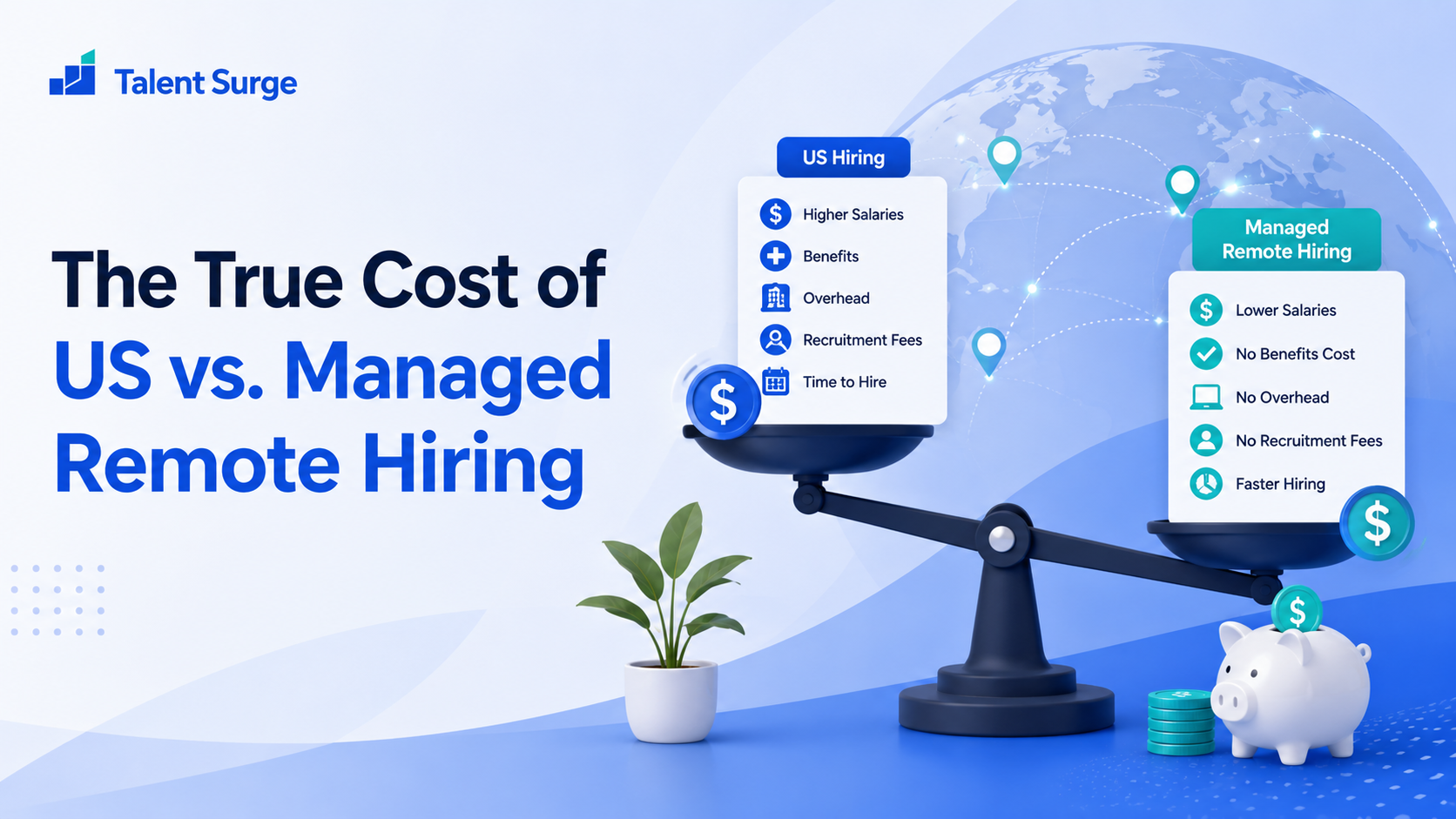
The True Cost of US vs. Managed Remote Hiring
The real cost of a US hire is salary plus benefits, taxes, recruiting, ramp, and management overhead. Here is the full math against a managed remote specialist.

Talent Surge vs. Upwork: Why Agencies Are Switching to Managed Offshore Talent
Upwork is built for sourcing one-off work fast. Talent Surge is built for dedicated, managed specialists who stay. Here is the honest comparison of marketplace freelancers vs managed offshore talent, with cost math, risk, and when each one wins.