
Virtual Assistant for Small Business: The Complete 2026 Guide
On this page
- Why Small Businesses Need Virtual Assistants More Than Anyone
- What Can a Virtual Assistant Do for a Small Business?
- What Type of VA Does Your Small Business Actually Need?
- How Much Does a Virtual Assistant Cost for a Small Business in 2026?
- The 5 Tasks Small Business Owners Should Delegate First
- Common Mistakes Small Businesses Make When Hiring a VA
- How to Hire a Virtual Assistant for Your Small Business
- FAQ
Running a small business means doing everything: sales, operations, marketing, customer service, administration, and strategy, often simultaneously, often alone.
The cost of that model is not just exhaustion. It's opportunity cost. Every hour you spend on administrative tasks, inbox management, and scheduling is an hour you're not spending on the work that actually grows the business.
A virtual assistant for your small business is one of the highest-leverage investments you can make. This guide covers everything you need to know: what a small business VA does, what it costs, how to hire the right one, and the mistakes most business owners make when they start.
Why Small Businesses Need Virtual Assistants More Than Anyone
Large enterprises have entire administrative departments. Mid-market companies have executive assistants, operations managers, and coordinators. Small businesses and solopreneurs typically have none of those, and the owner absorbs every administrative function personally.
The result is predictable: business owners working 12-hour days, spending the first two hours on email, missing follow-ups, delaying strategic decisions because there's no time to think, and growing more slowly than the business could support.
A virtual assistant changes the structure of your day. Instead of switching between administrative tasks and strategic work constantly, you delegate the administrative layer entirely and operate exclusively at the level the business actually needs from you.
What Can a Virtual Assistant Do for a Small Business?
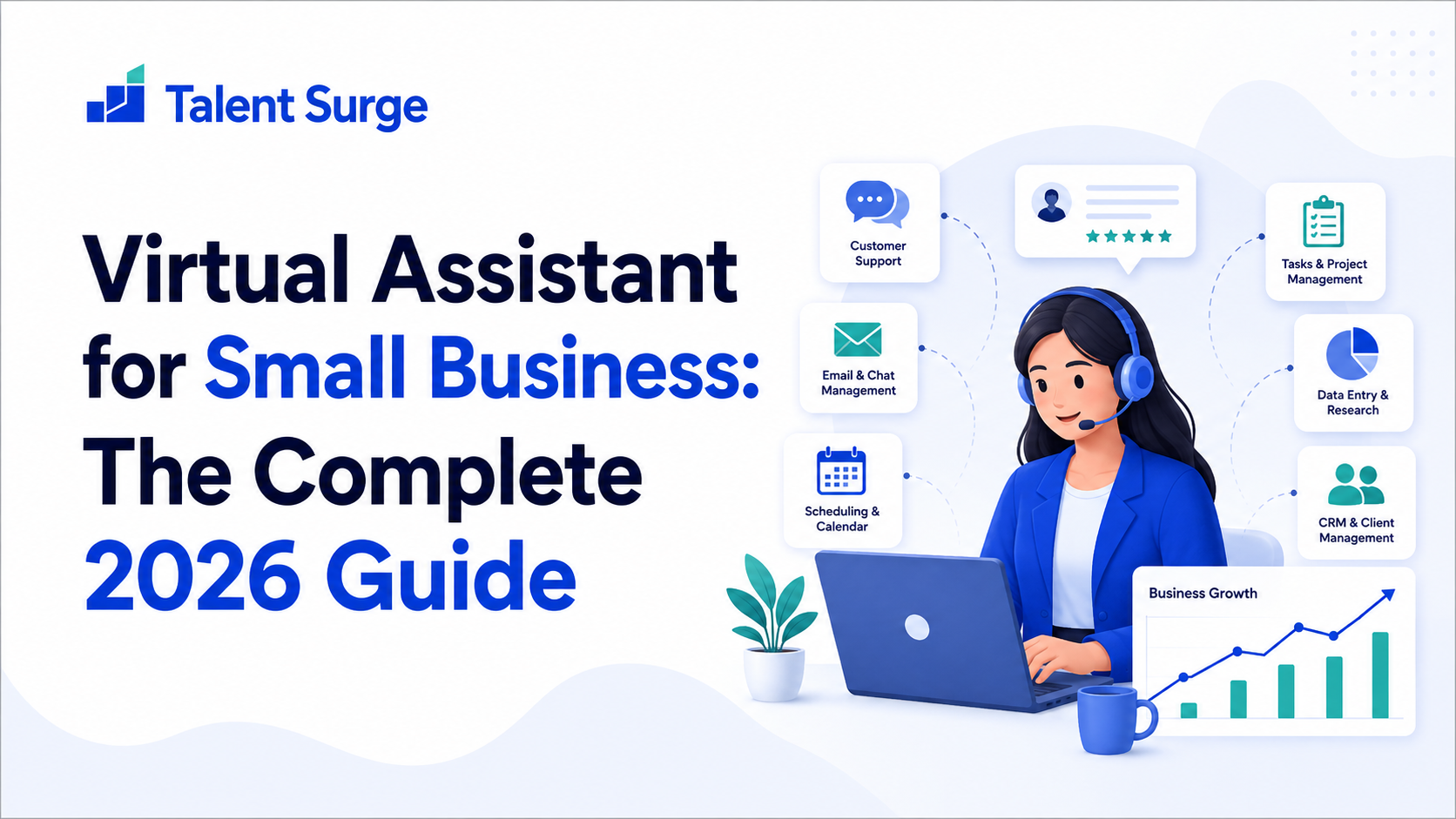
The scope of what a small business VA handles is broader than most owners initially assume. Here is a practical breakdown by function:
Administrative Operations
- Inbox management and email triage: sorting, flagging urgent items, drafting responses
- Calendar management: scheduling meetings, protecting focus time, managing scheduling conflicts
- Document preparation: reports, templates, proposals, presentations
- Data entry and database management
- CRM updates and contact management
- Filing, organisation, and document systems maintenance
Customer Support
- Responding to customer enquiries via email or chat
- Managing support tickets and ensuring timely responses
- Handling refund requests, complaint escalations, and follow-ups
- Maintaining FAQ documentation and support resources
- Following up with customers post-purchase or post-service
Sales and Business Development Support
- Lead research and prospect list building
- Initial outreach email drafting and follow-up sequences
- CRM data entry and pipeline management
- Scheduling sales calls and demos
- Preparing proposals and quote documents
Marketing Support
- Social media scheduling and basic content posting
- Newsletter preparation and distribution
- Blog publishing and content uploading in your CMS
- Keyword research and competitor monitoring
- Graphic asset preparation using templates in Canva or similar tools
- Review and testimonial management
Research and Analysis
- Market research and competitor intelligence
- Supplier and vendor research
- Product or service research for business decisions
- Industry news monitoring and briefing documents
Finance and Bookkeeping Support
- Invoice generation and tracking
- Expense report preparation
- Payment follow-ups and accounts receivable chasing
- Basic bookkeeping data entry and reconciliation support
E-commerce Operations
- Order management and fulfilment coordination
- Inventory tracking and stock level monitoring
- Product listing creation and optimisation
- Returns and refund processing
Not sure which tasks to delegate? Book a free discovery call and we'll help you identify the highest-impact areas to hand off first.
What Type of VA Does Your Small Business Actually Need?
Not every small business needs the same type of virtual assistant. Here is how to think about it:
- Founder or solo operator: You likely need an executive virtual assistant, someone senior enough to manage your calendar, inbox, and communications, and operate with minimal hand-holding. This is the highest-leverage hire for someone whose time is expensive.
- Service business: A general VA focused on client communications, scheduling, and administrative support is usually the right fit. Someone who can manage the operational layer while you focus on delivery.
- E-commerce business: You need someone comfortable with order management, customer support, and platform-specific tools like Shopify or Amazon Seller Central.
- Marketing-dependent business: A VA with content and social media skills handles your posting, scheduling, and basic creative production, freeing your time for strategy.
The mistake most small business owners make: they hire a generalist junior VA when what they actually need is a senior, specialist one. The cost difference is often small. The output difference is enormous.
How Much Does a Virtual Assistant Cost for a Small Business in 2026?
This is where most business owners get the math wrong.
| Hiring Model | Monthly Cost | What You Get |
|---|---|---|
| Freelance VA (Upwork, Fiverr) | $400 to $1,500 | Inconsistent, unmanaged, high turnover |
| US-based in-house part-time | $2,500 to $4,500 | Local, managed by you, expensive |
| Managed offshore VA (Talent Surge) | $480 to $2,900 | Dedicated, vetted, fully managed |
| Virtual assistant agency (retainer) | $1,200 to $3,500 | Shared VA, rotating staff, less dedicated |
The managed offshore model consistently wins on value for small businesses. You get a dedicated professional, not a shared resource rotating between five clients, who is fully supported by a managed services partner. You don't manage payroll, HR, performance reviews, or equipment. You manage the work. The partner manages everything else.
For a small business owner paying themselves $80,000 to $120,000 per year, recovering 10 hours per week through a VA more than pays for itself within the first month. See all pricing tiers and packages.
The 5 Tasks Small Business Owners Should Delegate First
If you're just starting to delegate, resist the urge to hand off everything at once. Start with these five. They deliver the fastest time savings with the lowest onboarding friction:
- Inbox management. Triage, flagging, and draft responses. This alone recovers 1 to 2 hours per day for most business owners.
- Calendar and scheduling. Eliminate the back-and-forth of scheduling coordination entirely. Your VA owns the calendar.
- Customer support emails. Routine customer enquiries, order questions, and basic support requests. Your VA handles the first response, escalates what actually needs you.
- Social media scheduling. You create or approve content once per week. Your VA schedules it, formats it, and posts it across platforms.
- Research tasks. Anything that requires gathering information: competitor pricing, supplier options, vendor research. You receive a summary document.
These five categories typically account for 15 to 20 hours of business owner time per week. Recovering them changes the shape of your business.
Ready to see how much you'd save? Use the cost calculator to compare a managed offshore VA against your current costs.
Common Mistakes Small Businesses Make When Hiring a VA
Hiring too junior to save money. The cheapest VA is rarely the most cost-effective. A junior VA requires constant oversight, makes more mistakes, and delivers lower output. For the same or slightly higher monthly cost, a senior VA through a managed service delivers dramatically better results.
Not onboarding properly. A VA can only perform as well as the context they've been given. Spending two hours in week one explaining your priorities, preferences, tools, and communication style pays dividends for months. Read our onboarding guide.
Not delegating enough. Many business owners hire a VA and then continue doing the tasks themselves out of habit. Set a rule: if something can be delegated, it must be. Your job is to create the workflows, not do the work.
Using a shared VA service. Many "VA services" provide a rotating pool of part-time assistants who work across multiple clients. You never build the relationship, context, or systems depth that makes a VA genuinely valuable. Always hire dedicated.
Not treating the VA as a professional. The best virtual assistants are ambitious, skilled professionals who have chosen remote work as their career path. Treat them as a trusted team member and they will perform like one.
How to Hire a Virtual Assistant for Your Small Business
You have three realistic options:
Freelance platforms: High volume, high variance, full management responsibility on you. Appropriate for one-off project tasks, not ongoing operational support.
Virtual assistant agencies: Better quality control but often provide shared (not dedicated) VAs. High retainer fees for what is sometimes inconsistent service.
Managed offshore partners: The optimal model for most small businesses. A company like Talent Surge sources, vets, and manages a dedicated VA on your behalf. You interview, select, and direct the work. The partner handles hiring, payroll, performance management, equipment, and replacement guarantees. See how it works.
The time to hire via a managed partner is typically 1 to 2 weeks from your first conversation to your VA being operational. Compare that to 6 to 10 weeks for a traditional hire.
FAQ
How much does a virtual assistant cost for a small business?
Through a managed offshore partner like Talent Surge, a dedicated virtual assistant costs $480 to $2,900 per month depending on the experience tier and package hours. This includes full management, equipment, and replacement guarantees. View all pricing tiers.
What tasks should I delegate to a virtual assistant first?
Start with inbox management, calendar and scheduling, and customer support emails. These three areas recover the most time with the lowest onboarding friction. Add social media scheduling and research tasks in weeks 2 and 3.
Should I hire a generalist or specialist VA?
For ongoing operational support, hire a specialist matched to your highest-need area. A senior VA focused on executive support, marketing, or customer service delivers far more than a generalist juggling everything.
How quickly can I get a VA working?
Through Talent Surge, 3 pre-vetted candidates are presented within 14 days. Most clients have their VA onboarded and productive within 2 to 3 weeks. Get started now.
Stop doing $15/hour work at your $150/hour rate. Get matched with a dedicated virtual assistant from Talent Surge. Pre-vetted, fully managed, placed in 14 days. Book your free discovery call.
Take action today
Stop comparing. Start saving.
US businesses save 60-70% vs local hires. Get 3 pre-vetted offshore specialists matched to your exact role delivered in 14 days, free with no commitment.
Keep reading

What Does a Content Strategist Actually Do? (And When Should You Hire One?)
A Content Strategist isn't just someone who plans blog posts. Here's what they own, what they deliver, and when you actually need one.
When Should You Hire a Remote PPC Manager? (Signs You've Waited Too Long)
If your Google Ads campaigns are set and forget, your CPL is climbing, and nobody is testing new angles you needed a PPC Manager yesterday.

What Is a Technical SEO Specialist? (And Why Your Regular SEO Expert Can't Do Their Job)
Technical SEO is a separate discipline. Here's what a Technical SEO Specialist actually does and the problems only they can fix.