
How to Hire a Remote Graphic Designer Without Sacrificing Quality
On this page
- Why Cheap Freelance Designers Fail
- The Third Path: Managed Offshore Design
- What a Dedicated Remote Designer Actually Produces
- How to Hire Correctly - The Vetting Checklist
- How to Brief a Remote Designer So They Deliver
- Scaling Design Output - When to Hire a Second Designer
- What Makes the Best Remote Designers Stand Out
- Common Mistakes That Wreck Designer Engagements
- Building the Full Creative Team Around Your Designer
- Designer Onboarding: The First Two Weeks That Set Quality for the Year
- FAQ
Most companies hiring a remote graphic designer for the first time follow a predictable path. They post on Upwork or Fiverr, get flooded with low-quality bids, hire someone for $15/hour, send a brief, receive work that misses the mark, send 5 rounds of revisions, give up, and conclude "you get what you pay for." Then they pivot to a US-based agency at $5,000/month and conclude design is too expensive to scale.
Both conclusions are wrong. There is a third path that produces consistent, brand-aligned design at 75% less than the US cost. This guide breaks down how to hire correctly, what to brief, and how to scale design output without losing quality.
Why Cheap Freelance Designers Fail
It is not usually the designer's skill that fails. It is the model. Here is what actually breaks:
- No brand investment: A $20/hr Upwork designer juggling 8 clients has no time to learn your brand. Every brief gets fresh-eyes work, which means generic output.
- No accountability layer: When work misses the mark, you have no escalation path. You either accept it or restart with another freelancer who will also miss the mark in different ways.
- Communication gaps: Cheap freelancers often have weaker English, leading to brief misunderstandings that produce revisions.
- No replacement guarantee: When the freelancer disappears mid-campaign (and they do), you start over from zero.
- No tool discipline: Working on personal devices with pirated software introduces security and consistency risks.
The Third Path: Managed Offshore Design
A managed offshore graphic designer through Talent Surge is structurally different from a freelancer:
- Dedicated to your account during contracted hours - learns your brand deeply over time
- Works from a managed office on a company laptop with licensed Adobe Creative Suite and Figma
- Vetted for actual design skill before reaching your shortlist - portfolio review, sample tasks, English fluency
- Wrapped in a Business Success Executive layer that monitors quality and addresses underperformance
- Free replacement guarantee if the fit is wrong
The result: design quality comparable to a US designer at 75-80% lower cost.
What a Dedicated Remote Designer Actually Produces
A full-time designer at 160 hours/month typically produces:
| Asset Type | Monthly Output (Expert Tier) |
|---|---|
| Social media graphics (single posts) | 40-80 |
| Carousel posts (multi-slide) | 10-20 |
| Ad creatives (Meta, Google Display) | 30-60 variants |
| Email templates / headers | 15-25 |
| Landing page graphics | 5-15 |
| Brand collateral (one-pagers, decks) | 3-8 |
| Video thumbnails | 15-30 |
| Reels/Stories templates | 10-20 |
This is the equivalent output of a US in-house designer costing $75K-$90K/year fully loaded. The Talent Surge Expert tier cost: $17,280/year.
Stop accepting bad design at any price point. Hire a Graphic Designer from $3/hr with vetting, brand training, and a free replacement guarantee.
How to Hire Correctly - The Vetting Checklist
1. Portfolio depth, not breadth
Look for designers who have produced consistent work for one brand over 6-12 months. Not designers with 30 unrelated projects. Brand longevity in their portfolio predicts your brand longevity.
2. Tool fluency that matches your stack
If you work in Figma, hire a Figma-fluent designer. If you work in Adobe (Photoshop, Illustrator, InDesign), hire someone with deep Adobe experience. Canva-only designers cap out at simple work; ad creative and brand work require more.
3. Brief comprehension
Give a written brief during interview. Ask them to summarise what they would produce. Listen for what they would clarify - good designers ask the right questions before starting work.
4. Trial task
Pay for a trial. A 2-4 hour paid task using a real brief from your business tells you more than any portfolio. Look at: brand alignment, brief adherence, file organisation, and how they handle one round of feedback.
5. Communication cadence
Test how they respond to messages. A 24-hour response cycle predicts how onboarding will feel. Daily responsiveness is the baseline for production design work.
How to Brief a Remote Designer So They Deliver
Bad design output is usually a brief problem, not a designer problem. A complete brief includes:
- Purpose: What is this design for? Ad, landing page, social, email, brand?
- Audience: Who sees it and what reaction do you want?
- Brand reference: Brand guidelines, colour codes, font names, logo files, examples of past work you approved
- Format and sizing: Exact dimensions, platform specs (Meta ad sizes, Instagram Story 1080x1920, etc.)
- Copy: Final headline, subhead, CTA - written, not "you write it"
- Reference examples: 2-3 designs from other brands you would happily steal from
- Deadline: Specific date/time, not "ASAP"
- Revision policy: "Two rounds of revision included" sets the expectation
Give that brief once. Your designer will execute correctly 80%+ of the time.
Scaling Design Output - When to Hire a Second Designer
One full-time designer covers most early-stage brands. Hire a second when:
- Your design backlog is regularly 2+ weeks deep
- You are launching products or campaigns where one designer cannot ship in time
- You need specialisation (one for brand, one for performance ad creative)
- You are running multiple brands or sub-accounts that each need design attention
Pair design with adjacent roles for higher leverage. A graphic designer paired with a Social Media Manager produces a constant stream of platform-ready content. Paired with a Meta Ads Expert, they accelerate creative testing cycles.
What Makes the Best Remote Designers Stand Out
Across hundreds of designer hires we have observed, the top quartile share a small set of working habits that compound into consistently better output. The differences are not about raw artistic skill - they are about how the work gets organized and delivered.
The best remote designers maintain a personal brand-asset library for each client. Within 30 days, they have built a private Figma file or Notion page with all logos, fonts, color codes, common iconography, ad-spec dimensions, and "approved style" example assets. Every new brief starts there, not from scratch. This single habit accounts for most of the speed and consistency gap between elite and average remote designers.
They version-control deliverables clearly. Files are named with date, version, and revision round. Round 1 v1, Round 1 v2 after feedback, Round 2 v1 after a second brief - never "final," never "final-FINAL," never "final-v3-real." Clients can find any version in seconds.
They flag scope creep early and constructively. When a brief expands mid-project, they note the expansion, estimate additional hours, and get sign-off before continuing. This prevents the slow-burn frustration of designers who quietly absorb extra work and then either burn out or start producing rushed output.
They proactively suggest alternates. For every brief, they deliver the requested design plus one alternative that pushes the brief in a direction the client might not have considered. Two of the alternatives become campaigns of their own; the other gets politely declined. Either way, the relationship deepens.
Common Mistakes That Wreck Designer Engagements
- Hiring without a brand foundation. If your brand guidelines are a vague "we like blue and modern fonts," every designer will produce different "modern blue" work. Lock the brand foundation first - colors, fonts, voice, logo usage - before bringing a designer on board.
- Treating revisions as failure. Two revision rounds are normal. Demanding zero-revision first drafts encourages designers to play it safe rather than push the brief. Budget for 2-3 rounds and use them productively.
- Pricing pressure on quality work. Pushing a Beginner tier designer onto a Pro-tier brand-build job produces predictable outcomes. Match the tier to the scope. Brand-build work belongs to Expert or Pro; high-volume social asset production fits Beginner or Expert.
- No feedback rituals. A 30-minute weekly review prevents 80% of revision-cycle pain. Without it, designers receive critique only when something is already wrong, which feels punitive and slows ramp.
- Asking the designer to also write copy. Design and copywriting are different skills. Hire a Copywriter for the words and let the designer focus on the visual system.
Building the Full Creative Team Around Your Designer
One designer is a strong starting point. As output expectations scale, the natural team build adds specialists rather than more generalists:
- A UI/UX Designer for product and web design work that requires Figma fluency and interaction design patterns. Different role from graphic/brand design.
- A Meta Ads Expert who provides the creative testing roadmap so the designer's output is directed at proven performance hypotheses, not gut feel.
- A Virtual Marketing Assistant who handles asset uploads, resizing for platform specs, and routing - freeing the designer for design work, not operational work.
- A Social Media Manager who briefs platform-specific creative needs and provides the audience and performance data that informs future designs.
For a full-stack design-plus-marketing team build, model the cost in the Cost Calculator. For a broader view of the managed offshore model and how it differs from freelance-marketplace hiring, see the managed vs freelance comparison and the Offshore Hiring Guide.
Designer Onboarding: The First Two Weeks That Set Quality for the Year
Skip onboarding and you teach a new designer that quality control is your job, not theirs. Run a structured first two weeks and you set the bar permanently. The onboarding sequence that produces the best long-term output:
Days 1-3: Brand immersion. Walk through brand guidelines, three favorite past projects, three campaigns that did not work and why. Share the design tool stack (Figma libraries, Adobe assets, Canva templates) and confirm access.
Days 4-7: First small live brief - a single social asset or one-pager. Two revision rounds with detailed written feedback explaining the why, not just the what. This sets the feedback culture for everything that follows.
Days 8-14: First medium brief - a multi-asset campaign or full landing page comp. The designer proposes the brief-back document and creative direction before producing assets. Approval gates are documented for future briefs.
By day 14, the designer has shipped two real deliverables, understands your feedback style, and has a working library of approved-style references. From that point, expect 2-3x faster turnaround than week one because the context investment compounds.
FAQ
Can a remote designer handle motion graphics or video?
Basic motion graphics in After Effects and short-form video editing in Premiere Pro are within Expert tier scope. For complex animation or long-form video, hire a dedicated video editor or motion designer.
What about Figma for product design?
Yes, but the role then leans toward UI/UX design rather than graphic design. Two different specialist roles; hire accordingly.
Will they use their own Adobe license?
No. Talent Surge specialists work on company-issued laptops with licensed Adobe Creative Cloud and Figma seats. No piracy risk, no licensing gaps.
How do I handle revisions remotely?
Most clients use Frame.io, Figma comments, or Loom video review for revision rounds. A 24-hour revision cycle is standard for Expert tier designers.
What if their design style does not match my brand after 30 days?
Free replacement within 30 days. Your brand assets, examples, and brief history carry over to the replacement designer.
Ready for consistent on-brand design every week? Book a free discovery call and we will match you with a vetted designer in 14 days.
Take action today
Stop comparing. Start saving.
US businesses save 60-70% vs local hires. Get 3 pre-vetted offshore specialists matched to your exact role delivered in 14 days, free with no commitment.
Keep reading
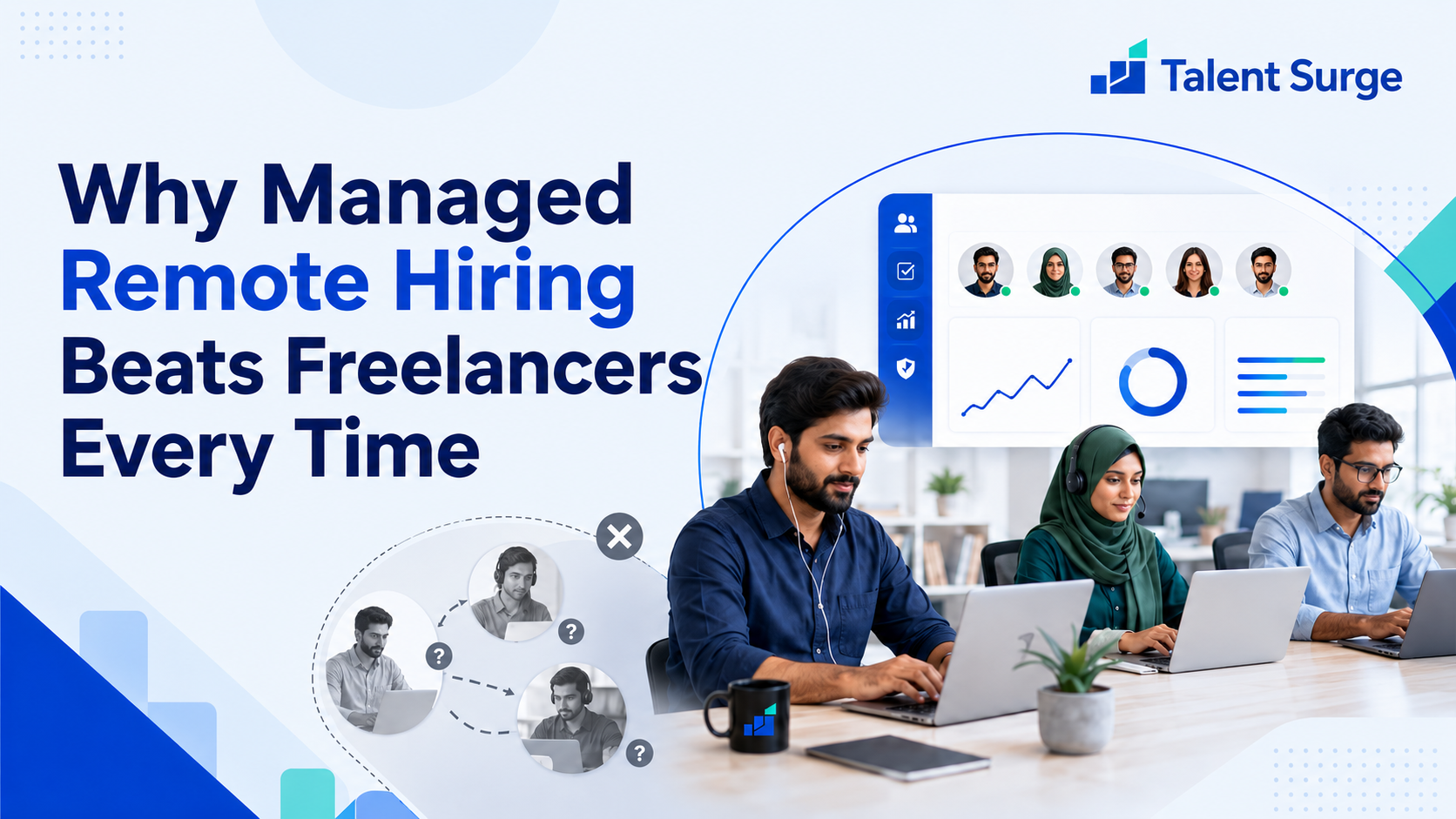
Why Managed Remote Hiring Beats Freelancers Every Time
Freelancers disappear. Managed remote staff don't. Here's the real difference for US businesses.
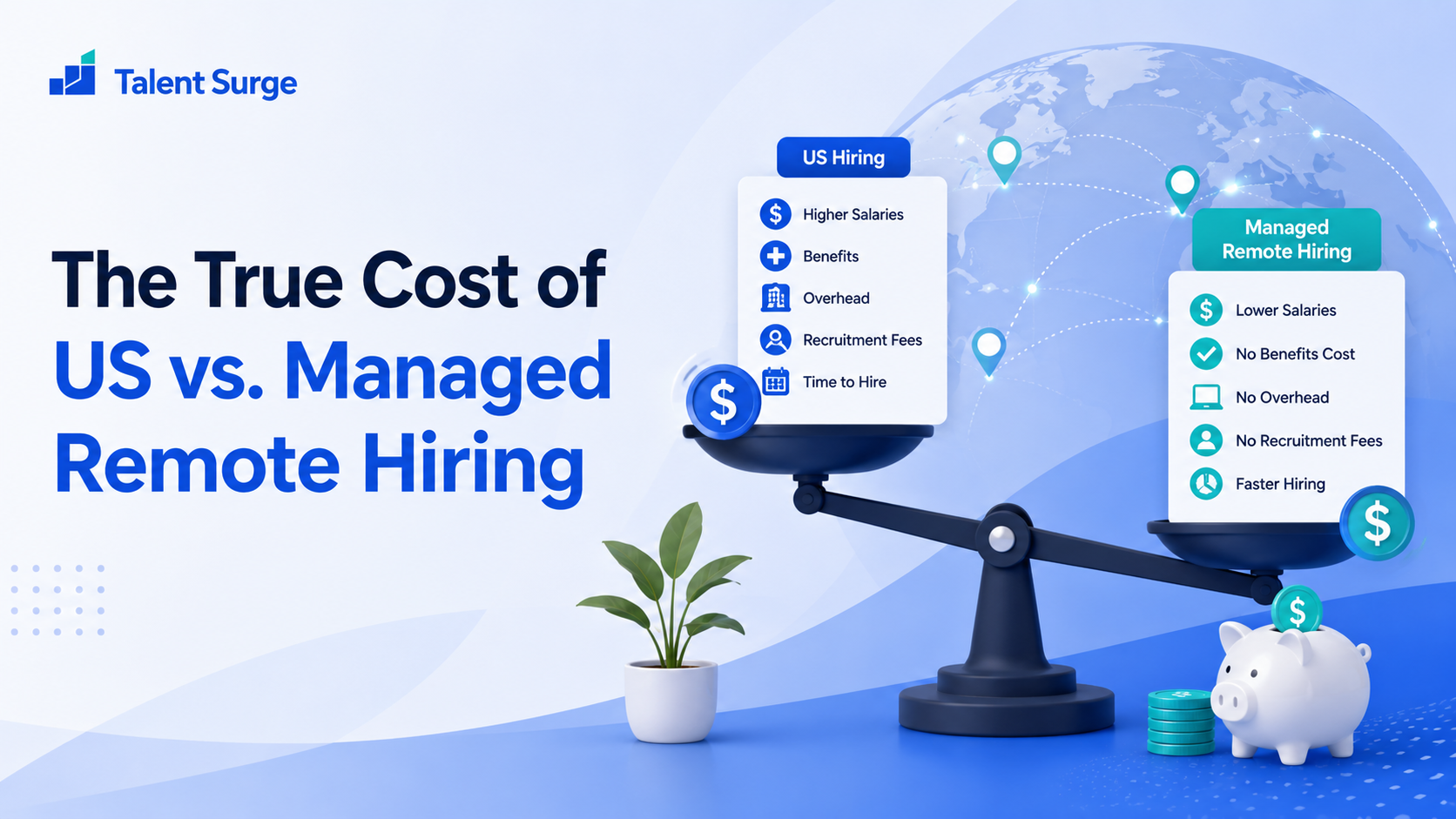
The True Cost of US vs. Managed Remote Hiring
The real cost of a US hire is salary plus benefits, taxes, recruiting, ramp, and management overhead. Here is the full math against a managed remote specialist.
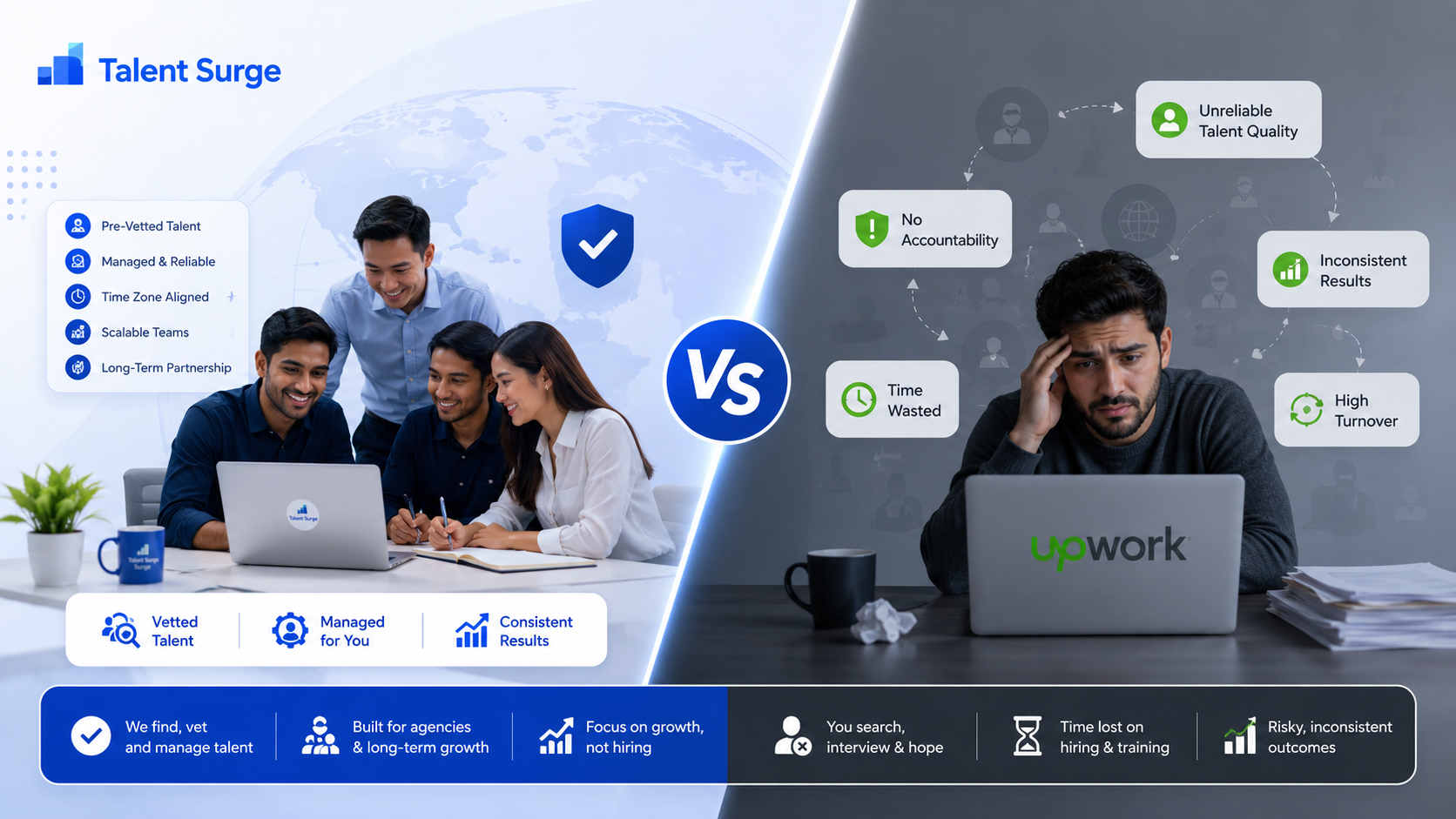
Talent Surge vs. Upwork: Why Agencies Are Switching to Managed Offshore Talent
Upwork is built for sourcing one-off work fast. Talent Surge is built for dedicated, managed specialists who stay. Here is the honest comparison of marketplace freelancers vs managed offshore talent, with cost math, risk, and when each one wins.