
AI Chatbot Developer vs AI Automation Expert: Which Do You Need?
On this page
- How do the options compare?
- What is the customer or employee actually trying to do?
- What does conversational specialization add?
- What does automation specialization add behind the conversation?
- Where must the conversational and operational boundaries meet?
- How would a hypothetical booking assistant divide the work?
- How should you evaluate candidates and handover quality?
- How should staffing and operating costs be scoped?
- What is the safest useful starting scope?
- Which sources inform this comparison?
- What else do business owners ask?
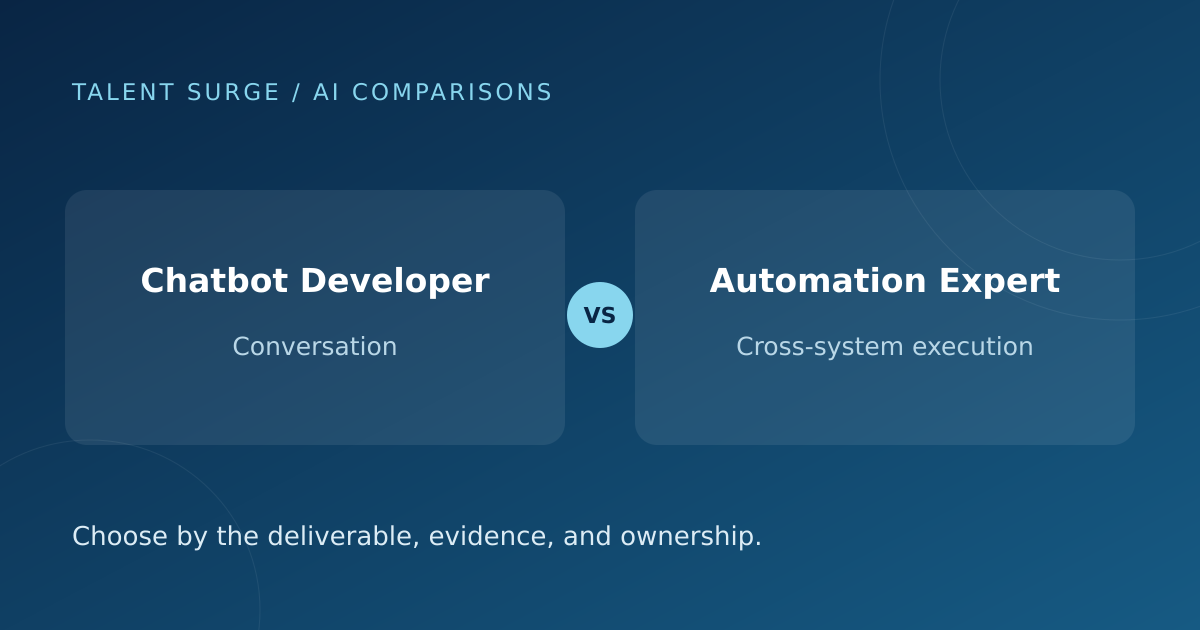
Choose an AI Chatbot Developer when the main deliverable is a dependable conversation with customers or staff. Choose an AI Automation Expert when the main deliverable is work moving between systems. Many projects need both: the chatbot handles dialogue and escalation while automation executes validated actions under explicit permissions and approval rules.
How do the options compare?
| Dimension | AI Chatbot Developer | AI Automation Expert |
|---|---|---|
| Primary interface | Conversation, intent, context, handoff | Triggers, records, routing, approvals |
| Primary deliverable | Usable conversational service | Operational cross-system workflow |
| Quality evidence | Task completion, grounded answers, escalation | Correct records, duplicate protection, recovery |
| Common overlap | Prompts, retrieval, API calls | Prompts, retrieval, API calls |
| Key boundary | User identity and conversational commitments | Write permissions and execution state |
| Hybrid pattern | Collect and clarify the request | Validate and execute the approved request |
What is the customer or employee actually trying to do?
Start with the interface where the problem occurs. If people cannot find a useful answer, misunderstand a booking flow, or cannot reach a human after a failed conversation, conversational design is central. If information arrives correctly but staff must copy it across systems and chase approvals, the bottleneck is operational automation.
A chat widget does not make every project a chatbot project. It may simply collect the request that starts a larger workflow. Equally, a workflow platform's chat feature does not guarantee good conversational behavior. The lead role should match the largest unresolved part of the service, and the brief should include the complete user outcome.
Distinguish this decision from chatbot versus live support, which concerns the service model. Here, the question is who designs and implements the system. A hybrid service can still need conversational expertise, automation expertise, and human support staff, each with a defined responsibility.
What does conversational specialization add?
A Chatbot Developer designs supported intents, clarification, conversational state, response constraints, and escalation. They determine what the assistant should say when information is missing or a request is out of scope. They also consider the channel: an embedded portal can have authenticated context, while a public website may have no reliable customer identity.
OpenAI's evaluation guidance distinguishes answer quality, tool selection, argument accuracy, and handoffs. Those are separate failure points in a conversation. A chatbot that sounds helpful but calls the wrong account lookup tool has not completed the task correctly. A technically accurate response can also fail if it leaves the user without a usable next step.
Ask for representative dialogues, unsupported requests, confusing follow-ups, and escalation tests. Measure completed tasks with appropriate human review, not just message volume or a lower handoff rate. Suppressing escalation can make a dashboard look better while worsening the experience. A good handoff transfers relevant context without exposing unnecessary personal information.
What does automation specialization add behind the conversation?
An Automation Expert maps triggers, fields, business rules, approvals, and execution states across tools. They determine which system is authoritative, how updates are recorded, and what happens when one step succeeds but another fails. Their scope often includes work that users never see in the conversational interface.
Anthropic's workflow definition is useful here: predefined paths can orchestrate model calls without giving a model control over every next action. A lead-routing process can classify an inquiry, validate required fields, create a draft CRM record, and wait for approval. It need not become an autonomous agent simply because one step uses AI.
Acceptance should include duplicate events, malformed input, expired credentials, provider limits, and partial completion. Ask how staff can find and repair a failed run without recreating completed actions. The goal is dependable execution with visible exceptions. A collection of connected applications is not enough if nobody knows whether a customer request finished.
Where must the conversational and operational boundaries meet?
Use a clear contract between the conversation and the action. The chatbot should provide a validated request with a known user, required fields, and an explicit action type. The workflow should return a meaningful state: completed, pending approval, rejected, or failed. Do not let the chatbot claim a booking or refund is complete merely because it generated the right words.
OWASP warns about excessive permissions and autonomy. An assistant that answers billing questions should not automatically receive permission to issue payments. Enforce authorization outside the model, minimize available tools, and require approval where consequences warrant it. Instructions asking a model to be careful do not substitute for application controls.
This contract is a useful shared deliverable for both hires. Compare it with Automation Expert versus Integration Developer when a platform connector cannot provide the required guarantees. Custom engineering may be needed for identity, transactions, or data contracts even if the front end is conversational.
How would a hypothetical booking assistant divide the work?
Hypothetical example, not a case study: a consultancy wants a website assistant that answers service questions and requests appointments. The Chatbot Developer defines the supported questions, retrieves approved service information, clarifies time-zone ambiguity, and creates a human escalation path. The Automation Expert validates availability, creates a pending booking, and sends confirmation only after the booking system accepts it.
Test two different conversations trying to reserve the same slot, a user changing their mind, and a calendar request timing out after the booking may already have succeeded. These are not only dialogue problems or only connector problems. The team must agree on the source of truth and how the user receives an accurate status.
A simpler implementation might keep the assistant read-only and link to an existing booking page. That can be the better initial scope if integrated booking adds risk without clear benefit. The example supports selecting a capability and boundary; it does not promise an increase in bookings, a particular deflection rate, or a fixed launch date.
How should you evaluate candidates and handover quality?
Give candidates a bounded scenario using synthetic information. Ask the Chatbot Developer to show how the assistant handles a question without a reliable answer, an angry customer, and a request requiring identity verification. Ask the Automation Expert to map the subsequent action, describe failure states, and explain which steps are safe to retry.
Look for a shared distinction between proposed actions and confirmed actions. Ask how changes to knowledge, prompts, platform settings, and permissions are recorded. A usable handover should include supported intents, workflow diagrams, access requirements, test cases, and the person who receives alerts. Do not accept 'the platform handles it' without checking the actual behavior.
Use Prompt Engineer versus AI Engineer when response quality is the specific unresolved issue. Prompt improvement may help an existing service, but it cannot repair missing authentication or a broken calendar integration. Hire against demonstrated gaps, not against a general label such as AI expert.
How should staffing and operating costs be scoped?
Both the AI Chatbot Developer and AI Automation Expert pages use Talent Surge technical tiers, including Expert from $11/hr and Pro from $18/hr. These are starting rates, not quotes for a complete chatbot or workflow. Review current pricing, candidate capability, and responsibility before comparing options.
Include channel or platform fees, model usage, retrieval storage, integration subscriptions, testing, human review, and maintenance. The chatbot cost guide and Automation Expert cost guide provide adjacent budgeting context. Use the calculator for staffing assumptions, not as a forecast of total provider spend.
Define the cost unit around a completed outcome. Counting messages can hide repeated clarifications, retries, or unresolved requests. Track the time staff spend checking and correcting outputs, alongside hosting and provider usage. Review those observations after a pilot before claiming savings or expanding autonomous actions.
What is the safest useful starting scope?
Choose one supported intent and one operational outcome. Set the authoritative source, the permitted action, the identity requirements, and the fallback. A read-only question-answering assistant or draft-only workflow can produce useful learning before consequential writes are enabled. Make clear to users when an output is a draft or a request rather than a completed action.
Keep manual support available and name who maintains content and integrations after launch. Review failure cases jointly with customer-facing staff because the most technically convenient behavior may not be understandable to users. Expand only when representative tests and observed use support the broader scope.
Explore adjacent choices through the comparison hub and offered capabilities through AI hiring. Bring the proposed conversation and workflow to a discovery call. The right role is the one that can own the missing capability while collaborating across the conversational and execution boundary.
Which sources inform this comparison?
Editorial sources checked 2026-10-07. The recommendations are decision frameworks, not measured customer results or market-demand claims. Offered-role scope and starting tiers were checked against the current site pages.
- OpenAI: Evaluation best practices: Representative tests, architecture-specific evaluation, edge cases, and human calibration; no model benchmark claimed. Checked 2026-10-07.
- Anthropic: Building effective agents: Architecture definitions and simplicity tradeoffs. Originally published December 2024; tooling has since changed. Used for principles, not current product recommendations. Checked 2026-10-07.
- OWASP: LLM06:2025 Excessive Agency: Minimize functionality, permissions, and autonomy; independently authorize consequential actions. Checked 2026-10-07.
- Relevant Talent Surge role and current pricing: site definitions and starting rates checked 2026-10-07; confirm scope and terms before engagement.
What else do business owners ask?
Can one person build the bot and its automations?
Yes, for a bounded scope if their work demonstrates conversational design, integrations, security, and recovery. Confirm the skill combination instead of assuming it from a title. More complex systems may need specialist engineering or independent review.
Which role should own escalation to a person?
The Chatbot Developer should design the conversational handoff, while automation may route the request and transfer context. A support or operations owner must approve where it goes and ensure someone can actually respond.
Does an automation platform make chatbot expertise unnecessary?
No. Platform features can reduce implementation effort, but supported intents, clarification, user expectations, and escalation still need design and testing. Assess the actual conversation rather than the availability of a chat component.
Should the chatbot be allowed to change customer records?
Only through explicitly authorized actions with validated inputs and suitable approval controls. Start with read-only or draft-only behavior where appropriate. The model's interpretation of a request must not independently grant account permissions.
How do we know whether a request really completed?
Use the authoritative system's confirmation and a tracked execution state. The assistant should distinguish pending, completed, rejected, and failed requests. Generated text claiming success is not evidence that the backend action happened.
What if our existing chatbot answers poorly?
Diagnose knowledge, retrieval, prompts, conversation flow, and integration failures separately. You may need focused improvement rather than a replacement. A prompt specialist can help response behavior, but missing permissions or unreliable writes require implementation work.
Match capability to your brief. Discuss the intended outcome, acceptance evidence, and operational ownership in a discovery call.
Take action today
Stop comparing. Start saving.
US businesses save 60-70% vs local hires. Get 3 pre-vetted offshore specialists matched to your exact role delivered in 14 days, free with no commitment.
Keep reading

AI Engineer vs AI Automation Expert: Which One Do You Actually Need in 2026?
AI Engineers ship custom AI products. AI Automation Experts wire AI into your existing workflows. Here is how to tell which one your business needs first.

AI Funnel Engineer vs AI Automation Expert: Where Each One Wins
AI Funnel Engineers build AI-driven sales funnels that convert. AI Automation Experts plug AI into your ops stack. Here is how each one works, where each wins, and which to hire first.

AI Prompt Engineer vs AI Chatbot Developer: Where Real ROI Lives
Prompt Engineers optimise the words you send to LLMs. Chatbot Developers ship full conversational products. Here is what each one does, where each wins, and which your roadmap actually needs first.