
AI Automation Expert vs Integration Developer: Who Connects Systems?
On this page
- How do the options compare?
- Is your main problem process design or interface engineering?
- What can a platform-focused Automation Expert own?
- When does custom integration development become necessary?
- How should retries and partial failures be designed?
- Where do permissions and data contracts belong?
- How would a hypothetical CRM-to-billing workflow divide work?
- How can you compare candidates and realistic costs?
- What should you establish before implementation starts?
- Which sources inform this comparison?
- What else do business owners ask?
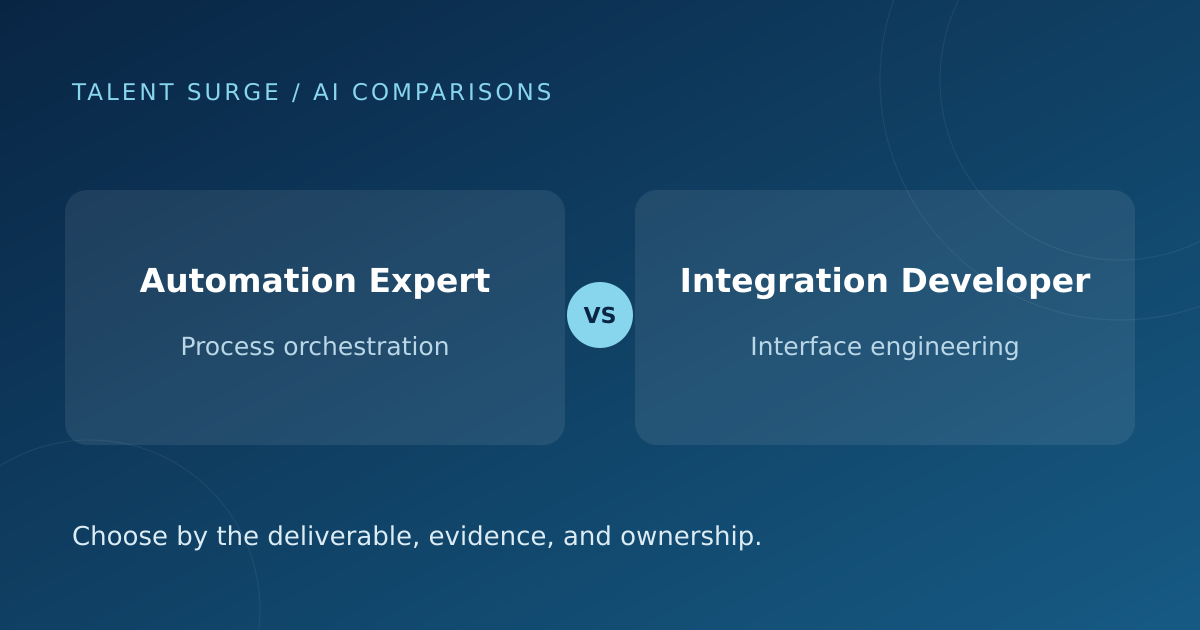
Choose an AI Automation Expert for process-oriented workflows built around existing platforms and supported connectors. Choose an Integration Developer when custom APIs, data contracts, or demanding reliability requirements dominate. The roles can overlap. A hybrid often works best when automation owns business routing and engineering supplies a dependable, permission-controlled integration layer.
How do the options compare?
| Decision | AI Automation Expert | Integration Developer |
|---|---|---|
| Dominant work | Process mapping and platform orchestration | Custom interfaces and service reliability |
| Typical artifacts | Workflow, field mappings, exception queue | API contract, adapter, tests, deployment |
| Good fit | Supported connectors and bounded business rules | Unsupported systems or complex data semantics |
| Reliability still required | Validated inputs, monitoring, recovery | Validated inputs, monitoring, recovery |
| Key constraint | Platform capabilities and execution limits | Engineering effort and maintenance ownership |
| Hybrid boundary | Owns when and why actions happen | Owns how systems exchange valid data |
Is your main problem process design or interface engineering?
If the systems already expose suitable connectors and the challenge is deciding when information should move, process-oriented automation may be the primary need. If the systems disagree about identifiers, data types, transaction states, or permission boundaries, custom integration work may dominate. Count neither applications nor connector icons as a reliable measure of complexity.
A two-system connection can be demanding if it affects financial records or must survive partial failure. A many-step workflow can remain manageable if it moves drafts through well-supported interfaces and tolerates delay. Define acceptable delay, error consequences, and recovery expectations before choosing the implementation approach.
This comparison is not the same as Automation Expert versus RPA Developer, which concerns application interaction and interface automation. Here the focus is data exchange through connectors and custom services. The term Integration Developer is a capability label in this article, not a claim of a new advertised Talent Surge role.
What can a platform-focused Automation Expert own?
The expert should map the business trigger, validate incoming fields, choose routing rules, implement approval steps, and make unsuccessful execution visible. They should understand connector limitations and be able to explain when custom code is necessary. Low-code work can require substantial technical judgment; it is not inherently less serious than code-first work.
Anthropic's predefined-workflow distinction supports keeping the process predictable where possible. AI may classify a request or draft a summary while the surrounding workflow uses explicit rules. If the model proposes a downstream action, validate that proposal before a connector receives it.
Useful deliverables include documented mappings, a workflow version, test cases, execution-state tracking, and recovery instructions. Ask how the route behaves if a trigger fires twice or an approval is withdrawn. A platform can simplify implementation, but the workflow owner must still understand what the platform actually guarantees and what requires additional controls.
When does custom integration development become necessary?
Custom work is often justified when a required interface is unsupported, authentication is unusual, or data transformations need a controlled contract. It may also be appropriate when multiple workflows need a reusable service rather than separate copies of complex mapping logic. The developer should define the interface, error states, deployment procedure, and maintainer.
The central deliverable is not merely code that calls an endpoint. It is an agreement about valid requests, valid responses, identity, state, and failure. For example, a successful network response may only mean a background job was accepted, not that the business action finished. That distinction should be reflected in the workflow and user-facing status.
Do not build custom services simply to avoid a subscription fee. Compare the cost of ownership, including testing, hosting, security patches, and incident response. Conversely, do not force a connector into a critical process when it cannot represent the needed states or access boundaries. The choice follows requirements, not a universal preference for code or platforms.
How should retries and partial failures be designed?
Assume an action can finish even when its confirmation is lost. If a timeout leads to a blind retry, a workflow may create duplicate records or repeat a customer-facing action. Use the target system's supported duplicate-protection mechanisms where available and maintain stable identifiers or reconciliation logic where appropriate. Do not claim exactly-once behavior without verifying the complete path.
Treat a multi-step process as a sequence of observable states. Record which steps completed, which are pending, and which need human review. Define whether the correct recovery is retrying, compensating for a prior action, or asking an operator to reconcile the system. Some actions cannot be safely undone automatically.
OpenAI's evaluation guidance separates tool selection from argument accuracy in AI-driven systems. Add conventional integration tests for failures outside the model: rejected fields, expired credentials, duplicate events, and unavailable dependencies. Model evaluation is necessary where judgment is used, but it is not a substitute for testing execution semantics.
Where do permissions and data contracts belong?
OWASP's excessive-agency guidance recommends limiting functionality, permissions, and autonomy. Give each workflow only the access it needs. A summarization route should not inherit permission to delete records just because the connector account is convenient. When actions are user-specific, enforce the user's authorization in the application or service layer.
Data contracts should document field meanings, required values, valid states, and ownership. A customer identifier from one application may not be a valid identifier in another. Normalize dates and currencies intentionally, distinguish unknown from empty, and retain enough provenance to investigate disputed updates. Avoid relying on an LLM to guess financially consequential mappings.
Define who reviews schema changes when a source application changes. The workflow owner needs a clear interface from the developer; the developer needs clear business semantics from the process owner. This collaboration resembles the responsibility split in Workflow Specialist versus Project Manager, but concentrates on the technical exchange boundary.
How would a hypothetical CRM-to-billing workflow divide work?
Hypothetical example, not a customer outcome: a company wants approved CRM deals to create draft billing records. The Automation Expert designs the trigger, required approval, notification, and exception queue. An Integration Developer builds a custom adapter because the billing service has no suitable connector and requires a specific account mapping.
The adapter validates identifiers and reports whether a draft already exists. The workflow distinguishes approval received, draft created, and failure needing reconciliation. If a request times out, the team checks the authoritative billing state before deciding whether another create request is safe. AI may summarize deal notes, but it does not choose the billing account without validation.
For a less consequential task, such as posting an internal summary, a supported connector may be entirely sufficient. The example does not mean every finance-related workflow needs custom development. It shows why action consequences, interface limitations, and recovery behavior matter more than whether a tool is described as low-code.
How can you compare candidates and realistic costs?
The Automation Expert role page uses technical tiers, including Expert from $11/hr and Pro from $18/hr. This article does not advertise an Integration Developer rate or service. If engineering capability is needed, discuss the scope through AI engineering and confirm the fit rather than assuming every engineer specializes in integration.
Review pricing and use the calculator for staffing assumptions. Add platform usage, custom hosting, tests, documentation, security review, and maintenance. The workflow total-cost guide helps organize cost categories; the build-versus-buy comparison addresses the broader sourcing decision.
Ask candidates to explain a timeout after a potentially successful write, a field changing type, and a revoked credential. Look for a concrete recovery plan rather than a blanket claim that retries fix everything. A bounded synthetic exercise can reveal whether the candidate understands both business state and technical failure.
What should you establish before implementation starts?
Define the authoritative system for each record, the allowed actions, the expected volume, tolerated delay, and who handles exceptions. Document sample valid and invalid requests. Assign a maintainer for both the workflow and any custom adapter, with support hours and a plan for connector or API changes.
Begin with draft or read-only behavior where it provides useful learning. Use chatbot versus automation when conversations start the process, because the user-facing status must agree with backend execution. Preserve a manual route while the team verifies representative cases.
Use the comparison hub for adjacent decisions and AI hiring for advertised roles. A discovery call should establish whether platform implementation, custom engineering, or a combination matches the requirements. The goal is a connection that can be operated and repaired, not merely a successful first run.
Which sources inform this comparison?
Editorial sources checked 2026-10-07. The recommendations are decision frameworks, not measured customer results or market-demand claims. Offered-role scope and starting tiers were checked against the current site pages.
- Anthropic: Building effective agents: Architecture definitions and simplicity tradeoffs. Originally published December 2024; tooling has since changed. Used for principles, not current product recommendations. Checked 2026-10-07.
- OpenAI: Evaluation best practices: Representative tests, architecture-specific evaluation, edge cases, and human calibration; no model benchmark claimed. Checked 2026-10-07.
- OWASP: LLM06:2025 Excessive Agency: Minimize functionality, permissions, and autonomy; independently authorize consequential actions. Checked 2026-10-07.
- Relevant Talent Surge role and current pricing: site definitions and starting rates checked 2026-10-07; confirm scope and terms before engagement.
What else do business owners ask?
Can an Automation Expert write custom code?
Some can. Confirm their experience with the required language, APIs, testing, and deployment. The title does not impose a strict coding boundary, but a workflow portfolio alone may not demonstrate service engineering capability.
Are low-code workflows less reliable?
Not inherently. Reliability depends on requirements, platform capabilities, implementation, and maintenance. A well-tested supported connector can be appropriate, while a poorly operated custom service can be fragile. Verify behavior rather than judging by the interface.
When should we build a reusable integration service?
Consider it when several workflows share complex mappings, unsupported interfaces, or demanding controls. Compare reuse benefits with hosting and maintenance costs. A reusable service still needs a named owner and a documented contract.
Should every failed request be retried?
No. Some failures are permanent, and some timeouts leave completion uncertain. Use supported duplicate protection and reconciliation. Determine whether retrying, compensating, or human review is safe for the specific action.
Does AI remove the need for data mapping?
No. Important field meanings, identifiers, and valid states require explicit definitions. AI may help interpret unstructured input, but consequential mappings should be validated against a contract rather than guessed.
Is Integration Developer an advertised Talent Surge role?
This article uses the title to compare capabilities and does not claim a dedicated advertised role or rate. Confirm availability and scope during discovery. The linked engineering and automation pages describe the current offered roles.
Match capability to your brief. Discuss the intended outcome, acceptance evidence, and operational ownership in a discovery call.
Take action today
Stop comparing. Start saving.
US businesses save 60-70% vs local hires. Get 3 pre-vetted offshore specialists matched to your exact role delivered in 14 days, free with no commitment.
Keep reading

AI Engineer vs AI Automation Expert: Which One Do You Actually Need in 2026?
AI Engineers ship custom AI products. AI Automation Experts wire AI into your existing workflows. Here is how to tell which one your business needs first.

AI Funnel Engineer vs AI Automation Expert: Where Each One Wins
AI Funnel Engineers build AI-driven sales funnels that convert. AI Automation Experts plug AI into your ops stack. Here is how each one works, where each wins, and which to hire first.

AI Prompt Engineer vs AI Chatbot Developer: Where Real ROI Lives
Prompt Engineers optimise the words you send to LLMs. Chatbot Developers ship full conversational products. Here is what each one does, where each wins, and which your roadmap actually needs first.