
AI Prompt Engineer vs AI Engineer: When Is Each Needed?
On this page
- How do the options compare?
- Is the problem model behavior or the surrounding application?
- What is substantive prompt engineering?
- What must an AI Engineer own beyond prompts?
- When does a dedicated prompt specialist make sense?
- What would a hypothetical quality-improvement project look like?
- Why do stronger prompts not solve security on their own?
- How should capability and price be compared?
- What should a shared quality contract contain?
- Which sources inform this comparison?
- What else do business owners ask?
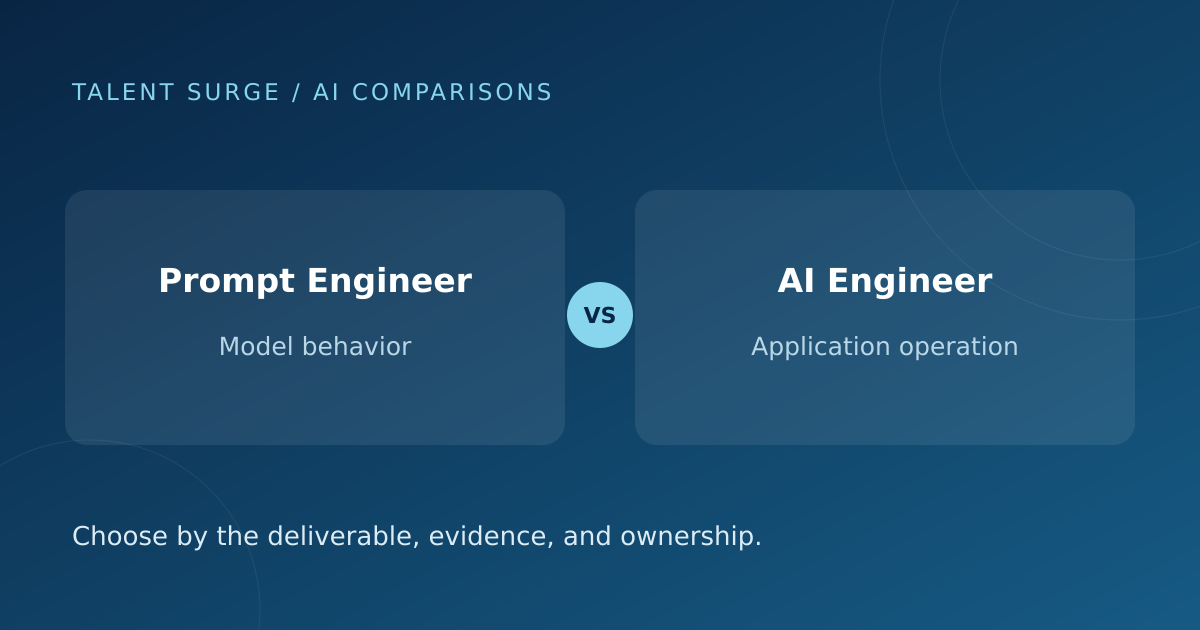
An AI Prompt Engineer improves instructions, context, examples, and evaluation for model behavior. An AI Engineer owns the application around that behavior, including integrations, deployment, security, and reliability. Prompt work can be part of engineering. Choose a separate specialist when a measured quality problem warrants focused optimization, not merely because the application uses prompts.
How do the options compare?
| Decision | AI Prompt Engineer | AI Engineer |
|---|---|---|
| Primary scope | Instructions, context, examples, evaluation | Application architecture and operation |
| Typical deliverable | Versioned prompts and measured quality changes | Deployed service with tests and support plan |
| Can directly fix | Ambiguous instructions or weak examples | Missing integrations or unsafe execution paths |
| Cannot fix alone | Authorization, outages, absent source data | Unclear business policy or invalid quality labels |
| Common overlap | Model choice, structured output, evaluations | Model choice, structured output, evaluations |
| Best hiring evidence | Controlled comparisons and failure analysis | End-to-end implementation and recovery |
Is the problem model behavior or the surrounding application?
Classify failures before hiring. If the model receives the correct source information but repeatedly misunderstands a task or produces an unsuitable format, prompt and evaluation work may help. If the right information never reaches the model, credentials expire, or users can access records they should not see, the application has a different problem.
OpenAI's optimization guide describes an iterative cycle of evaluations, prompting, and, where appropriate, fine-tuning. It does not make prompt changes a replacement for software architecture. Its current page also flags legacy tooling, so use the principles and confirm supported implementation surfaces with the chosen provider.
Write down the observed failure, an example input, the expected behavior, and the system state. Separate a missing business rule from a misunderstood instruction. If stakeholders disagree about what a correct answer is, neither hire can responsibly optimize toward an undefined target. Resolve the acceptance policy before treating the issue as a technical quality problem.
What is substantive prompt engineering?
Useful prompt work includes task decomposition, instruction hierarchy, source context, examples, output constraints, and systematic testing. A specialist should be able to explain why a change helps and where it makes behavior worse. A collection of impressive one-off prompts is less informative than a repeatable comparison on representative inputs.
OpenAI's evaluation best practices recommends architecture-specific evaluation and coverage of edge cases. For a classification task, inspect confusion between categories and behavior when no category fits. For a drafting task, inspect factual support, prohibited commitments, and adherence to the requested structure. Keep human judgment calibrated where scoring requires interpretation.
Require versioned artifacts and a record of tested model settings. Evaluate changes against held-out examples rather than only the samples used to improve the prompt. Different tasks may require different approaches. A shorter prompt or a more persuasive tone is not inherently better if it harms correctness or makes failures harder to detect.
What must an AI Engineer own beyond prompts?
An Engineer connects model behavior to a dependable user service. Their scope can include authentication, data retrieval, APIs, storage, background execution, deployment, monitoring, provider limits, and cost controls. They determine how output becomes an authorized action and what happens when dependencies are unavailable.
Engineering acceptance includes constraints that a model cannot enforce alone. An application should check whether a user may access a document before retrieval, validate tool arguments before execution, and track whether a write actually completed. It should also let maintainers disable a failing feature without losing unrelated business operations.
Read prototype versus production for the launch boundary. A demonstration with carefully selected inputs may still lack an operating plan. If the question is who should deliver the conversational experience, compare the existing Prompt Engineer versus Chatbot Developer article; that is a narrower product responsibility than general application engineering.
When does a dedicated prompt specialist make sense?
A dedicated specialist can be useful before or after launch if the workload has clear behavior requirements and enough evaluation work to justify focused attention. For example, a regulated drafting process may need substantial review before any customer exposure. An established service may need prompt experiments after recurring failures are classified.
Do not use a universal traffic or company-size threshold. Estimate the actual task: collecting examples, defining rubrics, managing prompt versions, comparing models, and working with domain reviewers. If an existing engineer can cover this work reliably within the project, a separate role may add coordination without addressing a gap.
Also diagnose missing knowledge. A prompt cannot reliably supply a policy it never received. RAG versus fine-tuning explains the knowledge-versus-behavior distinction. A specialist may identify that retrieval is the problem, but data access and indexing still need an implementation owner. Focused optimization should remain connected to the complete application.
What would a hypothetical quality-improvement project look like?
Hypothetical example, not a measured customer result: a team uses AI to draft responses to supplier inquiries. The application already retrieves the correct purchase-order details, but drafts sometimes confuse a proposed delivery date with a confirmed one. A Prompt Engineer builds representative examples and a rubric distinguishing confirmed, proposed, and unknown information.
An AI Engineer ensures source fields are correctly labeled, the application preserves that distinction, and messages remain drafts until approved. The team evaluates prompt variants on held-out inquiries and reviews ambiguous cases with procurement staff. If the retrieval code supplies the wrong purchase order, that is an engineering defect rather than evidence that a more elaborate prompt is needed.
Success is a measured improvement under the agreed rubric without unacceptable regressions in other cases. It is not a promise of zero errors or automatic labor savings. Both roles should record limitations, maintain a safe fallback, and leave the reviewers enough context to understand what the system knows.
Why do stronger prompts not solve security on their own?
OWASP's prompt-injection guidance explains both direct attacks and instructions hidden in external content. It explicitly notes that retrieval and fine-tuning do not fully mitigate injection. Treat incoming documents and messages as untrusted data even when they come through an approved connector.
A prompt specialist can improve the separation of instructions and source material, test hostile inputs, and document expected refusals. An engineer must enforce identity, permissions, tool restrictions, and output handling outside the model. A model refusing an attack in one test does not prove that unauthorized actions are impossible.
Security reviews should focus on consequences as well as language. If the assistant can only draft a response, an injection has different consequences than if it can send messages or modify records. Reduce unnecessary access, require approval for consequential actions, and test boundary failures. The responsibility for those controls should be explicit in the brief, not implied by the word prompt.
How should capability and price be compared?
The current Prompt Engineer and AI Engineer pages both use technical tiers, including Expert from $11/hr and Pro from $18/hr. Those starting tiers do not establish that the jobs have identical scope or effort. Check pricing and the candidate assessment against your actual deliverables.
Include evaluation-data preparation, domain review, implementation, provider usage, monitoring, and maintenance. The fine-tuning versus prompting cost guide covers an adjacent technical cost choice. The staffing calculator can help compare working-hour assumptions, but it does not predict quality improvements or model usage.
Ask candidates to explain an experiment that failed or a case where changing the prompt was not the right fix. Evidence of diagnosis is more useful than a promise to eliminate hallucinations. In a bounded exercise, reward a clear test plan and honest limitations rather than an attractive output generated from a single easy example.
What should a shared quality contract contain?
Specify the supported task, authoritative context, output format, unacceptable failures, evaluation cases, and release thresholds. Name who updates examples, who approves domain labels, who maintains prompts, and who integrates changes into the application. Keep a held-out test set and a way to revert a change that performs poorly in use.
Separate quality goals from business claims. A response can satisfy the rubric while still requiring a human decision, and a lower model cost can be outweighed by more review work. Track completed outcomes, review effort, and incidents together. Use observed results to decide whether further specialization is worthwhile.
Explore connected decisions in the comparison hub and offered roles in AI hiring. Bring a small set of representative failures to a discovery call. Matching the hire to those failures is more useful than requesting a prompt specialist simply because your product uses a language model.
Which sources inform this comparison?
Editorial sources checked 2026-10-07. The recommendations are decision frameworks, not measured customer results or market-demand claims. Offered-role scope and starting tiers were checked against the current site pages.
- OpenAI: Model optimization: Evaluation, prompting, and fine-tuning principles. Page now flags legacy tooling; verify current provider support before implementation. Checked 2026-10-07.
- OpenAI: Evaluation best practices: Representative tests, architecture-specific evaluation, edge cases, and human calibration; no model benchmark claimed. Checked 2026-10-07.
- OWASP: LLM01:2025 Prompt Injection: Direct and indirect injection risks and layered mitigations; neither retrieval nor fine-tuning eliminates the risk. Checked 2026-10-07.
- Relevant Talent Surge role and current pricing: site definitions and starting rates checked 2026-10-07; confirm scope and terms before engagement.
What else do business owners ask?
Can an AI Engineer do prompt engineering?
Yes. Prompt design and evaluation are often part of application engineering. A separate specialist is useful when focused behavior work exceeds available capacity or needs particular expertise, not because prompts are categorically outside engineering.
Must a product be live before hiring a Prompt Engineer?
No. High-risk or complex tasks may need substantial evaluation and prompt work before launch. Choose by workload and demonstrated needs rather than a fixed pre-launch or post-launch rule.
Can prompts eliminate hallucinations?
No prompt can guarantee that all unsupported outputs disappear. Improve source context and evaluations, enforce application boundaries, and provide abstention or human review where needed. Assess residual errors against the consequences of use.
Who decides whether fine-tuning is needed?
The implementation team and domain owner should use measured failures, available training data, and current provider support. Establish prompting and retrieval baselines first. Fine-tuning is an option for suitable behavior gaps, not a mandatory step.
What is the best hiring exercise?
Use representative synthetic examples and ask for a diagnosis, rubric, experiment plan, and limitations. For engineering, include the request path, authorization, and recovery. Do not judge either role by one polished generated answer.
Who owns prompt versions after handover?
Assign a named maintainer and an approval process. Record the tested model, context assumptions, evaluation results, and rollback option. Prompt changes can alter user-visible behavior and should not bypass the application's release controls.
Match capability to your brief. Discuss the intended outcome, acceptance evidence, and operational ownership in a discovery call.
Take action today
Stop comparing. Start saving.
US businesses save 60-70% vs local hires. Get 3 pre-vetted offshore specialists matched to your exact role delivered in 14 days, free with no commitment.
Keep reading

AI Engineer vs AI Automation Expert: Which One Do You Actually Need in 2026?
AI Engineers ship custom AI products. AI Automation Experts wire AI into your existing workflows. Here is how to tell which one your business needs first.

AI Funnel Engineer vs AI Automation Expert: Where Each One Wins
AI Funnel Engineers build AI-driven sales funnels that convert. AI Automation Experts plug AI into your ops stack. Here is how each one works, where each wins, and which to hire first.

AI Prompt Engineer vs AI Chatbot Developer: Where Real ROI Lives
Prompt Engineers optimise the words you send to LLMs. Chatbot Developers ship full conversational products. Here is what each one does, where each wins, and which your roadmap actually needs first.