
AI Workflow Specialist vs Project Manager: Who Owns Automation?
On this page
- How do the options compare?
- What does ownership mean in an automation project?
- What should an AI Workflow Specialist actually implement?
- When does a Project Manager become the more urgent hire?
- How should the two collaborate without duplicating work?
- What would this look like in a hypothetical rollout?
- What evidence should you ask for during hiring?
- How should cost and capacity be compared?
- What is a practical first-step decision?
- Which sources inform this comparison?
- What else do business owners ask?
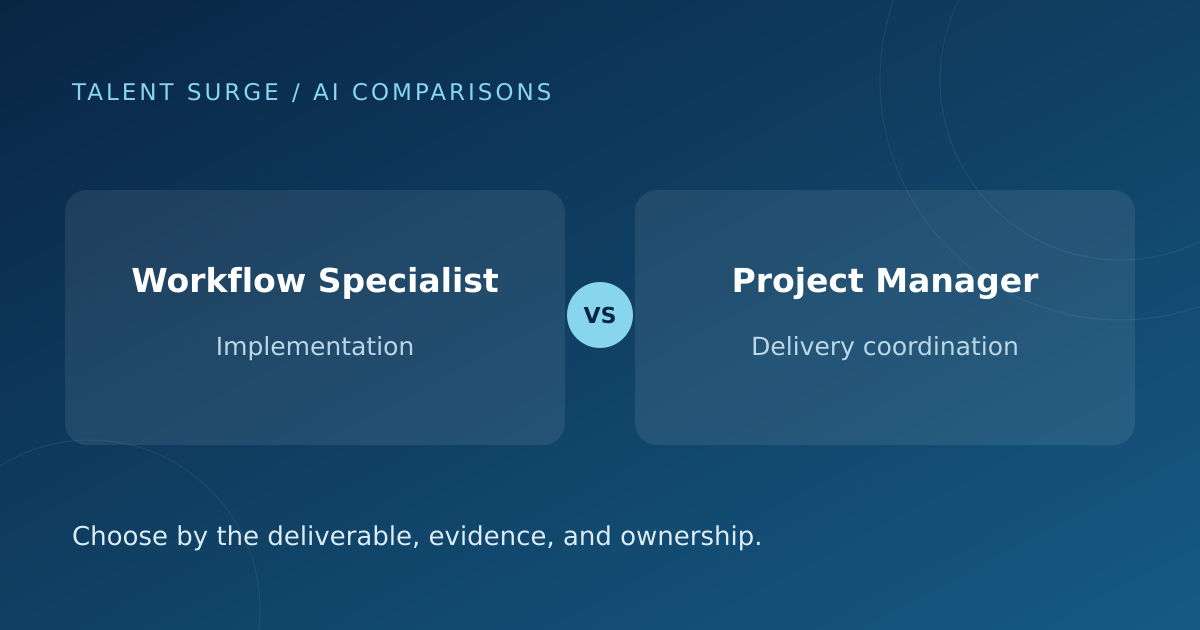
An AI Workflow Specialist designs and improves how automated work runs. A Project Manager coordinates scope, people, dependencies, and delivery. Hire the specialist for implementation capability, the manager for delivery coordination, or both when a rollout spans teams. Keep business-policy approval with a named process owner rather than either title alone.
How do the options compare?
| Responsibility | AI Workflow Specialist | Project Manager |
|---|---|---|
| Primary output | Tested workflow and operating instructions | Delivery plan and coordinated rollout |
| Key decisions | Routing, integration, exceptions, evaluation | Scope, sequencing, resources, communication |
| Typical evidence | Execution logs, tests, recovery demonstrations | Dependency map, risk register, acceptance record |
| Does not automatically own | Business policy and portfolio priority | Technical design and model quality |
| Shared responsibility | Implementation risks and adoption feedback | Implementation risks and adoption feedback |
| Business process owner | Approves policy and acceptable exceptions | Approves policy and acceptable exceptions |
What does ownership mean in an automation project?
Ownership is not one undifferentiated job. Somebody must decide what the process should do, somebody must build and maintain it, and somebody must coordinate the change. These responsibilities can sit with fewer people in a small team, but they still need separate names and acceptance conditions. Otherwise everyone assumes someone else approved an exception or will respond when execution fails.
PMI's description of Project Manager duties emphasizes goals, scope, tasks, resources, stakeholders, risks, and delivery. It does not make the manager the automatic technical authority for every system being delivered. A Workflow Specialist brings implementation capability, while a finance or operations leader may remain the business process owner.
Define ownership at the decision level. The process owner approves an invoice policy; the specialist implements checks; the manager coordinates access, review, training, and release. This division reduces ambiguity without imposing a large governance structure. For a modest workflow, a short responsibility matrix may be enough.
What should an AI Workflow Specialist actually implement?
Expect a map of triggers, inputs, transformations, decisions, approvals, and downstream actions. The specialist should identify which steps are deterministic and which depend on model judgment. They should also document where data is stored, which identity is used, and how an unsuccessful run becomes visible to an accountable person.
Anthropic distinguishes predefined workflows from model-directed agents. That distinction is useful here: workflow work need not be agentic, and adding an LLM does not justify autonomous decision-making. A specialist should be able to choose a simple route when the process is stable and explain when dynamic tool selection is genuinely needed.
Acceptance should include ordinary runs, incomplete inputs, duplicate triggers, provider failures, and recovery. A visual canvas without those tests is a design artifact, not an operational handover. See agents versus workflow automation for architecture selection and the Workflow Specialist versus Automation Expert comparison for adjacent implementation scope.
When does a Project Manager become the more urgent hire?
A manager becomes especially useful when the team already has implementation skills but delivery stalls across departments. Symptoms include unclear priorities, delayed access approvals, conflicting acceptance criteria, unmanaged vendor dependencies, and training that never reaches users. Those problems do not disappear because a specialist writes a more sophisticated workflow.
The manager should make dependencies and decisions visible. A rollout plan might identify who approves data access, when legal or security review is needed, which team tests exceptions, and what operating procedure changes at launch. Useful measures include blocked work, unresolved decisions, readiness, and whether agreed deliverables have been accepted.
Do not use a Project Manager to substitute for absent technical capability. If nobody can design a reliable integration, coordination alone cannot create one. Equally, do not expect a Workflow Specialist to absorb unlimited stakeholder work alongside implementation. Assess where progress stops today and hire for that constraint rather than defaulting to the more technical title.
How should the two collaborate without duplicating work?
Give the specialist responsibility for design notes, technical estimates, tests, and operating documentation. Give the manager responsibility for dependency tracking, coordination, decision records, and release readiness. Have both review the same acceptance criteria so technical completion and business acceptance are not separate surprises at the end.
The business process owner should approve which exceptions require human judgment and which actions the system may take. The specialist translates those boundaries into enforceable controls. The manager ensures the right people review them and that changes are recorded. An approval meeting should not replace a technical test, and a passing test should not replace policy approval.
OWASP's excessive-agency guidance recommends minimizing functionality, permissions, and autonomy. Translate that into the shared brief: which systems are read-only, which writes need approval, and who authorizes expanded permissions. If a workflow suggests a payment, separate suggesting it from executing it. The responsibility matrix should make that separation visible.
What would this look like in a hypothetical rollout?
Hypothetical example, not a customer result: a services company wants an onboarding workflow across sales, finance, and account management. An AI step summarizes a signed brief; deterministic steps create draft tasks; a human approves the client-facing message. The Workflow Specialist builds the route and tests missing fields, duplicate submissions, and failed CRM updates.
The Project Manager coordinates access from system administrators, schedules review by finance and account management, records unresolved policy questions, and organizes training. The operations lead decides which clients follow the standard process and which need bespoke handling. None of these people should claim that a successful sample run proves the whole rollout is complete.
If the team is small and the process involves one application, a capable specialist and an available process owner may cover coordination themselves. If several business units have competing deadlines, separate project management may be worthwhile. The scenario illustrates a decision process, not a promised timeline or savings figure.
What evidence should you ask for during hiring?
For the specialist, request an anonymized workflow walkthrough: why particular steps were automated, how inputs were validated, and how failures were investigated. Ask them to explain an exception without showing confidential customer data. A strong answer should include monitoring and manual fallback, not just screenshots of connected tools.
For the manager, ask for an example of resolving a cross-team dependency or changing scope after new evidence emerged. How did they distinguish an implementation issue from a business decision? What made a deliverable ready for acceptance? Look for clear communication and escalation practices rather than promises that every deadline will always be met.
Use the same hypothetical brief for both interviews and compare the questions they ask. Their different perspectives should complement one another. Include the handover criteria from prototype versus production in the exercise. A candidate who cannot identify an accountable post-launch owner is leaving a substantial delivery risk unresolved.
How should cost and capacity be compared?
The AI Workflow Specialist page uses technical tiers, including Expert from $11/hr and Pro from $18/hr. The Project Manager page uses standard tiers, including Expert from $9/hr and Pro from $16/hr. These are current starting tiers, not equivalent quotes for an identical job. Check responsibilities and terms on pricing.
Budget implementation hours and coordination hours separately. Add application subscriptions, provider usage, user training, testing, and maintenance. The workflow total-cost guide covers useful cost categories, while the calculator supports staffing comparisons. Neither can infer how much stakeholder coordination your organization needs.
Do not assume automation eliminates management work. Some work shifts toward reviewing exceptions, investigating failures, and maintaining policy. Track that effort during a pilot. A workflow that completes quickly but leaves staff fixing ambiguous outputs may not be a useful operational improvement. Capacity assumptions should be reviewed against observed use.
What is a practical first-step decision?
Pick one process and identify its largest unresolved constraint. If it lacks a workable design or tested implementation, start with specialist capability. If a capable builder is blocked by approvals, dependencies, or unclear scope, strengthen project management. If the process itself has no agreed policy, resolve that with its business owner before asking either hire to automate it.
Write a brief that includes the trigger, intended outcome, exception owner, access limits, acceptance evidence, and maintenance responsibilities. The approval-workflow guide can help make the approval boundary concrete. Start with a bounded pilot and retain a manual route until operational performance supports expansion.
Check adjacent role choices in the comparison hub and advertised capabilities in the AI hiring hub. A discovery call should clarify which responsibilities need dedicated support and which can remain with your team. The aim is explicit accountability, not adding roles for their own sake.
Which sources inform this comparison?
Editorial sources checked 2026-10-07. The recommendations are decision frameworks, not measured customer results or market-demand claims. Offered-role scope and starting tiers were checked against the current site pages.
- PMI: What is a Project Manager?: Primary professional-body description of scope, resources, stakeholders, and delivery responsibilities. Checked 2026-10-07.
- Anthropic: Building effective agents: Architecture definitions and simplicity tradeoffs. Originally published December 2024; tooling has since changed. Used for principles, not current product recommendations. Checked 2026-10-07.
- OWASP: LLM06:2025 Excessive Agency: Minimize functionality, permissions, and autonomy; independently authorize consequential actions. Checked 2026-10-07.
- Relevant Talent Surge role and current pricing: site definitions and starting rates checked 2026-10-07; confirm scope and terms before engagement.
What else do business owners ask?
Can a Project Manager build AI workflows?
Yes, if they have demonstrated implementation skills. The title alone does not establish those skills. Confirm integrations, testing, access controls, and recovery experience before assigning technical ownership alongside coordination.
Can a Workflow Specialist manage a small project?
Often, provided the scope is bounded and the business owner is available for decisions. Reserve capacity for coordination rather than assuming it is free. Larger stakeholder groups or conflicting dependencies may justify separate management.
Who approves business rules?
A named process owner with the appropriate authority should approve policies and acceptable exceptions. The specialist implements those rules, and the manager coordinates review. Neither role should independently invent financial or customer commitments.
Who responds when a workflow fails after launch?
Name an operational responder and a technical maintainer before release. Define support hours, alert routing, manual fallback, and escalation. The Project Manager may coordinate incidents but is not automatically the person qualified to repair an integration.
Does every AI workflow need an agent?
No. Predefined steps with bounded classification or drafting can be sufficient. Use model-directed decisions only where flexibility addresses a measured need and where limits, evaluation, and approval controls are appropriate.
What should success be measured against?
Use agreed completion quality, exception burden, recovery time, adoption, and total effort. Delivery coordination can also track unresolved decisions and blocked dependencies. Compare with a baseline instead of promising savings before observing real use.
Match capability to your brief. Discuss the intended outcome, acceptance evidence, and operational ownership in a discovery call.
Take action today
Stop comparing. Start saving.
US businesses save 60-70% vs local hires. Get 3 pre-vetted offshore specialists matched to your exact role delivered in 14 days, free with no commitment.
Keep reading

AI Engineer vs AI Automation Expert: Which One Do You Actually Need in 2026?
AI Engineers ship custom AI products. AI Automation Experts wire AI into your existing workflows. Here is how to tell which one your business needs first.

AI Funnel Engineer vs AI Automation Expert: Where Each One Wins
AI Funnel Engineers build AI-driven sales funnels that convert. AI Automation Experts plug AI into your ops stack. Here is how each one works, where each wins, and which to hire first.

AI Prompt Engineer vs AI Chatbot Developer: Where Real ROI Lives
Prompt Engineers optimise the words you send to LLMs. Chatbot Developers ship full conversational products. Here is what each one does, where each wins, and which your roadmap actually needs first.