
AI Agents vs Workflow Automation: Which Should You Build?
On this page
- How do the options compare?
- What separates an agent from an AI-enabled workflow?
- When are predefined workflows the better starting point?
- When can an agent add useful flexibility?
- How should a hybrid architecture divide responsibilities?
- What would a hypothetical invoice investigation illustrate?
- What failures must be evaluated before release?
- How should cost, maintenance, and staffing be estimated?
- How can you decide with a bounded pilot?
- Which sources inform this comparison?
- What else do business owners ask?
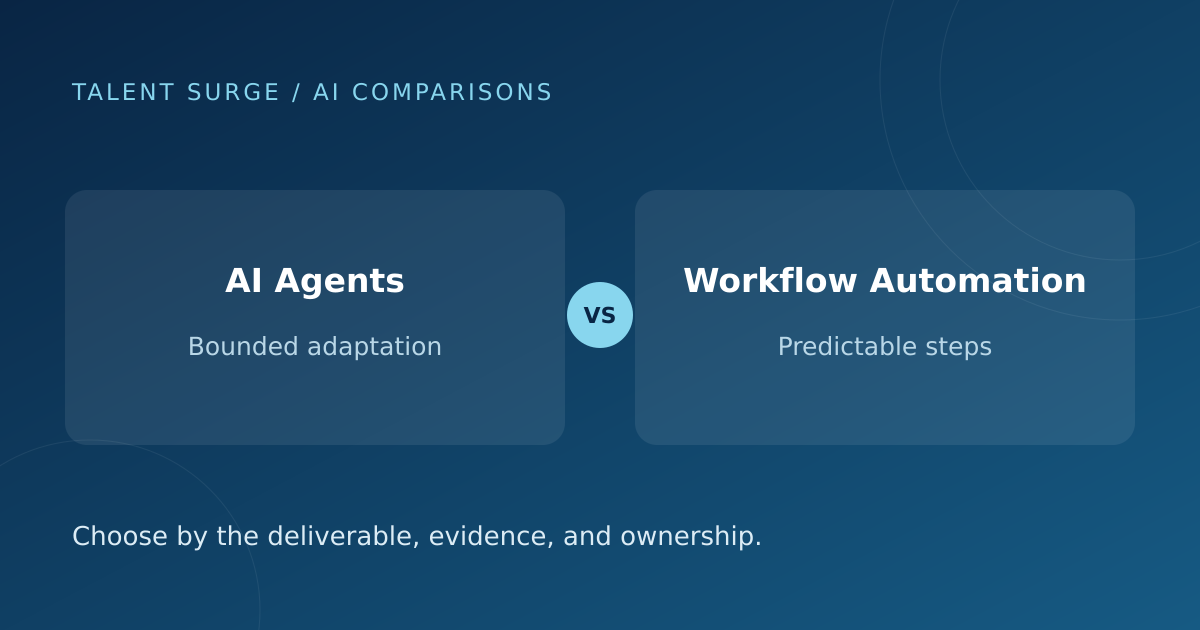
Use workflow automation when the steps and decision rules can be specified in advance. Use an AI agent when useful execution requires bounded, model-directed choices about what to do next. A hybrid often fits business operations: deterministic controls manage permissions and approvals while an agent handles the uncertain portion under explicit limits.
How do the options compare?
| Dimension | Workflow automation | AI agent |
|---|---|---|
| Control path | Defined steps and branches | Model chooses some next steps or tools |
| Good fit | Stable processes with explicit rules | Tasks needing adaptive investigation or planning |
| AI can still be used | Classification, extraction, drafting | Planning, selection, synthesis, tool use |
| Evaluation focus | Step correctness and complete execution | Trajectory, tool selection, arguments, stopping |
| Operating limits | Retries, queues, timeouts, permissions | Those limits plus action and iteration budgets |
| Hybrid approach | Enforces state and consequential approvals | Performs bounded uncertain subtasks |
What separates an agent from an AI-enabled workflow?
Anthropic's architecture guide distinguishes workflows, where models and tools follow predefined code paths, from agents, where a model dynamically directs part of the process and tool use. These are architectural descriptions, not a guarantee of product quality. Vendors use the word agent differently, so inspect what the system actually controls.
A workflow can contain AI without becoming an agent. For example, a fixed route may receive an email, classify its topic, validate the category, draft a response, and wait for review. The model supplies judgment inside a prescribed path. An agent might instead decide which records to examine, which approved tool to call, and whether more investigation is needed.
The distinction matters because dynamic choice introduces additional failure modes and evaluation work. Do not choose an agent merely because it sounds more capable. Ask which decisions cannot be usefully specified in advance and whether giving the model those decisions improves the task enough to justify the operational complexity.
When are predefined workflows the better starting point?
Prefer a workflow when inputs, rules, and acceptable outputs are sufficiently stable. Examples include moving approved data between applications, requesting review before a write, or generating a draft from a known template. The system can still branch and handle exceptions; deterministic does not mean it has only one linear path.
Defined paths are easier to inspect because maintainers know which step should occur next. They can test inputs, monitor states, and identify the failed operation. That predictability is useful when actions affect financial records, customer commitments, or access rights. It does not eliminate outages or incorrect implementation, but it makes the control structure explicit.
Begin with the simplest useful baseline. The approval-workflow guide provides an adjacent implementation example. If a fixed route performs acceptably, adding model-directed planning may increase latency, cost, and maintenance without solving an actual problem. Confirm the limitation before expanding the architecture.
When can an agent add useful flexibility?
An agent may help when the path depends on information discovered during the task. A research assistant might inspect an approved source, find missing context, and choose another allowed lookup. A support investigator might need different tools depending on the failure described. The valuable capability is bounded adaptation, not unrestricted autonomy.
Specify the task boundary, available tools, stopping conditions, and prohibited actions. A successful agent should know when evidence is insufficient and when to request human help. If the desired result is vague, the system may keep acting without a meaningful completion condition. More iterations do not necessarily make an answer more reliable.
OpenAI's evaluation guidance separates tool choice, argument accuracy, and handoff behavior. Use those distinctions to measure whether the adaptive path is useful. Compare complete tasks against the workflow baseline on representative and difficult cases. A compelling trace from one example is not evidence that agentic execution is the better architecture overall.
How should a hybrid architecture divide responsibilities?
Use deterministic code or platform controls for identity, permissions, state transitions, and consequential approvals. Let the agent handle a bounded uncertain subtask, such as investigating a question or proposing a categorized action. Validate the proposal before it reaches a write-capable tool. Treat the model's output as a request, not authorization.
OWASP's excessive-agency guidance identifies excessive functionality, permissions, and autonomy as risk sources. Apply that guidance by offering narrow tools, separating read and write capabilities, and requiring approval for high-impact actions. The approval must be enforced by the surrounding application, not merely described in the agent's instructions.
Assign the architecture and operating controls to someone with demonstrated capability. Workflow Specialist versus Project Manager explains why implementation ownership and delivery coordination are different. automation versus integration engineering addresses the service boundary when reliable custom tools are needed.
What would a hypothetical invoice investigation illustrate?
Hypothetical example, not an observed business result: an accounts team receives invoices that occasionally lack a valid purchase-order reference. A fixed workflow validates fields, checks existing records, and routes unresolved cases to a person. This is a useful baseline even without a language model.
A bounded agent could examine approved purchase-order records and supplier correspondence to propose the likely reference. It should return evidence and uncertainty, not authorize payment. A deterministic approval step then decides whether the proposal is accepted. If evidence conflicts, the correct result may be escalation rather than another tool call.
Compare the agent with the baseline on cases with missing references, ambiguous supplier names, and conflicting records. Measure correctness, staff review effort, task completion, and operating cost. The agent is worthwhile only if those observations support it under the agreed risk limits. The scenario does not imply that all invoice processing benefits from agents or that any savings are guaranteed.
What failures must be evaluated before release?
For workflows, test invalid inputs, duplicates, failed connectors, expired credentials, partial completion, and manual recovery. For agents, add wrong tool selection, fabricated arguments, unnecessary loops, unsupported conclusions, and failure to stop. Evaluate the entire outcome rather than only the fluency of the final response.
OWASP's prompt-injection guidance describes instructions hidden in external content. An agent reading emails or documents must not treat those instructions as authority to broaden its task or permissions. Test malicious and accidental instruction-like content, and enforce access boundaries independently of the model's response.
Set task-level time, cost, action, and iteration limits. Decide what happens when each limit is reached and show that state to the operator. Maintain a recoverable execution record without retaining unnecessary sensitive content. A system that silently stops after exhausting its budget can leave staff unaware that a business action remains incomplete.
How should cost, maintenance, and staffing be estimated?
A workflow may have platform fees, model calls, connector limits, and exception review. An agent can add repeated reasoning calls, tool execution, more evaluation cases, and investigation effort when paths vary. Estimate cost per completed task and include failed or abandoned runs. A low price for one model call is not the operating cost of an agent.
The Workflow Specialist page uses technical tiers, including Expert from $11/hr and Pro from $18/hr. Review current pricing and capability against the scope. The staffing calculator and production-agent cost guide help organize assumptions without promising a budget or return.
This article chooses architecture, not sourcing. The earlier build-versus-buy guide covers that separate decision. Whether you buy or build, require a named maintainer, a review process for model and tool changes, and an incident route. A managed product does not remove the need for organizational accountability.
How can you decide with a bounded pilot?
Choose one task, document the current process, and define useful completion. Build or configure the least complex baseline that meets the requirements. Add agentic choice only to the part that remains uncertain. Use the same representative cases to compare alternatives and review differences in quality, latency, human effort, and failure recovery.
Keep consequential actions behind approval until evidence supports a wider scope. Use prototype versus production as the launch checklist: evaluation is only one readiness requirement. Permissions, monitoring, rollback, and support ownership must also be established.
Browse the comparison hub and AI hiring hub for connected decisions. Bring the baseline, unresolved uncertainty, and action limits to a discovery call. The practical question is whether bounded adaptation improves this task, not whether agents will replace all workflows.
Which sources inform this comparison?
Editorial sources checked 2026-10-07. The recommendations are decision frameworks, not measured customer results or market-demand claims. Offered-role scope and starting tiers were checked against the current site pages.
- Anthropic: Building effective agents: Architecture definitions and simplicity tradeoffs. Originally published December 2024; tooling has since changed. Used for principles, not current product recommendations. Checked 2026-10-07.
- OpenAI: Evaluation best practices: Representative tests, architecture-specific evaluation, edge cases, and human calibration; no model benchmark claimed. Checked 2026-10-07.
- OWASP: LLM06:2025 Excessive Agency: Minimize functionality, permissions, and autonomy; independently authorize consequential actions. Checked 2026-10-07.
- OWASP: LLM01:2025 Prompt Injection: Direct and indirect injection risks and layered mitigations; neither retrieval nor fine-tuning eliminates the risk. Checked 2026-10-07.
- Relevant Talent Surge role and current pricing: site definitions and starting rates checked 2026-10-07; confirm scope and terms before engagement.
What else do business owners ask?
Is every workflow containing an LLM an agent?
No. A workflow can use a model for classification or drafting while following predefined steps. In this comparison, an agent has model-directed choices about some next steps or tool use. Inspect control behavior rather than vendor terminology.
Will agents replace ordinary automation?
Not universally. Stable processes often benefit from explicit steps and rules. Agents can help with uncertain subtasks, but the surrounding system still needs deterministic permissions, execution states, and recovery.
Can an agent be limited to read-only work?
Yes, and read-only scope can be a useful starting point. Limit tools and data access, set budgets, and provide escalation. Reading sensitive or malicious content still creates risks, so read-only does not mean review is unnecessary.
How should consequential actions be approved?
Enforce approval in the application or workflow before execution, with appropriate identity and authority. A model suggesting an action is not permission to perform it. Record the approved action and confirm the authoritative system's result.
What is the most useful comparison metric?
Measure correct completed outcomes alongside staff review effort, latency, cost, and failure recovery. Use a representative baseline. A final-answer score or a successful demonstration alone misses many operational failures.
Do we need multiple agents?
Only if the additional structure solves an evidenced limitation. Multiple agents add coordination and evaluation work. A single model call, workflow, or bounded agent may be sufficient, and should be compared before increasing complexity.
Match capability to your brief. Discuss the intended outcome, acceptance evidence, and operational ownership in a discovery call.
Take action today
Stop comparing. Start saving.
US businesses save 60-70% vs local hires. Get 3 pre-vetted offshore specialists matched to your exact role delivered in 14 days, free with no commitment.
Keep reading

AI Engineer vs AI Automation Expert: Which One Do You Actually Need in 2026?
AI Engineers ship custom AI products. AI Automation Experts wire AI into your existing workflows. Here is how to tell which one your business needs first.

AI Funnel Engineer vs AI Automation Expert: Where Each One Wins
AI Funnel Engineers build AI-driven sales funnels that convert. AI Automation Experts plug AI into your ops stack. Here is how each one works, where each wins, and which to hire first.

AI Prompt Engineer vs AI Chatbot Developer: Where Real ROI Lives
Prompt Engineers optimise the words you send to LLMs. Chatbot Developers ship full conversational products. Here is what each one does, where each wins, and which your roadmap actually needs first.