
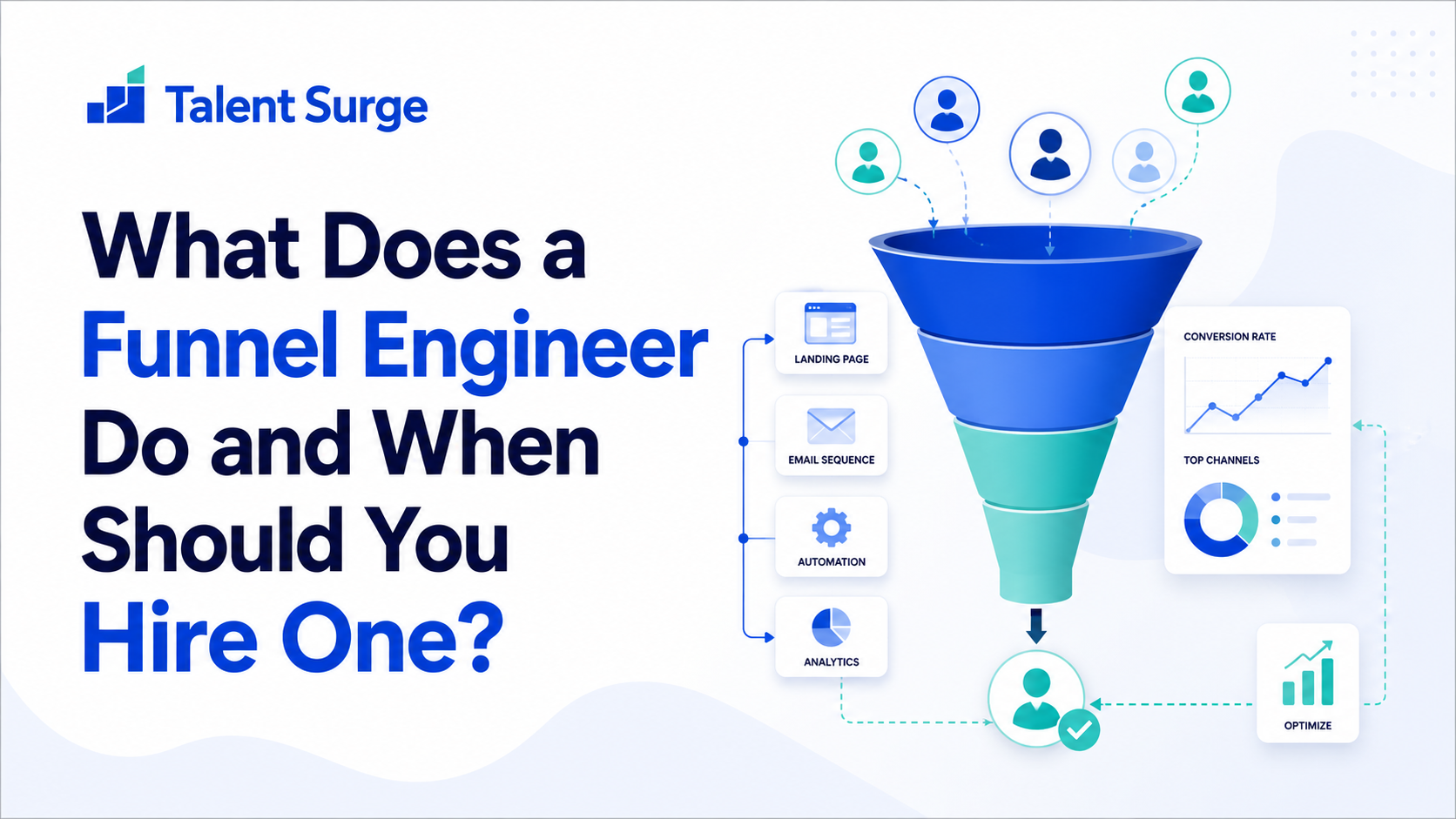
What Does a Funnel Engineer Do and When Should You Hire One?
On this page
Most marketing teams can write an ad and build a basic landing page. What they usually cannot do is connect every piece, the ad, the page, the CRM, the email sequence, the checkout, and the tracking, into a single revenue machine that you can measure and improve. That connective, technical work is what a funnel engineer owns. If your funnels feel like a patchwork of tools bolted together over time, this is the role that ties them into one optimized system.
This guide explains what a funnel engineer actually does, the stack they manage, the KPIs they answer for, when to hire one, and how the role differs from a developer or a copywriter.
What is a funnel engineer?
A funnel engineer operates at the intersection of marketing, technical building, and analytics. They are not primarily a copywriter, not a pure software developer, and not a media buyer; instead they build and maintain the infrastructure that makes marketing funnels run efficiently and convert at the highest possible rate. Think of them as the person who owns the path from "someone clicked the ad" to "money landed and the follow-up sequence fired," including everything that has to fit together in between.
What they actually do
The day-to-day is part construction and part optimization. Core responsibilities include:
- Building high-converting landing pages and funnel flows in ClickFunnels, GoHighLevel, Webflow, or Unbounce
- Designing end-to-end funnel architecture from ad click to sale to upsell and retention sequence
- Connecting the CRM and email platform to funnel stages so leads route and trigger automatically
- Building A/B testing frameworks for headlines, offers, page layouts, and flow variations
- Analyzing conversion data step by step to find where prospects drop off and fixing it
- Implementing pixel and event tracking through Google Tag Manager so every stage is measurable
- Setting up checkout, payment, and post-purchase flows including abandoned-cart and order-bump logic
The copy and the ads still belong to specialists; a funnel engineer briefs and edits copy and coordinates with media buyers, but their unique contribution is the working, tracked, automated structure underneath. For the writing itself, pair them with a copywriter; for the traffic, a Google Ads expert or Meta Ads expert.
Tools they use
| Category | Common tools |
|---|---|
| Funnel builders | ClickFunnels, GoHighLevel, Webflow, Unbounce, Leadpages |
| CRM and automation | GoHighLevel, HubSpot, ActiveCampaign, Keap |
| Email marketing | Klaviyo, Mailchimp, ActiveCampaign, Drip |
| Tracking and analytics | Google Tag Manager, GA4, Hotjar, Microsoft Clarity |
| Payment and checkout | Stripe, ThriveCart, SamCart |
| A/B testing | VWO, Optimizely, and native split-test tools |
A strong funnel engineer also overlaps with automation work, wiring tools together through Zapier or Make. If your needs lean heavily that way, an automation expert or a GoHighLevel expert may be the closer fit.
KPIs they own
A funnel engineer should be measured on outcomes, not activity. The metrics they own typically include:
- Conversion rate by funnel step: landing page, opt-in, checkout, and upsell, so improvements are pinpointed rather than guessed
- Cost per lead and cost per acquisition: in partnership with the media buyer, since funnel efficiency directly lowers both
- Average order value: through order bumps, upsells, and cross-sells built into the flow
- Lead-to-customer rate: driven by nurture sequences and follow-up automation
- Tracking accuracy: clean event data and attribution so every other number can be trusted
When to hire one
The right moment is when paid traffic is working, or you want it to, but your conversion rate tells a different story. Clear signals:
- Traffic arrives but leads do not convert: your funnel has gaps, and someone needs to audit each step and find the leak.
- Your CRM does not connect to your pages: leads get entered by hand or lost, and automation should be closing that gap.
- You run multiple offers with no testing framework: without systematic A/B testing you are guessing what works.
- Upsell and follow-up sequences are not automated: post-purchase flows, abandoned-cart recovery, and nurture are all automatable revenue most teams leave unbuilt.
The business case is usually fast to justify. If you spend $5,000 a month on paid ads converting at 2%, lifting that to 4% doubles your leads with no extra ad spend. A funnel engineer at Expert tier through Talent Surge is $11/hr ($1,760/month full-time), and the first conversion improvement they ship typically clears that cost within 30-60 days. Model your own numbers in the cost calculator.
Funnel engineer vs related roles
| Capability | Developer | Copywriter | Funnel engineer |
|---|---|---|---|
| Build landing pages | Yes (code) | Writes copy | Yes (visual plus code-light) |
| Write high-converting copy | No | Yes | Can brief and edit |
| Connect CRM and email | With dev time | No | Yes, natively |
| Set up A/B testing | Technical setup only | No | Full cycle |
| Analyze conversion data | No | No | Yes, a core skill |
| Own the full funnel | No | No | Yes |
Where Talent Surge fits
Talent Surge is a managed offshore operations partner, not a marketplace. It places pre-vetted, office-based funnel engineers who work exclusively on your account on company laptops, delivered in about 14 days from $3/hr, with HR and performance handled by a Business Success Executive and a free replacement guarantee if the fit is wrong. That means you get a builder who actually owns conversion outcomes without US salary overhead. Start with the remote funnel engineer role, then get 3 matched candidates for your first seat.
FAQ
Is a funnel engineer a technical or a marketing role?
Both. The best ones think like marketers, understanding what converts and why, and work like technical builders, executing precisely inside funnel tools and automation platforms.
What experience tier should I hire?
Expert tier ($11/hr) suits established funnels that need optimization. Pro tier ($18/hr) suits complex, multi-product funnels or high-spend media accounts. See the funnel engineer role and the pricing page.
Can a funnel engineer also manage my ads?
Some can, but it creates a split-focus problem. For best results, pair a funnel engineer with a dedicated PPC manager or media buyer.
How is this different from an automation expert?
An automation expert focuses on connecting systems and workflows broadly. A funnel engineer focuses specifically on the conversion path from ad to sale, including pages, tracking, and revenue optimization.
Related Reading
- What is a GoHighLevel expert
- What does a Meta Ads expert do
- When to hire a remote PPC manager
- How to build a remote marketing team
- Hire a remote funnel engineer
- Hire an AI funnel engineer
Your funnel is leaking revenue. Get a matched funnel engineer from Talent Surge placed in 14 days, managed from day one.
Take action today
Stop comparing. Start saving.
US businesses save 60-70% vs local hires. Get 3 pre-vetted offshore specialists matched to your exact role delivered in 14 days, free with no commitment.
Keep reading
What Is a Technical Project Manager? (And When Does Your Marketing Stack Need One?)
CRM builds, automation workflows, and API integrations keep failing? You don't need a better developer. You need a Technical PM who bridges strategy and technical execution.
What Does a Remote SEO Expert Actually Do for a Marketing Agency?
A remote SEO expert is not just someone who runs a keyword report. Here is exactly what one owns week to week - the tasks, tools, KPIs, and the 90-day impact curve - and how it differs from a generalist squeezing SEO in around other work.