
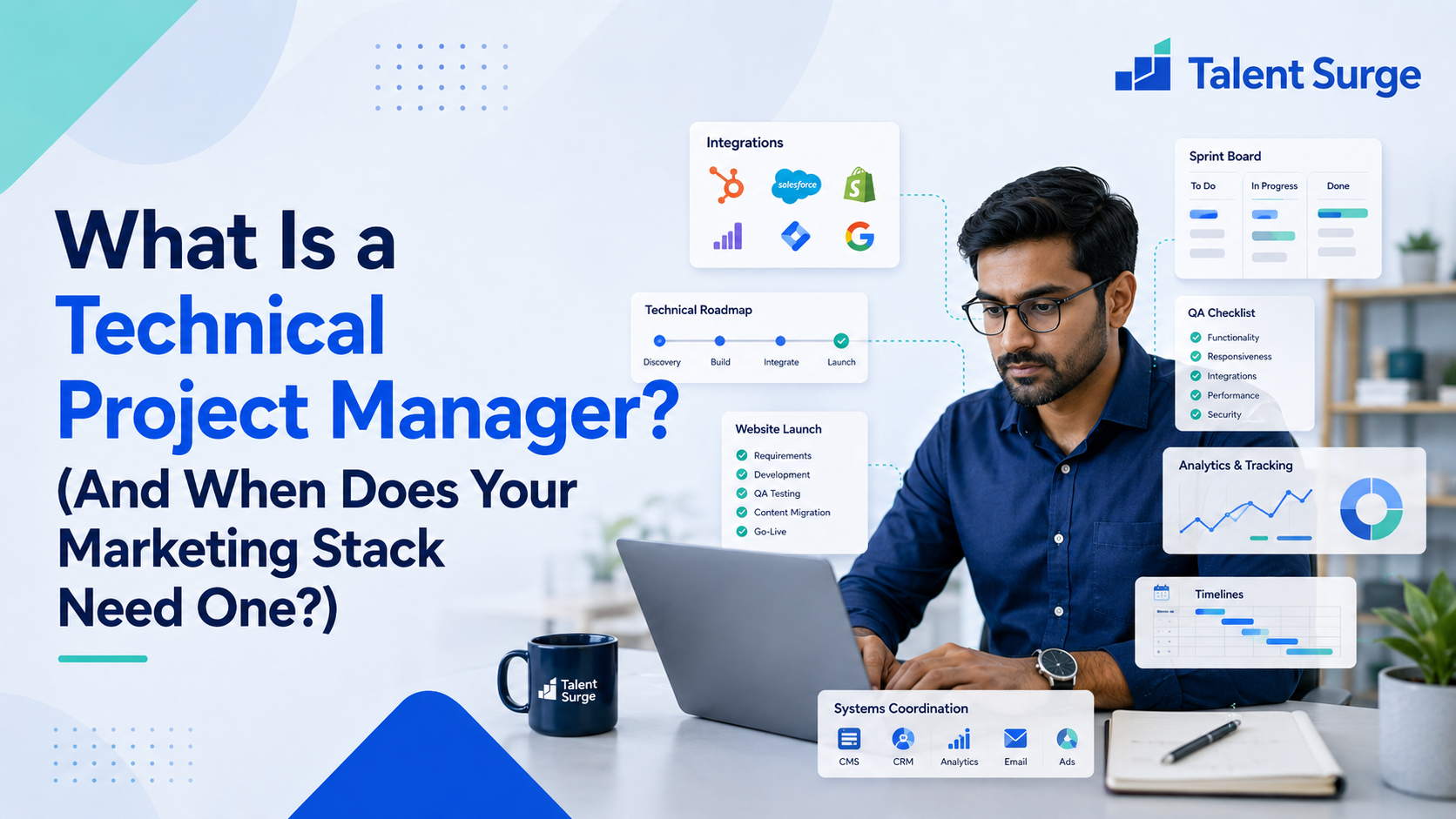
What Is a Technical Project Manager? (And When Does Your Marketing Stack Need One?)
On this page
Marketing technology projects have a well-documented failure rate. CRM implementations that stretch months past deadline. Automation workflows that work in testing and break in production. API integrations between marketing platforms that require three rounds of rework before they function. Reporting dashboards that someone spent 80 hours building that nobody uses.
The root cause is almost never the technology. It's the coordination layer. Specifically, the absence of a Technical Project Manager who sits at the intersection of business requirements and technical execution someone who can speak both languages fluently, translate between them accurately, and ensure the build matches the brief.
How a Technical PM Differs from a Standard Project Manager
A standard Project Manager coordinates deliverables: campaigns, content, creative, client communication. They're excellent at tracking milestones, managing timelines, and enforcing scope. They're not equipped to write a technical specification that a developer can implement, to assess whether a Zapier workflow is architected correctly, or to QA a HubSpot pipeline build against acceptance criteria.
A Technical Project Manager operates at that boundary:
| Function | Standard PM | Technical PM |
|---|---|---|
| Project timeline and milestone management | Yes | Yes |
| Scope documentation and change control | Yes | Yes with technical scoping included |
| Technical requirements documentation | Basic | Deep developer-ready specifications |
| API and integration architecture review | No | Yes |
| QA against technical acceptance criteria | No | Yes tests functionality, not just aesthetics |
| CRM configuration and workflow logic | No | Yes can both spec and evaluate |
| Developer communication and sprint management | Surface-level | Technical peer understands the implementation layer |
| Cross-platform marketing tech coordination | Tool-agnostic | Tool-proficient HubSpot, GHL, Zapier, Make, n8n |
The Projects a Technical PM Owns
Every one of the following project types benefits from a Technical PM and suffers without one:
- CRM builds and migrations: HubSpot, GoHighLevel, Salesforce, Pipedrive setting up deal pipelines, contact properties, lifecycle stages, and automations. Or migrating from one CRM to another without losing data, historical context, or automation logic.
- Marketing automation workflows: Multi-step automation built in HubSpot, Zapier, Make, n8n, ActiveCampaign, or Klaviyo. A Technical PM designs the logic, writes the spec, coordinates the build, and QAs every branch before launch.
- API integrations: Connecting your CRM to your ad platforms, your lead capture forms to your email system, your payment processor to your customer success dashboard. These projects require someone who understands what APIs can and can't do before a line of code is written.
- Full funnel tech stack builds: Landing page builder + CRM + email platform + tracking layer + analytics dashboard. The coordination between four or more platforms, each with their own requirements and limitations, is where most funnel builds fail without a Technical PM.
- Analytics and attribution builds: GA4 configuration, custom reporting dashboards in Looker Studio or Google Sheets, UTM taxonomy systems, multi-touch attribution models. A Technical PM scopes these correctly so the output is actually useful.
- Website migrations: Particularly migrations that involve carrying over marketing automation triggers, tracking pixels, conversion goals, and integrated CRM forms without breaking any of them.
Have a marketing tech project that needs proper management? Explore the Technical PM role → or get matched candidates now.
What Happens Without a Technical PM
Without a dedicated Technical PM, one of two people absorbs the coordination role: you (the business owner or marketing director), or nobody. The outcomes are predictable:
- If you absorb it: You spend 10-20 hours per week as an unpaid translator between your marketing team's requirements and your developer's implementation. Your projects deliver late. Your marketing strategy gets deprioritised because you're debugging HubSpot workflows.
- If nobody absorbs it: The developer builds what they understood, not what was meant. The marketing team receives a build that doesn't match the brief. A second (sometimes third) round of "fixes" follows, each round costing more time and money than the original scope.
A failed CRM implementation at a growth-stage company typically costs $20,000-$80,000 in wasted development time, data cleanup, and opportunity cost from delayed marketing operations. A Technical PM's annual cost at Expert tier through Talent Surge: $21,120. One clean delivery pays for the year.
How to Identify If You Need a Technical PM Specifically
You need a Technical PM (not a standard PM) if any of the following apply:
- You are about to start, or currently running, a CRM build or migration
- You are building or rebuilding marketing automation workflows with significant logic branches
- You need to connect two or more marketing platforms via API or integration layer
- You are building an attribution model or analytics reporting system
- You have developers on your team who are waiting for requirements that nobody is qualified to write
- Your marketing tech projects consistently deliver late, over-budget, or with significant rework cycles
FAQ
Does a Technical PM need to be able to code?
Not necessarily though many can. A Technical PM's primary value is the ability to translate between business requirements and technical implementation with enough depth to write accurate specifications, evaluate technical trade-offs, and QA implementation against defined criteria. Coding ability is useful but not the defining skill.
What tools should a Technical PM be proficient in?
HubSpot, GoHighLevel, Zapier, Make (formerly Integromat), n8n, Google Analytics 4, Looker Studio, and standard project management tools (ClickUp, Asana, Notion). Additional platform experience in Salesforce, ActiveCampaign, or Klaviyo is valuable depending on your stack. See full role details →
What's the difference between Expert tier and Pro tier for a Technical PM?
Expert tier ($11/hr) is appropriate for most marketing tech stack projects CRM builds, automation workflows, API integrations. Pro tier ($18/hr) makes sense for enterprise-complexity implementations, multi-platform builds with significant custom development, or Technical PMs who also manage development sprints directly.
Stop absorbing your own technical project management. Get 3 matched Technical PM candidates → offshore, managed, placed in 14 days.
Take action today
Stop comparing. Start saving.
US businesses save 60-70% vs local hires. Get 3 pre-vetted offshore specialists matched to your exact role delivered in 14 days, free with no commitment.
Keep reading

What Does a Content Strategist Actually Do? (And When Should You Hire One?)
A Content Strategist isn't just someone who plans blog posts. Here's what they own, what they deliver, and when you actually need one.
When Should You Hire a Remote PPC Manager? (Signs You've Waited Too Long)
If your Google Ads campaigns are set and forget, your CPL is climbing, and nobody is testing new angles you needed a PPC Manager yesterday.

What Is a Technical SEO Specialist? (And Why Your Regular SEO Expert Can't Do Their Job)
Technical SEO is a separate discipline. Here's what a Technical SEO Specialist actually does and the problems only they can fix.