
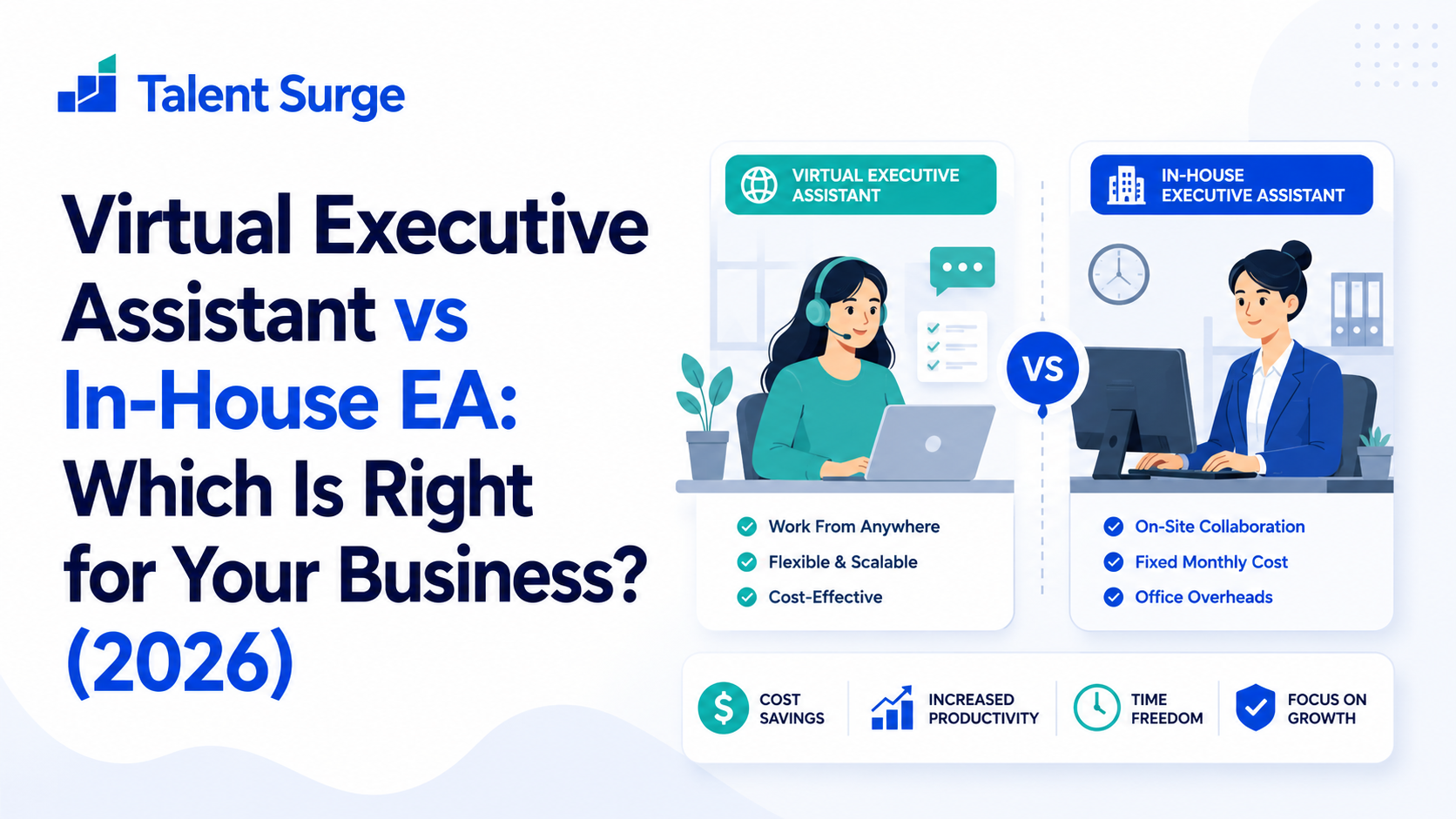
Virtual Executive Assistant vs In-House EA: Which Is Right for Your Business? (2026)
On this page
For most growing businesses, the moment eventually arrives: you need executive-level support, and you need to decide how to get it.
The traditional answer has always been to hire an in-house executive assistant, someone who sits in your office, attends meetings in person, and is available five days a week at their desk. For decades, this was the only model. And for some organizations, it still makes sense.
But in 2026, the alternative has matured. A virtual executive assistant, sourced and managed through a dedicated offshore partner, now delivers the same quality of output at a fraction of the cost, with faster onboarding, broader talent access, and built-in replacement guarantees.
This guide breaks down both options across every dimension that matters: cost, quality, flexibility, security, onboarding speed, and replacement risk. No fluff. Just the numbers and the logic.
Cost: The Most Obvious Difference
In-house EA
A full-time in-house executive assistant in the US costs between $55,000 and $85,000 in base salary depending on location and seniority. But salary is only part of the equation.
- Health insurance and benefits: $8,000 to $15,000/year
- Payroll taxes (employer portion): 7.65% of salary
- Office space and equipment: $3,000 to $6,000/year
- Recruiting and placement fees: $5,000 to $15,000 (one-time)
- Paid time off and sick leave: 15 to 25 days/year (cost absorbed)
Fully loaded, a mid-level US-based EA costs $80,000 to $120,000 per year. A senior-level EA in a major metro can exceed $140,000.
Virtual EA (managed offshore)
Through a managed offshore partner like Talent Surge, a dedicated virtual executive assistant costs $18,000 to $35,000 per year. That rate includes everything: HR, payroll, benefits, company-issued devices, screen monitoring, a dedicated Business Success Executive, and a 30-day free replacement guarantee.
There are no benefits to administer, no office space to provide, no recruitment fees, and no equipment costs. The partner absorbs all operational overhead.
See the exact savings for your situation. Use the Talent Surge cost calculator to compare managed offshore vs US hire costs for any role and engagement level.
Quality: Can a Virtual EA Match an In-House Hire?
In-house EA
When you hire well, an in-house EA can be exceptional. They learn your habits, anticipate your needs, and integrate deeply into your organization. The challenge is hiring well. In a local market, you're limited to whoever is available, willing, and within commuting distance. In competitive metro areas, the best candidates are often priced out of reach or already employed.
Virtual EA (managed)
A managed virtual EA partner draws from a global talent pool. This means access to professionals with 5 to 10+ years of C-suite support experience at multinational companies, individuals who have chosen remote work as a career path, not as a fallback. Rigorous vetting (skills testing, English fluency assessment, background checks, cultural fit interviews) ensures quality that matches or exceeds what most businesses find locally.
The key variable is the partner, not the model. Through a partner with strong vetting and management infrastructure, virtual EA quality is consistently high. Through a freelance marketplace with no oversight, it's inconsistent. The model matters less than the execution.
Flexibility and Scalability
In-house EA
An in-house hire is a fixed commitment. You're paying the same salary whether your workload is at peak or in a slow period. Adjusting hours, shifting responsibilities, or scaling down requires HR conversations, contract modifications, and sometimes legal complexity. If your business is seasonal or growing unpredictably, the fixed-cost employment model creates friction.
Virtual EA (managed)
Managed virtual EA arrangements are designed for flexibility. You choose from engagement packages (40, 80, or 160 hours per month) and can adjust as your needs change. Scaling up means adding hours or a second specialist. Scaling down doesn't require a termination conversation.
For founders and executives in growth mode, where role definitions shift and needs evolve quarter to quarter, the virtual model provides structural flexibility that in-house employment cannot match.
Security and Confidentiality
In-house EA
Physically present in your office, using company devices, on your network. Security feels inherent. But many in-house EAs also use personal devices, personal email accounts, and have access that isn't formally controlled. The security is often assumed rather than enforced.
Virtual EA (managed)
Through a quality managed partner, security is formalized and enforced. Talent Surge virtual executive assistants work from CISM-certified office facilities on company-issued laptops. Every specialist signs an NDA before day one. Screen monitoring runs during every shift. Access credentials are managed centrally and revoked immediately at offboarding. Data handling follows documented security protocols.
For executives handling sensitive information, board materials, financial data, personnel decisions, the managed virtual model often provides stronger security than a loosely managed in-house arrangement. Learn more about Talent Surge security standards.
Replacement Risk: What Happens When It Doesn't Work Out?
In-house EA
Ending an employment relationship requires notice periods, severance, potential HR involvement, and in some jurisdictions significant legal complexity. Replacing an in-house EA who doesn't work out costs $8,000 to $15,000 in recruiting fees alone, plus 6 to 10 weeks of lost productivity.
Virtual EA (managed)
Through a quality managed partner, replacement is structured and fast. You give advance notice, and within days you are interviewing vetted replacement candidates. There are no severance costs, no unemployment implications, and no recruiting fees. The managed partner absorbs the operational overhead.
For businesses in growth mode, where needs shift, roles evolve, and headcount flexibility matters, the virtual model is architecturally superior.
Onboarding Speed: Days vs Months
In-house EA timeline
- Job description drafting: 1 to 2 weeks
- Job posting and applications: 2 to 3 weeks
- Screening and interviews: 2 to 3 weeks
- Offer, acceptance, notice period: 2 to 4 weeks
- Onboarding and ramp-up: 4 to 6 weeks
- Total time to full productivity: 12 to 18 weeks
Managed virtual EA timeline
- Submit requirements: Day 1
- Candidate matching: 3 to 5 days
- Interview: Day 7 to 10
- Onboarding: Day 14 to 21
- Total time to full productivity: 3 to 4 weeks
If you need executive support now, not in four months, the virtual model is not just faster. It's the only model that meets the timeline most executives actually face.
Side-by-Side Comparison
| Dimension | In-House EA | Virtual Executive Assistant |
|---|---|---|
| Annual cost | $96K to $144K | $18K to $35K |
| Time to hire | 12 to 18 weeks | 2 to 3 weeks |
| Talent pool | Local market only | Global top talent |
| Quality | High (if hired well) | High (if vetted well) |
| Flexibility | Low, employment contract | High, managed service |
| Replacement | Expensive, slow | Free, fast (30 days) |
| Security | Assumed, often informal | Enforced, CISM-certified |
| Management overhead | You handle everything | Partner manages operations |
| Benefits/payroll | You administer | Partner handles |
| Physical presence | Yes | No |
Ready to see how much you'd save? Compare the cost of a managed virtual EA vs a US in-house hire using Talent Surge's free cost calculator.
When In-House Still Makes Sense
Despite the clear advantages of the virtual model on cost, speed, flexibility, and replacement risk, there are situations where an in-house EA remains the right choice:
- You need daily physical presence (reception management, office operations, handling physical documents and packages)
- Your role involves highly sensitive in-person meetings where a physical EA presence is required
- You operate in a heavily regulated environment with strict on-site data handling requirements
- Your organization's culture is deeply office-first and integration is impossible remotely
If none of these apply to you, and for most modern founders and executives, they don't, the in-house premium is very difficult to justify.
The Bottom Line
For the vast majority of executives in 2026, the virtual executive assistant model delivers equivalent quality, dramatically lower cost, faster time-to-hire, and far greater flexibility than the in-house alternative.
The executives who still default to in-house are often doing so out of habit, not analysis. When you run the actual numbers across cost, speed, flexibility, quality, security, and replacement risk, the virtual model wins on every dimension except physical presence.
If physical presence isn't a genuine requirement for your executive support (and for 90%+ of executives reading this, it isn't), the decision is clear.
FAQ
How much does a virtual executive assistant cost compared to an in-house EA?
A US-based in-house EA costs $80,000 to $140,000 per year fully loaded. A managed virtual executive assistant through a partner like Talent Surge costs $18,000 to $35,000 per year, all-inclusive. Calculate your exact savings here.
Is a virtual executive assistant as reliable as an in-house hire?
Through a managed partner, yes. Virtual EAs work dedicated hours, are supervised by a Business Success Executive, and operate under screen monitoring and performance reviews. Reliability is built into the management infrastructure, not left to chance.
Can a virtual EA handle confidential executive work?
Absolutely. Talent Surge VEAs sign NDAs before day one, work from CISM-certified office facilities on company-issued devices, and have all access credentials centrally managed. Learn about our security framework.
How fast can I get a virtual executive assistant placed?
Through Talent Surge, 3 pre-vetted candidates are presented within 14 days. Most clients have their VEA onboarded and working within 3 weeks. See how it works.
What if my virtual EA doesn't work out?
Talent Surge provides a free 30-day replacement guarantee. If the match isn't right, a new candidate is sourced and onboarded at no additional cost to you.
Ready to make the switch? Get matched with a pre-vetted virtual executive assistant from Talent Surge. 3 candidates in 14 days. Fully managed. Free replacement guarantee. Book your free discovery session.
Take action today
Stop comparing. Start saving.
US businesses save 60-70% vs local hires. Get 3 pre-vetted offshore specialists matched to your exact role delivered in 14 days, free with no commitment.
Keep reading
Talent Surge vs. Upwork: Why Agencies Are Switching to Managed Offshore Talent
Upwork is built for sourcing one-off work fast. Talent Surge is built for dedicated, managed specialists who stay. Here is the honest comparison of marketplace freelancers vs managed offshore talent, with cost math, risk, and when each one wins.
In-House Marketing Team vs. Offshore Remote Team: What's Actually Better in 2026?
In-house or offshore is the wrong question. The real one is which roles belong local, which belong offshore, and what hybrid structure gives you the best output per dollar. Here is the role-by-role answer with real cost math.
Copywriter vs. Content Strategist: Which Role Should You Hire First?
They're not the same role. Here's how to decide which hire moves the needle first for your business.