
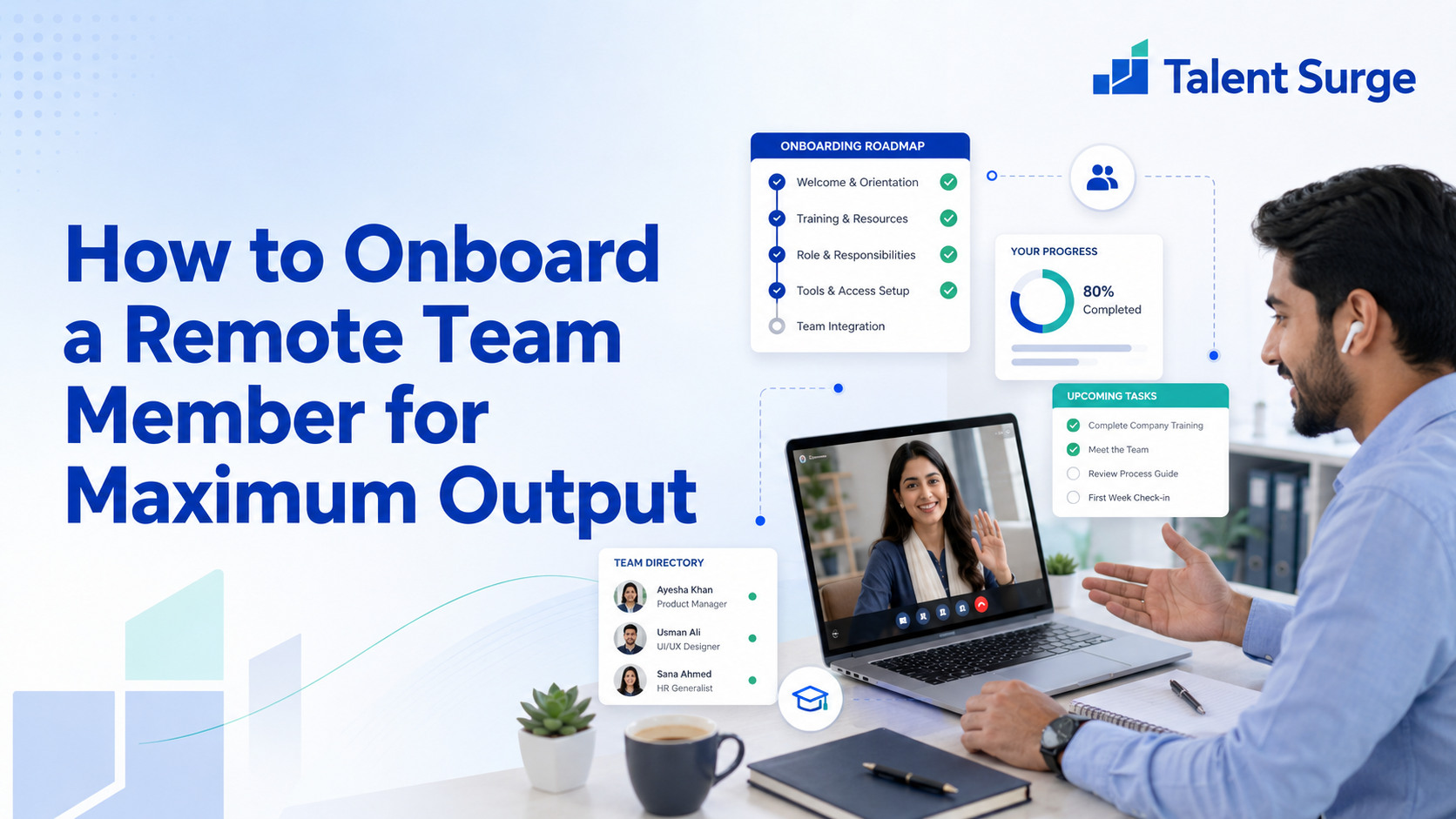
How to Onboard a Remote Team Member for Maximum Output
On this page
Most remote hiring failures don't happen in the interview. They happen in the first two weeks. A new hire who doesn't receive proper context, tool access, and direction in the first 14 days will spend the next 60 days trying to reverse-engineer what they should be doing and producing mediocre work in the process.
This is the onboarding framework that Talent Surge recommends to all clients when a new offshore specialist joins their team. It's built on one principle: your specialist's first 90 days of performance are determined by your first 14 days of onboarding.
Before Day One: Preparation That Pays Off
Most onboarding problems are created before the specialist starts not after. Common preparation failures include:
- Tool access not granted until day three or four
- No written brand guide or client context document
- No documented SOPs for recurring tasks
- No clear expectations set for the first 30 days
Before your specialist's first day, prepare these three things:
- Access checklist: Every platform they'll use project management tool, Google Drive, communication channel, client reporting dashboards, social accounts, ad platforms. All access granted on day one.
- Context document: Brand voice, client list and descriptions, tone guidelines, standards for output quality, and examples of work you consider excellent.
- First-week tasks list: 3-5 low-stakes tasks that let them demonstrate their skills while they're getting oriented. Not your most critical deliverables but real work with clear briefs.
Week One: Context Over Tasks
The instinct when someone new starts is to immediately assign the backlog. Resist it. Week one is primarily about context absorption not output volume.
Schedule a 60-minute kickoff call covering:
- Your business model and revenue streams
- Your clients and their specific needs
- Your quality standards and what "good" looks like in your context
- Your communication preferences (async vs. real-time, response time expectations)
- Your reporting expectations (what you want to see and how often)
The more context a specialist has in week one, the more independently they can operate from week three onwards. Context investment now pays back in reduced management overhead for months.
The 30-60-90 Day Framework
Set explicit expectations for what success looks like at each milestone. Share these on day one. A specialist who knows what they're being measured on will orient their effort accordingly.
Day 30 Orientation complete: They can execute all core tasks independently, understand your brand and clients, and produce output that meets your quality bar with minimal revisions. KPIs being tracked but not yet judged.
Day 60 Independent execution: Tasks are completed on schedule without reminders. Quality is consistent. They're identifying improvements or asking the right strategic questions. First KPI review conducted.
Day 90 Full productivity: They're operating as a functional team member with institutional knowledge. KPIs should be tracking toward target. Formal performance review with your Talent Surge BSE conducted at this milestone.
Note: Talent Surge's Business Success Executives track this cadence for you. Your BSE flags when a specialist is falling behind the 30-60-90 trajectory so you can intervene early rather than late. Start your first hire →
Communication Structure That Works for Remote Teams
Remote teams don't fail because of time zone differences. They fail because communication infrastructure was never designed. Here's the structure that works:
- Daily task updates: Your specialist logs what they worked on, what's in progress, and what's blocked in your project management tool (Asana, ClickUp, Monday.com). Takes 5 minutes to write, takes 2 minutes to read. No meeting required.
- Weekly async sync: A brief written or Loom video update on the week's key outputs, any blockers, and the plan for next week. 10 minutes of their time, 5 minutes of yours.
- Monthly BSE performance review: Talent Surge's BSE conducts a formal performance review with documented outcomes. You receive the summary. Any performance issues get escalated at this point not by you, by the BSE.
The Most Common Onboarding Mistakes to Avoid
| Mistake | What It Costs You | How to Avoid It |
|---|---|---|
| Delayed tool access | 1-3 days of lost productivity | Pre-grant access before day one |
| No written brief for first tasks | Revisions, frustration, wasted time | Prepare 3-5 tasks with full context |
| No 30-60-90 expectations set | Misaligned performance for 3 months | Share milestones on day one |
| No regular communication cadence | Drift, misalignment, dropped tasks | Daily updates + weekly async review |
| Overloading week one with tasks | Overwhelmed specialist, poor first output | Limit week one to orientation + 3-5 tasks |
FAQ
How long does it take a new Talent Surge specialist to reach full productivity?
Most specialists reach full independent productivity between day 30 and day 45, assuming they receive a structured onboarding as outlined above. Specialists with prior experience in their role may be fully productive by day 14-21.
What if the specialist isn't performing well at the 30-day mark?
Contact your BSE immediately. Early intervention additional context, adjusted task briefs, or a performance conversation is far more effective than waiting for the 90-day review. Your BSE can diagnose whether the issue is onboarding quality, role fit, or specialist performance.
Do I need to be available during their working hours?
Not necessarily. Most Talent Surge clients manage their specialists asynchronously with scheduled weekly touchpoints. You set the working hours at engagement start including timezone coverage that works for your operations.
Ready to build a high-output offshore team? Get 3 pre-vetted candidates matched to your first role →
Take action today
Stop comparing. Start saving.
US businesses save 60-70% vs local hires. Get 3 pre-vetted offshore specialists matched to your exact role delivered in 14 days, free with no commitment.
Keep reading

Why Managed Remote Hiring Beats Freelancers Every Time
Freelancers disappear. Managed remote staff don't. Here's the real difference for US businesses.
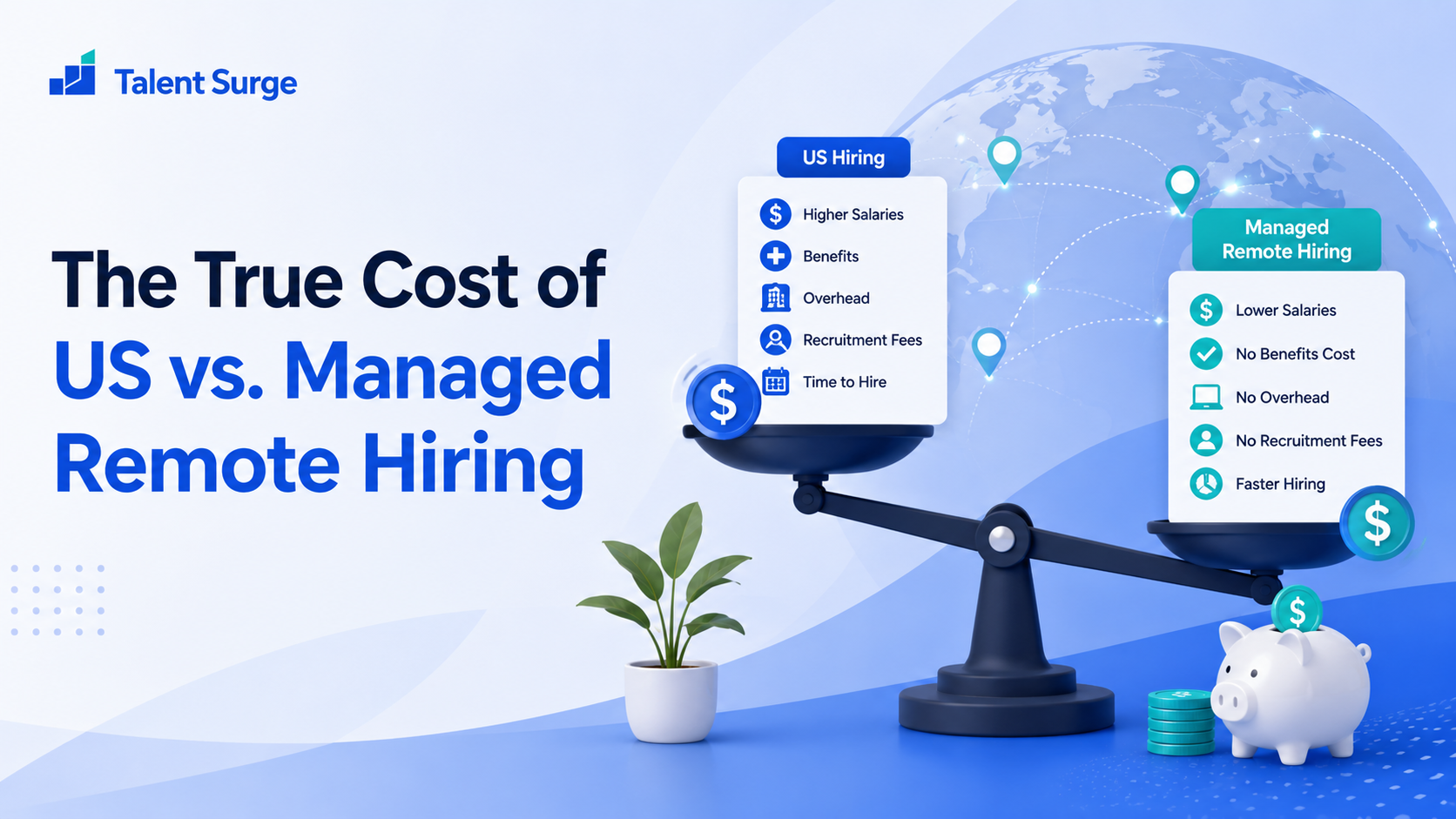
The True Cost of US vs. Managed Remote Hiring
The real cost of a US hire is salary plus benefits, taxes, recruiting, ramp, and management overhead. Here is the full math against a managed remote specialist.

Talent Surge vs. Upwork: Why Agencies Are Switching to Managed Offshore Talent
Upwork is built for sourcing one-off work fast. Talent Surge is built for dedicated, managed specialists who stay. Here is the honest comparison of marketplace freelancers vs managed offshore talent, with cost math, risk, and when each one wins.