
Part-Time vs Full-Time Offshore Hiring: Which Should You Choose?

On this page
One of the first decisions in offshore hiring is how many hours you actually need. Hire too few and the work piles up. Hire too many and you pay for idle time. The right answer depends on the shape of the work, not a default assumption.
Here is how to choose between part-time and full-time offshore engagements, with a simple decision guide and the cost math behind each.
Key Takeaways
- Match hours to the actual recurring workload, not a default assumption.
- Part-time fits support roles, new functions, and sub-20-hour workloads.
- Full-time wins when a role needs deep context and fast, consistent turnaround.
- Even full-time managed offshore starts at $3/hr, well below US in-house cost.
Match Hours to the Work, Not the Calendar
Start by listing the recurring tasks and estimating weekly hours honestly. Many roles, especially admin, content, and support at lower volume, fit comfortably in part-time. Others, like managing multiple client accounts or owning a function end to end, need full-time focus.
When Part-Time Makes Sense
Part-time is ideal when the workload is real but not yet 40 hours, when you are testing a new function, or when the role is genuinely support-level. It keeps cost low while removing work from your plate. You can scale up as volume grows.
When Full-Time Wins
Full-time is the better choice when a role needs deep context, fast turnaround, and continuity. A dedicated full-time specialist builds institutional knowledge, owns outcomes, and is available throughout your overlap window. For client-facing or revenue roles, this usually pays for itself.
Want to see the numbers first? Use the Cost Calculator to compare offshore, US in-house, and freelance costs for any role and tier.
Part-Time vs Full-Time Decision Guide
| Signal | Lean part-time | Lean full-time |
|---|---|---|
| Weekly workload | Under 20 hours | 30 hours or more |
| Context needed | Task-based | Deep and ongoing |
| Turnaround needs | Flexible | Fast and consistent |
| Role type | Support | Ownership or client-facing |
| Budget stage | Testing the role | Committed to scaling |
The Hidden Cost of Under-Hiring
Hiring too few hours has a quiet cost: work backs up, quality slips under pressure, and you end up filling the gap yourself. If you find yourself routinely doing the specialist's overflow, that is the signal to move from part-time to full-time. Under-hiring often costs more in your own time than the extra hours would.
The Cost Math
Even full-time managed offshore hiring starts at $3/hr depending on tier, far below the $40/hr to $80/hr of a US in-house hire. That means full-time is often affordable even for small teams. Run your scenario in the Cost Calculator and compare tiers on the pricing page.
Start Lean, Then Scale
If you are unsure, start part-time to validate the role and the fit, then scale to full-time as the workload proves out. A managed engagement makes that transition simple, and you keep the same specialist so no knowledge is lost. See virtual assistant vs specialist to pick the right role first.
The Bottom Line
Choose hours based on the real shape of the work. Part-time suits sub-20-hour, task-based support roles you want to test. Full-time suits deep, client-facing, ownership roles. With managed offshore from $3/hr, full-time is affordable far earlier than most teams expect.
Frequently Asked Questions
Can I start part-time and scale to full-time offshore?
Yes. Many clients start part-time to validate the role, then scale to full-time as the workload grows, keeping the same specialist. Talent Surge supports both.
Is full-time offshore hiring affordable for a small business?
Often yes. Managed offshore rates start at $3/hr depending on tier, well below US in-house costs. Compare in the Cost Calculator.
How do I estimate the hours I need?
List the recurring tasks and weekly hours honestly. If it is under 20, start part-time. If it needs deep context and fast turnaround, go full-time.
What are the signs I should move from part-time to full-time?
If work routinely backs up, quality slips under deadline pressure, or you find yourself covering the overflow, it is time to move to full-time.
Does part-time offshore cost more per hour than full-time?
Rates start at $3/hr depending on experience tier for both. Full-time simply buys more capacity and deeper context. Compare on the pricing page.
Not sure how many hours you need? Tell Talent Surge about the work and we will recommend the right engagement. See pricing.
Take action today
Stop comparing. Start saving.
US businesses save 60-70% vs local hires. Get 3 pre-vetted offshore specialists matched to your exact role delivered in 14 days, free with no commitment.
Keep reading

Why Managed Remote Hiring Beats Freelancers Every Time
Freelancers disappear. Managed remote staff don't. Here's the real difference for US businesses.
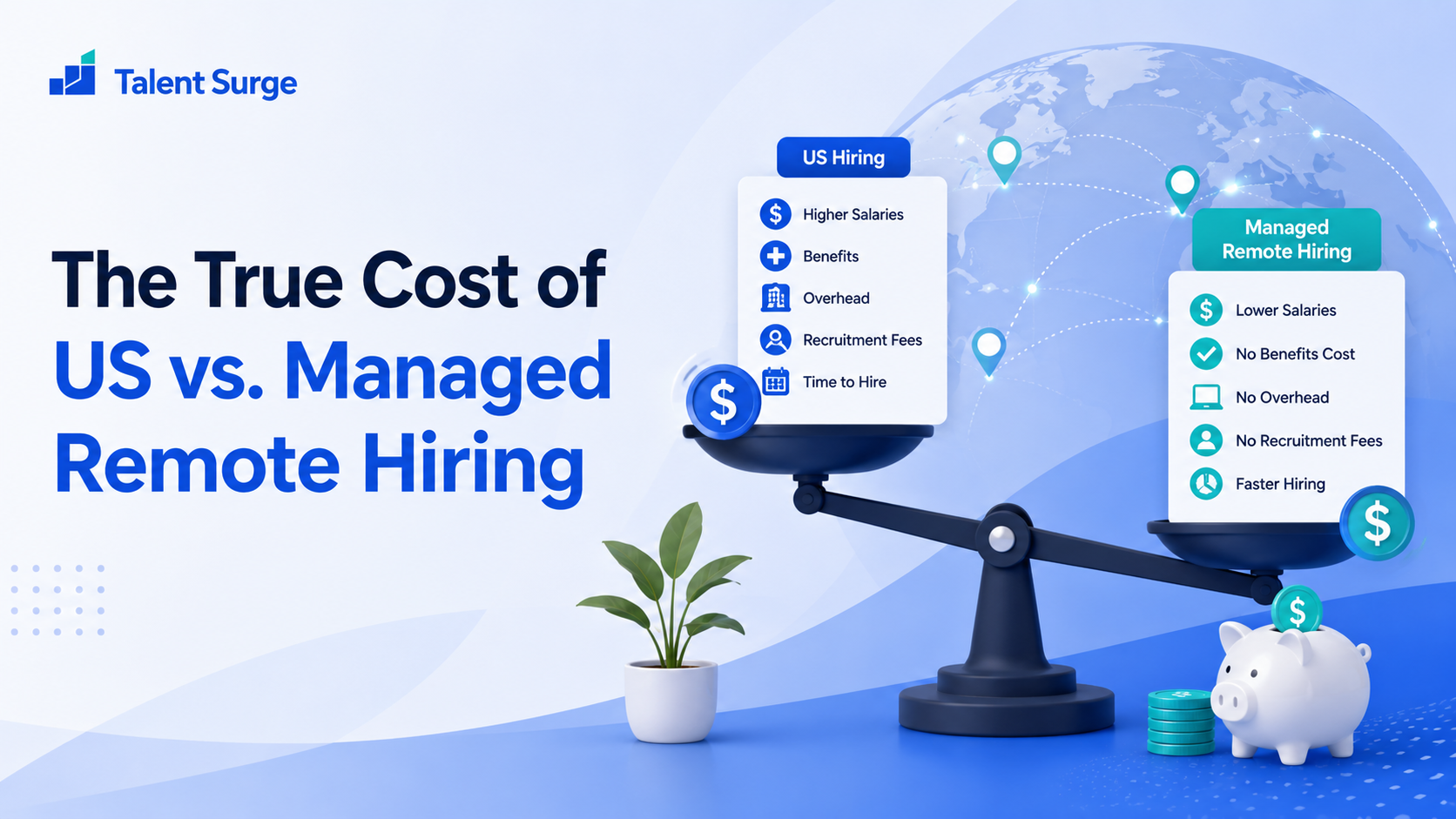
The True Cost of US vs. Managed Remote Hiring
The real cost of a US hire is salary plus benefits, taxes, recruiting, ramp, and management overhead. Here is the full math against a managed remote specialist.

Talent Surge vs. Upwork: Why Agencies Are Switching to Managed Offshore Talent
Upwork is built for sourcing one-off work fast. Talent Surge is built for dedicated, managed specialists who stay. Here is the honest comparison of marketplace freelancers vs managed offshore talent, with cost math, risk, and when each one wins.