
What Is a Virtual Executive Assistant? Complete Guide (2026)
On this page
- What Is a Virtual Executive Assistant?
- Virtual Executive Assistant vs. Regular Virtual Assistant
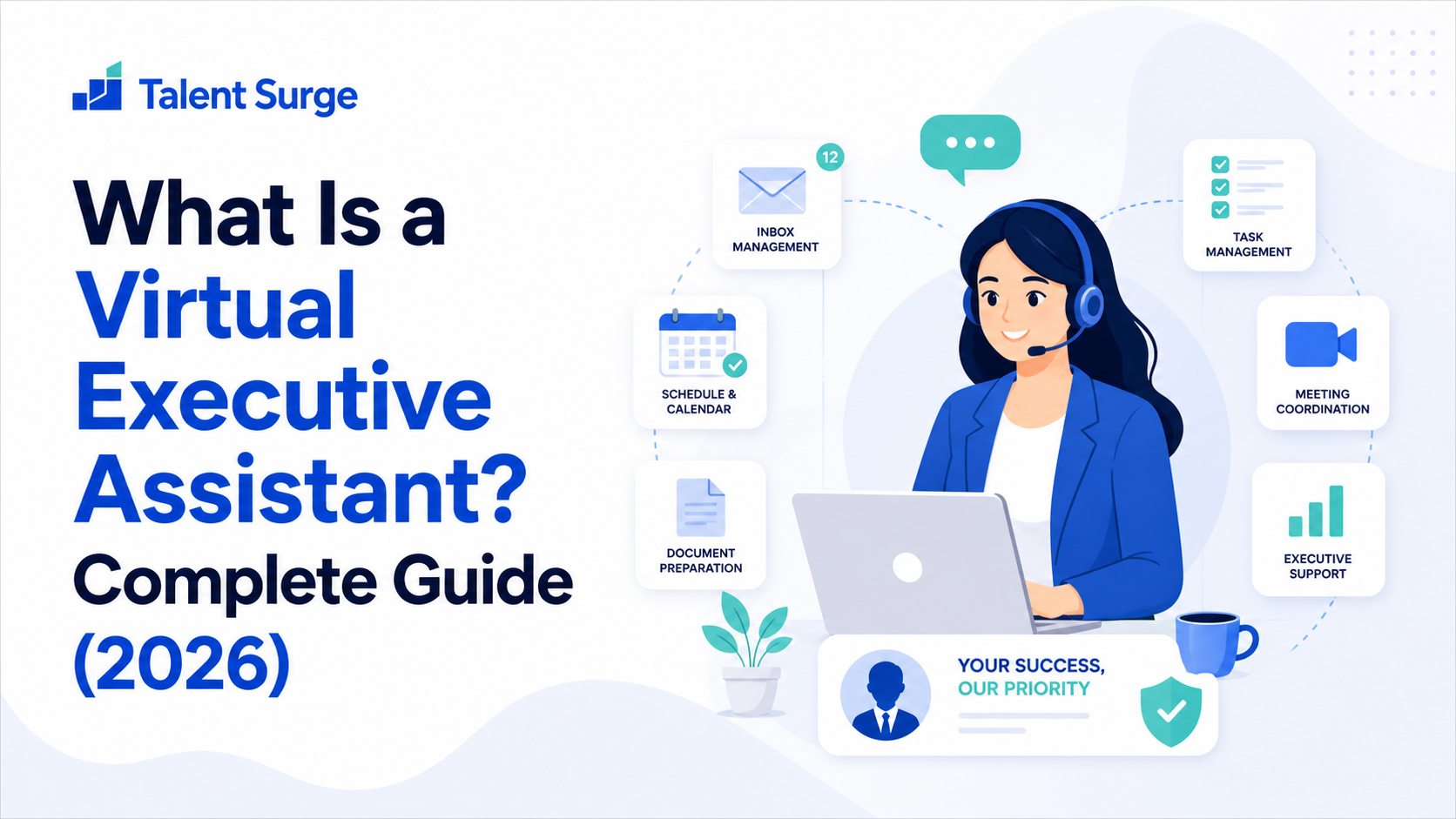
- What Does a Virtual Executive Assistant Do?
- Why Executives Are Choosing Virtual Over In-House
- What Industries Hire Virtual Executive Assistants?
- How to Know When You're Ready to Hire a Virtual Executive Assistant
- How to Hire a Virtual Executive Assistant in 2026
- What to Look for in a Virtual Executive Assistant
- FAQ
If you're a founder, CEO, or senior executive spending hours every week on scheduling, emails, and administrative tasks, you already know the problem. Your time is your scarcest resource, and too much of it is leaking into work that shouldn't require your attention at all.
A virtual executive assistant (VEA) is the solution most high-performing executives are turning to in 2026. But what exactly does a VEA do, how are they different from a standard virtual assistant, and is hiring one the right move for your business?
This guide answers all of it.
What Is a Virtual Executive Assistant?
A virtual executive assistant is a senior-level remote professional who provides high-touch administrative and operational support to executives, founders, and C-suite leaders, all without being physically present in your office.
Unlike a general virtual assistant who handles basic tasks like data entry or social media scheduling, a virtual executive assistant operates as a trusted partner to leadership. They manage complex calendars, handle sensitive communications, coordinate across teams, prepare executive briefings, and often serve as the gatekeeper between you and the rest of the world.
They work remotely, typically from a different city or country, but are fully integrated into your workflows, tools, and communication channels.
Virtual Executive Assistant vs. Regular Virtual Assistant
This is where most businesses get confused. Both roles are remote. Both save you money compared to a full-time in-house hire. But the similarities largely stop there.
| Factor | Virtual Assistant | Virtual Executive Assistant |
|---|---|---|
| Level | Junior to mid | Senior, experienced |
| Supports | Anyone on the team | Executives and C-suite only |
| Tasks | Data entry, scheduling, social media | Executive calendar, travel, comms, briefings |
| Decision-making | Follows strict instructions | Exercises independent judgment |
| Communication | Basic email handling | Manages executive inbox, stakeholder comms |
| Confidentiality | Standard | High, handles sensitive information |
| Onboarding time | Days | Days to 1 week |
The core difference is judgment and seniority. A virtual executive assistant doesn't just complete tasks. They anticipate needs, manage priorities, and protect the executive's time proactively.
What Does a Virtual Executive Assistant Do?
Here's a breakdown of the most common responsibilities handled by a VEA:
Calendar and Schedule Management
Your VEA owns your calendar entirely. They schedule meetings, block focus time, manage timezone conflicts, reschedule without involving you, and ensure you're never double-booked. For busy executives, this alone can recover 8-12 hours per week.
Email and Communication Management
A VEA sorts, prioritizes, flags, and drafts responses in your inbox. They act as the first line of communication, filtering what actually needs your attention from what doesn't.
Travel Coordination
Business travel involves dozens of micro-decisions: flights, hotels, ground transport, visa requirements, meeting logistics, itineraries. Your VEA handles all of it end-to-end.
Meeting Preparation and Follow-up
Before every important meeting, your VEA compiles briefings, background notes, and agendas. After meetings, they track action items and follow up with stakeholders on your behalf.
Stakeholder and Vendor Communication
A VEA communicates with clients, partners, vendors, and board members on your behalf, drafting emails, coordinating calls, and managing relationships you don't have time to manage directly.
Document and Report Preparation
Presentations, reports, executive summaries, board decks. Your VEA prepares, edits, and organizes documents so you walk into every meeting fully prepared.
Project Coordination
Many VEAs take on lightweight project management, tracking deliverables, following up on tasks, and ensuring nothing falls through the cracks across your team.
Personal and Executive Administration
Expense reports, invoices, subscriptions, personal appointments, and other administrative tasks that consume executive time but don't require executive thinking.
Mid-article CTA: Want a dedicated virtual executive assistant placed in 14 days, fully managed? See Talent Surge's VEA hiring process →
Why Executives Are Choosing Virtual Over In-House
The traditional model - hiring a full-time, in-office executive assistant - still makes sense for some organizations. But for a growing number of founders and executives, the virtual model is clearly superior.
- Cost savings are dramatic. A senior in-house executive assistant in the US costs $65,000-$95,000 per year in salary alone, before benefits, payroll taxes, office space, and equipment. A virtual executive assistant sourced from a managed offshore partner delivers the same quality of work at 40-70% of that cost.
- Talent pool is global. When you hire in-house, you're limited to your local market. Virtual hiring opens access to the top 1% of executive assistant talent globally, professionals with C-suite experience at multinational companies who are choosing remote work.
- Speed of hire is faster. Finding, screening, and hiring an in-house EA takes 6-12 weeks on average. Through a managed service like Talent Surge, you can have a pre-vetted virtual executive assistant matched and onboarded within days.
- Flexibility is built in. Your business needs fluctuate. Virtual arrangements are easier to scale, adjust, or restructure without the HR complexity of full-time employment.
What Industries Hire Virtual Executive Assistants?
Virtual executive assistants are not industry-specific. They serve executives across:
- Technology and SaaS: startup founders, CTOs, and product leaders
- Finance and Investment: fund managers, analysts, and financial advisors
- Healthcare: practice owners, hospital administrators, and consultants
- E-commerce and Retail: brand founders and operations directors
- Legal: law firm partners and general counsel
- Real estate: investment groups, brokers, and developers
- Consulting: independent consultants and advisory firms
If you're an executive with a packed calendar and a growing set of responsibilities, you're a candidate for a virtual executive assistant, regardless of your industry.
How to Know When You're Ready to Hire a Virtual Executive Assistant
Most executives wait too long. Here are the clearest signs you're ready:
- You're spending more than 2 hours per day on email and scheduling
- Important tasks are slipping because you're buried in low-value admin
- You've missed meetings, deadlines, or follow-ups in the last 90 days
- You regularly work evenings and weekends just to "catch up"
- You have no buffer time between meetings
- Your inbox has become unmanageable
If three or more of these apply to you, the ROI of a virtual executive assistant will be immediate and significant.
How to Hire a Virtual Executive Assistant in 2026
You have three main options:
- Freelance platforms (Upwork, Fiverr): Low cost but high risk. You're responsible for vetting, interviewing, onboarding, managing, and replacing if things go wrong. Quality is inconsistent and turnover is high.
- EA staffing agencies: Better quality but expensive. Most charge significant placement fees plus ongoing retainers, and you still manage the relationship yourself.
- Managed offshore partners (recommended): Companies like Talent Surge source, vet, and manage your virtual executive assistant end-to-end. You get a dedicated, senior-level professional who is fully supervised, trained, and ready to integrate with your workflows, at a fraction of the cost of a US-based hire.
Explore Talent Surge's virtual executive assistant services →
What to Look for in a Virtual Executive Assistant
When evaluating candidates, prioritize:
- 5+ years of C-suite or executive support experience
- Exceptional written English communication, they're representing you
- Proactive problem-solving, not just task execution
- Discretion and confidentiality, they'll handle sensitive information
- Tech fluency: comfort with Google Workspace, Slack, Notion, Asana, Zoom, and your CRM
- Timezone alignment or flexibility: they should be available when you are
FAQ
How much does a virtual executive assistant cost in 2026?
A US-based in-house EA costs $65,000-$95,000 per year plus benefits. Through a managed offshore partner like Talent Surge, a dedicated virtual executive assistant starts from $18,000-$35,000 per year, fully managed including all HR, device, security, and oversight costs. Use our cost calculator to see your exact savings →
Is a virtual executive assistant the same as a virtual assistant?
No. A standard VA typically handles junior to mid-level administrative tasks. A virtual executive assistant operates at a senior level, supporting founders and C-suite executives with complex calendar management, stakeholder communications, travel logistics, briefings, and discretionary judgment. The difference is seniority, scope, and trust.
How long does it take to onboard a virtual executive assistant?
Through Talent Surge, candidates are matched within 14 days. Onboarding typically takes 1-2 weeks. By week 3-4, most VEAs are operating independently with daily task reports and minimal supervision required.
Can a virtual executive assistant handle confidential information?
Yes. Talent Surge VEAs sign NDAs before day one, work from company-secured devices in CISM-certified office facilities, and operate under screen monitoring during work hours. Inbox and calendar access are managed through controlled credentials, not personal accounts.
What's the difference between part-time and full-time VEA engagement?
Part-time (80 hours/month) works well for executives who need support 3-4 days per week with a moderate calendar and inbox load. Full-time (160 hours/month) is right for executives with high-volume operations, complex travel schedules, and the need for a consistently available support presence. View all engagement packages →
End CTA: Ready to hire your virtual executive assistant? Get matched with 3 pre-vetted VEA candidates from Talent Surge, placed in 14 days, managed from day one.
Take action today
Stop comparing. Start saving.
US businesses save 60-70% vs local hires. Get 3 pre-vetted offshore specialists matched to your exact role delivered in 14 days, free with no commitment.
Keep reading

What Does a Content Strategist Actually Do? (And When Should You Hire One?)
A Content Strategist isn't just someone who plans blog posts. Here's what they own, what they deliver, and when you actually need one.
When Should You Hire a Remote PPC Manager? (Signs You've Waited Too Long)
If your Google Ads campaigns are set and forget, your CPL is climbing, and nobody is testing new angles you needed a PPC Manager yesterday.

What Is a Technical SEO Specialist? (And Why Your Regular SEO Expert Can't Do Their Job)
Technical SEO is a separate discipline. Here's what a Technical SEO Specialist actually does and the problems only they can fix.