
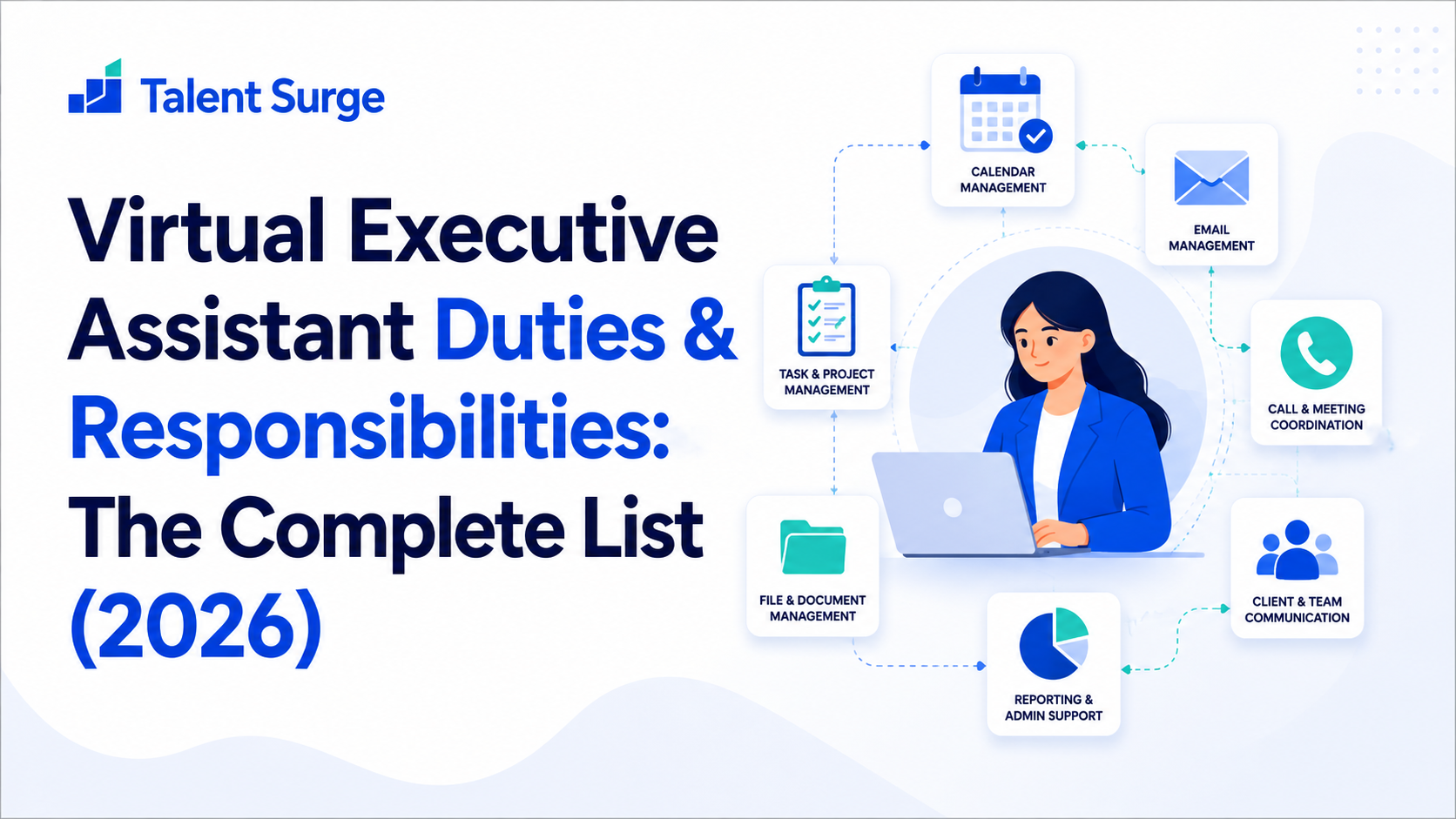
Virtual Executive Assistant Duties & Responsibilities: The Complete List (2026)
On this page
- What Makes a Virtual Executive Assistant Different From a Regular VA
- Category 1: Calendar and Schedule Management
- Category 2: Email and Communications Management
- Category 3: Travel Coordination
- Category 4: Meeting Preparation and Follow-up
- Category 5: Stakeholder and Vendor Communications
- Category 6: Document and Report Preparation
- Category 7: Project and Operations Coordination
- Category 8: Personal and Administrative Support
- Category 9: Research and Intelligence
- How to Prioritise What to Delegate First
- The ROI Calculation
- FAQ
One of the most common questions executives ask before hiring a virtual executive assistant is: what exactly will they handle?
It's a fair question. The scope of a virtual EA is broader than most people assume and understanding it clearly is what separates executives who extract enormous value from the role versus those who underutilise it.
This is the definitive breakdown of virtual executive assistant duties and responsibilities in 2026, organised by category so you can quickly identify what applies to your specific situation.
What Makes a Virtual Executive Assistant Different From a Regular VA
Before listing responsibilities, this distinction matters.
A general virtual assistant handles task-based, process-driven work: social media scheduling, data entry, basic research, transcription. The work is largely transactional and requires minimal judgment.
A virtual executive assistant operates at a senior level. Their responsibilities require discretion, independent judgment, strong communication skills, and the ability to represent an executive professionally. They don't just complete tasks. They manage priorities, protect time, and operate as a trusted extension of leadership.
Every responsibility in this list reflects that senior standard.
Category 1: Calendar and Schedule Management
This is typically the first and highest-impact area a virtual EA takes over. For most executives, calendar chaos is the single biggest drain on productive time.
Core duties include:
- Owning the executive's calendar end-to-end: scheduling meetings, managing recurring appointments, building daily and weekly structure
- Protecting focus blocks and strategic work time from unnecessary interruptions
- Coordinating across multiple timezones for distributed teams and international clients
- Triaging all incoming meeting requests, accepting and declining based on established priority criteria
- Rescheduling conflicts proactively without requiring the executive's involvement
For executives receiving 20 to 40 meeting requests per week, effective calendar management alone recovers 8 to 12 hours.
Category 2: Email and Communications Management
The executive inbox is a significant source of daily cognitive load. A skilled virtual EA takes primary ownership of it.
Core duties include:
- Triaging the inbox daily: sorting, categorising, and flagging messages that require the executive's direct attention
- Drafting responses in the executive's voice for routine and semi-routine communications
- Handling straightforward inquiries independently and without escalation
- Unsubscribing from irrelevant mailing lists and managing inbox hygiene
- Monitoring urgent threads and escalating time-sensitive items immediately
- Managing multiple email accounts where applicable
- Following up on unanswered emails and ensuring nothing falls through the cracks
Many executives go from spending 90+ minutes on email daily to under 20 minutes once a skilled EA has full ownership of the inbox.
Category 3: Travel Coordination
Business travel involves dozens of micro-decisions and logistics. A virtual EA handles all of it so the executive simply shows up.
Core duties include:
- Research and booking flights, hotels, and ground transportation
- Managing complex multi-leg itineraries with multiple cities and timezones
- Handling visa applications, travel documentation, and compliance requirements where needed
- Coordinating airport transfers, car services, and restaurant reservations
- Building detailed travel itineraries with all logistics consolidated into a single document
- Managing travel expense tracking and receipts
- Rebooking and managing changes when travel plans shift
Category 4: Meeting Preparation and Follow-up
What happens before and after meetings is often where the most value is lost. A virtual EA manages both ends.
Pre-meeting duties include:
- Preparing one-page briefing documents for important calls and meetings: attendee backgrounds, agenda items, open questions, relevant context
- Distributing agendas to participants in advance
- Collating all materials the executive needs to be fully prepared
- Researching attendees: professional backgrounds, company info, recent news for client or prospect meetings
Post-meeting duties include:
- Documenting action items and decisions from meeting notes or recordings
- Sending follow-up emails and summaries to attendees
- Tracking action items to completion and following up with responsible parties
- Scheduling any required follow-up meetings
This alone eliminates the post-meeting chaos that costs most executive teams hours every week.
Category 5: Stakeholder and Vendor Communications
A virtual EA handles the constant flow of outbound and relationship communications that don't require the executive personally.
Core duties include:
- Managing communications with clients, partners, suppliers, and vendors on the executive's behalf
- Drafting and sending professional emails, proposals, and follow-ups in the executive's voice
- Liaising with board members, investors, and key stakeholders for routine coordination
- Managing relationship touchpoints: birthday acknowledgements, follow-ups, check-in messages
- Handling vendor negotiations and procurement communications for routine purchases
- Coordinating with internal teams on the executive's behalf
Category 6: Document and Report Preparation
Executives shouldn't spend their time formatting slides or compiling reports. A virtual EA handles document work end-to-end.
Core duties include:
- Creating, editing, and formatting presentations and slide decks
- Preparing executive summaries, briefing documents, and status reports
- Compiling research and data into structured documents
- Proofreading and editing documents before distribution
- Organising and maintaining file systems: Google Drive, SharePoint, Notion, or wherever the executive's documents live
- Preparing board packs, investor updates, and reports with all supporting materials attached
- Managing document templates and standardising formats across the organisation
Category 7: Project and Operations Coordination
Senior virtual EAs often extend into lightweight project management and operations coordination, a high-value area most executives don't initially anticipate.
Core duties include:
- Tracking project deliverables across teams and following up with owners on deadlines
- Maintaining project logs, status trackers, and accountability dashboards
- Coordinating between internal teams and external contractors or agencies
- Managing recurring operational processes: weekly reporting, team check-ins, invoice approvals
- Flagging blockers and escalating issues before they become problems
- Supporting hiring processes: scheduling candidate interviews, managing applicant tracking, and coordinating with recruiters
Category 8: Personal and Administrative Support
Executive time leaks into personal administrative tasks that have nothing to do with business strategy. A virtual EA handles these too.
Core duties include:
- Managing expense reports and submitting reimbursements
- Researching and purchasing gifts, event tickets, and personal items
- Coordinating personal appointments that don't require the executive's time to organise
- Managing subscriptions, memberships, and recurring services
- Handling insurance, warranty, and service communications where appropriate
- Supporting the executive's personal calendar alongside their professional one
Category 9: Research and Intelligence
An often-overlooked but high-value responsibility: keeping the executive informed without them spending hours reading.
Core duties include:
- Competitive intelligence: monitoring competitor news, launches, and market movements
- Industry news briefings and trend summaries
- Due diligence research on potential partners, hires, or acquisition targets
- Preparing talking points and background research before conferences, podcasts, or media appearances
- Compiling market research and summarising findings into executive-ready documents
Want to see what a virtual EA costs? Use the cost calculator to compare managed offshore EA rates against US-based hiring costs.
How to Prioritise What to Delegate First
If you're onboarding a virtual executive assistant for the first time, don't try to hand off everything at once. Start with the highest-volume, lowest-judgment tasks and build from there.
Suggested delegation order:
- Week 1: Calendar management and travel coordination. These are highest volume and lowest risk to start with.
- Week 2: Email triage and inbox management. Requires a brief onboarding on your communication preferences and voice.
- Week 3: Meeting prep and post-meeting follow-ups. Once they know your priorities, this becomes highly autonomous.
- Month 2+: Stakeholder communications, document preparation, research, and project coordination.
Most executives who follow this sequence report being fully operational with their VA within 30 days.
The ROI Calculation
If a virtual executive assistant recovers 10 hours per week for an executive earning $150,000 per year, that's roughly $720 in recovered executive time every single week, or $37,000 annually.
The fully-managed offshore virtual executive assistant through a service like Talent Surge costs a fraction of that. The ROI is not marginal. It's transformational.
Ready to put a dedicated virtual executive assistant to work on these responsibilities? Explore Talent Surge's virtual executive assistant services and have a pre-vetted, senior-level EA matched to your needs in days. Book your free discovery call.
FAQ
What is the most important duty of a virtual executive assistant?
Calendar and schedule management is typically the highest-impact responsibility. For executives receiving 20 to 40 meeting requests weekly, effective calendar management alone recovers 8 to 12 hours per week. Learn more about EA services.
How is a virtual executive assistant different from a regular virtual assistant?
A virtual EA operates at a senior level, handling responsibilities that require discretion, judgment, and professional communication. A general VA handles task-based, transactional work. The scope, autonomy, and decision-making authority are fundamentally different.
How quickly can a virtual EA take over my calendar and inbox?
Most executives are fully operational with their EA within 2 to 3 weeks. Calendar management typically transitions in week 1, with email and communications following in week 2. See the full onboarding process.
Take action today
Stop comparing. Start saving.
US businesses save 60-70% vs local hires. Get 3 pre-vetted offshore specialists matched to your exact role delivered in 14 days, free with no commitment.
Keep reading

What Does a Content Strategist Actually Do? (And When Should You Hire One?)
A Content Strategist isn't just someone who plans blog posts. Here's what they own, what they deliver, and when you actually need one.
When Should You Hire a Remote PPC Manager? (Signs You've Waited Too Long)
If your Google Ads campaigns are set and forget, your CPL is climbing, and nobody is testing new angles you needed a PPC Manager yesterday.

What Is a Technical SEO Specialist? (And Why Your Regular SEO Expert Can't Do Their Job)
Technical SEO is a separate discipline. Here's what a Technical SEO Specialist actually does and the problems only they can fix.