
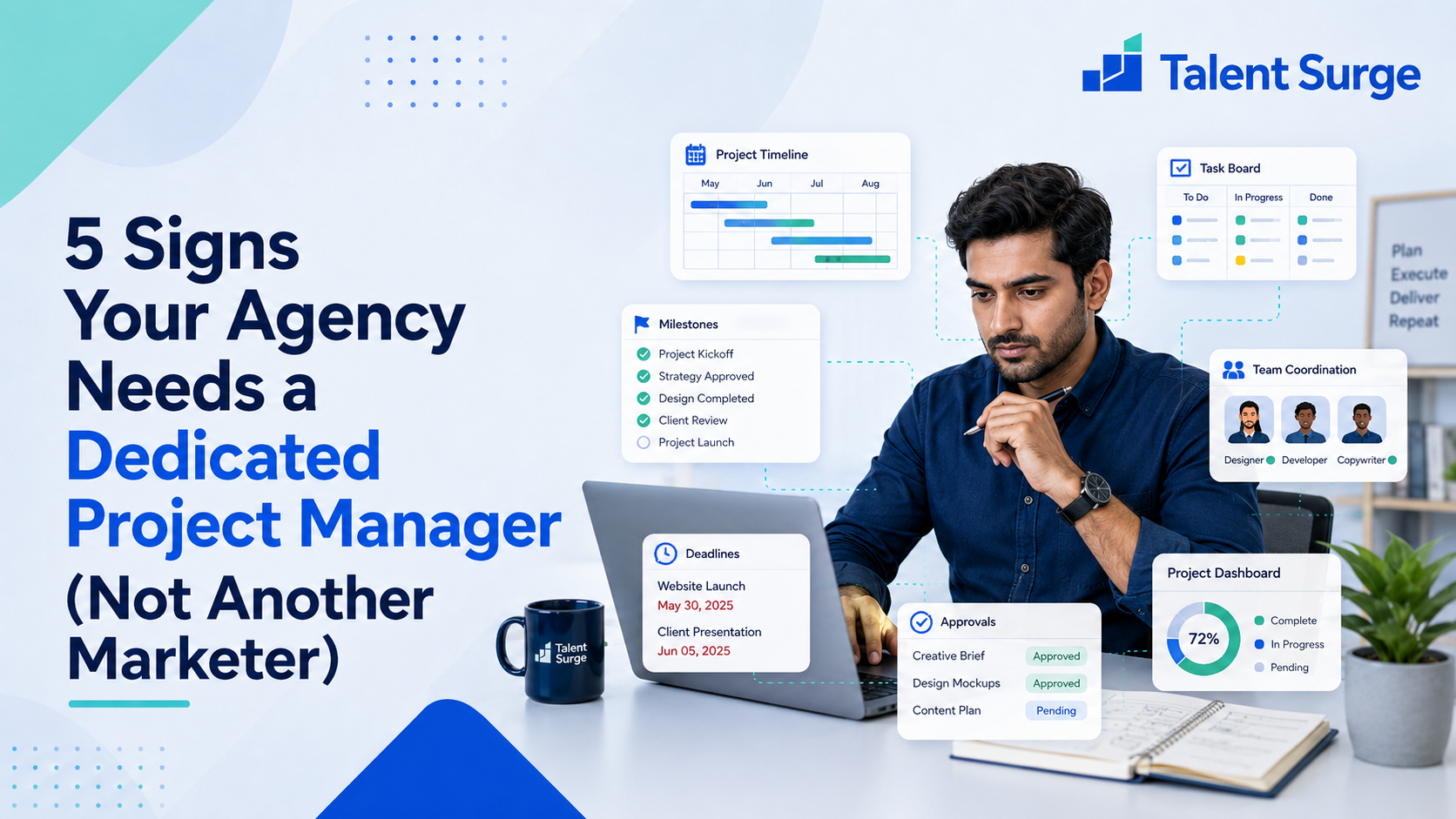
5 Signs Your Agency Needs a Dedicated Project Manager (Not Another Marketer)
On this page
- Sign 1: Clients Are Chasing You for Updates
- Sign 2: Deadlines Are Treated as Suggestions
- Sign 3: You (the Owner or Senior Leader) Are Managing the Team's Day-to-Day
- Sign 4: Scope Creep Is Silently Eating Your Margins
- Sign 5: Your Operations Live in People's Heads
- What Changes When You Hire a Dedicated Project Manager
- FAQ
When agency projects slip, the instinctive response is to hire another marketer another SEO person, another content writer, another account executive. This is almost always the wrong diagnosis. Project delivery failures are rarely a skills problem. They're a coordination problem. And you don't fix a coordination problem with more skilled people. You fix it with a dedicated Project Manager.
Here are the five signs your agency has a coordination problem that only a Project Manager can solve and what changes when you hire one.
Sign 1: Clients Are Chasing You for Updates
If clients send "just checking in" emails before you've proactively updated them, your delivery communication is broken. Client anxiety is the first and most visible sign of a project management gap.
A dedicated Project Manager owns status communication as a core function. They send proactive updates before clients have to ask weekly status reports, milestone confirmations, and early warnings when timelines shift. Clients who receive consistent, proactive communication don't send anxious check-in emails. They renew.
The business impact: agencies with systematic project communication report significantly higher client retention rates. A Project Manager's first month often pays for their annual cost by preventing a single client churn.
Sign 2: Deadlines Are Treated as Suggestions
When your team regularly submits deliverables at the last minute or late, with no advance warning there's no accountability infrastructure. Deadlines without milestones are aspirations. Milestones without tracking are theater.
A Project Manager breaks every project into tracked milestones with assigned owners and clear handoff dependencies. When a milestone is at risk, they flag it 48-72 hours before the deadline not after it's missed. They run the team's delivery calendar, not just the output calendar. The difference is visible within the first 30 days of a PM hire.
Sign 3: You (the Owner or Senior Leader) Are Managing the Team's Day-to-Day
This is the most expensive sign and the most common. If you're spending 2+ hours per day assigning tasks in Asana, following up on stalled deliverables, resolving blockers between team members, or determining what's "done" you're operating as an unpaid Project Manager at your own agency.
The opportunity cost is significant. At a typical agency owner's effective hourly rate of $150-$250, 2 hours of daily task coordination costs $1,500-$2,500 per week $78,000-$130,000 annually in lost growth-oriented time. An offshore Project Manager at Talent Surge Expert tier costs $17,280/year. The ROI is immediate and obvious.
Sign 4: Scope Creep Is Silently Eating Your Margins
Scope creep is the most common margin killer in agency work and the most preventable. It manifests as "quick changes" that accumulate into unpaid hours, client requests that get accommodated without documentation, and project definitions that expand week over week without corresponding billing adjustment.
A Project Manager enforces scope boundaries as a standard operating procedure:
- Every project begins with a documented scope of work with explicit in/out-of-scope definitions
- Change requests are documented and assessed before work begins
- Out-of-scope work triggers a change order process not silent accommodation
- Monthly scope reviews identify patterns of creep before they become recurring margin problems
Agencies typically recover 10-20% of project margins within 90 days of implementing proper scope management. That's pure bottom-line impact from better coordination, not better marketing.
Sign 5: Your Operations Live in People's Heads
When a key team member leaves, does your agency continue operating smoothly or does tribal knowledge walk out the door with them? If the answer is the latter, you have no documented processes. Only a Project Manager has both the incentive and the mandate to document and systematise how your agency delivers work.
A PM builds and maintains:
- Standard Operating Procedures (SOPs) for every recurring deliverable type
- Project templates in your PM tool (ClickUp, Asana, Monday.com) so every project starts from a consistent structure
- Client communication templates and status report formats
- Onboarding documentation for new team members
- Knowledge bases for recurring decision frameworks
With documented processes, your agency's operational quality becomes independent of any individual team member. It scales with your headcount instead of fragmenting with it.
Calculate what a Project Manager would cost your agency: Compare offshore PM costs vs the management time you're currently spending →
What Changes When You Hire a Dedicated Project Manager
| Agency Challenge | Without a PM | With a Dedicated PM |
|---|---|---|
| Client update requests | Reactive clients chase | Proactive updates sent before clients ask |
| Deadline management | Last-minute with no early warning | Milestones tracked, risks flagged 48-72 hrs early |
| Owner's coordination time | 2-4 hrs/day minimum | Under 30 minutes/day (approval and review only) |
| Scope management | Creep absorbed silently | Change orders documented and billed |
| Process documentation | Lives in heads breaks when people leave | SOPs documented, systematised, and maintained |
| New team member onboarding | Informal owner-dependent | Structured PM-owned with documentation |
FAQ
Does a remote Project Manager work effectively compared to an in-office PM?
Yes, for agency work. Project management is fundamentally an asynchronous coordination function task tracking, status communication, milestone management, and process documentation all work well in async remote environments. Talent Surge PMs use your existing tools (ClickUp, Asana, Monday.com, Notion) and operate within your working hours. Explore the Project Manager role →
What PM tools should a dedicated Project Manager be proficient in?
ClickUp, Asana, Monday.com, Notion, and Basecamp are the most common agency PM tools. Talent Surge PMs are evaluated for proficiency in the tools your agency uses not generic PM tool knowledge.
When should I hire a PM vs a Technical PM for my agency?
A standard Project Manager handles campaign delivery, content production, and client communication coordination. A Technical PM is needed when your agency delivers CRM implementations, marketing automation workflows, or complex tech stack projects. See the Technical PM role →
Stop being your own Project Manager. Get 3 matched PM candidates → offshore, dedicated, placed in 14 days.
Take action today
Stop comparing. Start saving.
US businesses save 60-70% vs local hires. Get 3 pre-vetted offshore specialists matched to your exact role delivered in 14 days, free with no commitment.
Keep reading
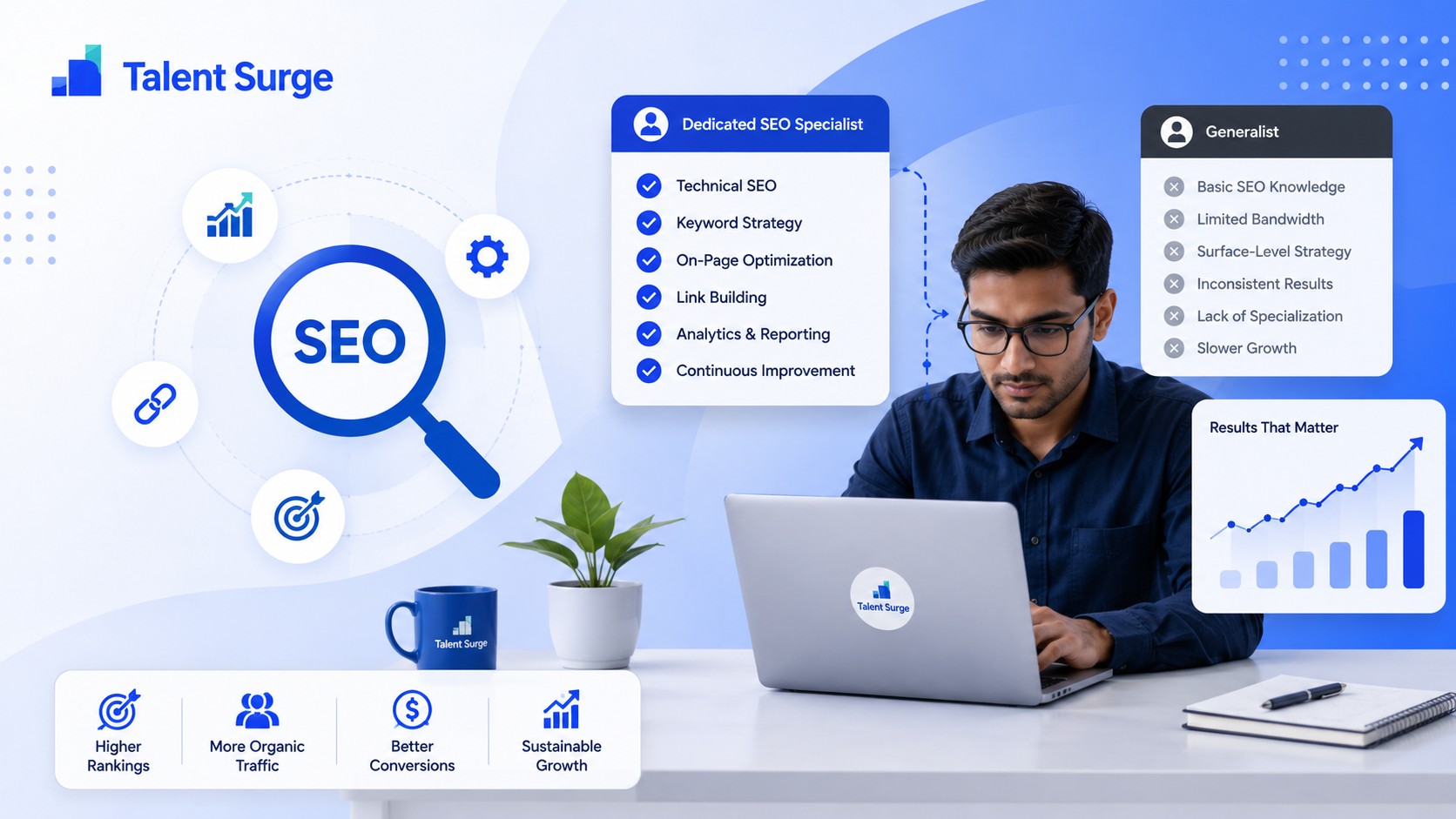
Why Marketing Agencies Need a Dedicated SEO Specialist (Not a Generalist)
Most agency SEO is delivered by a generalist juggling ten other tasks, and clients feel the shallow results. Here is why a dedicated SEO specialist changes outcomes, retention, and margin, plus the cost math that makes the switch affordable.
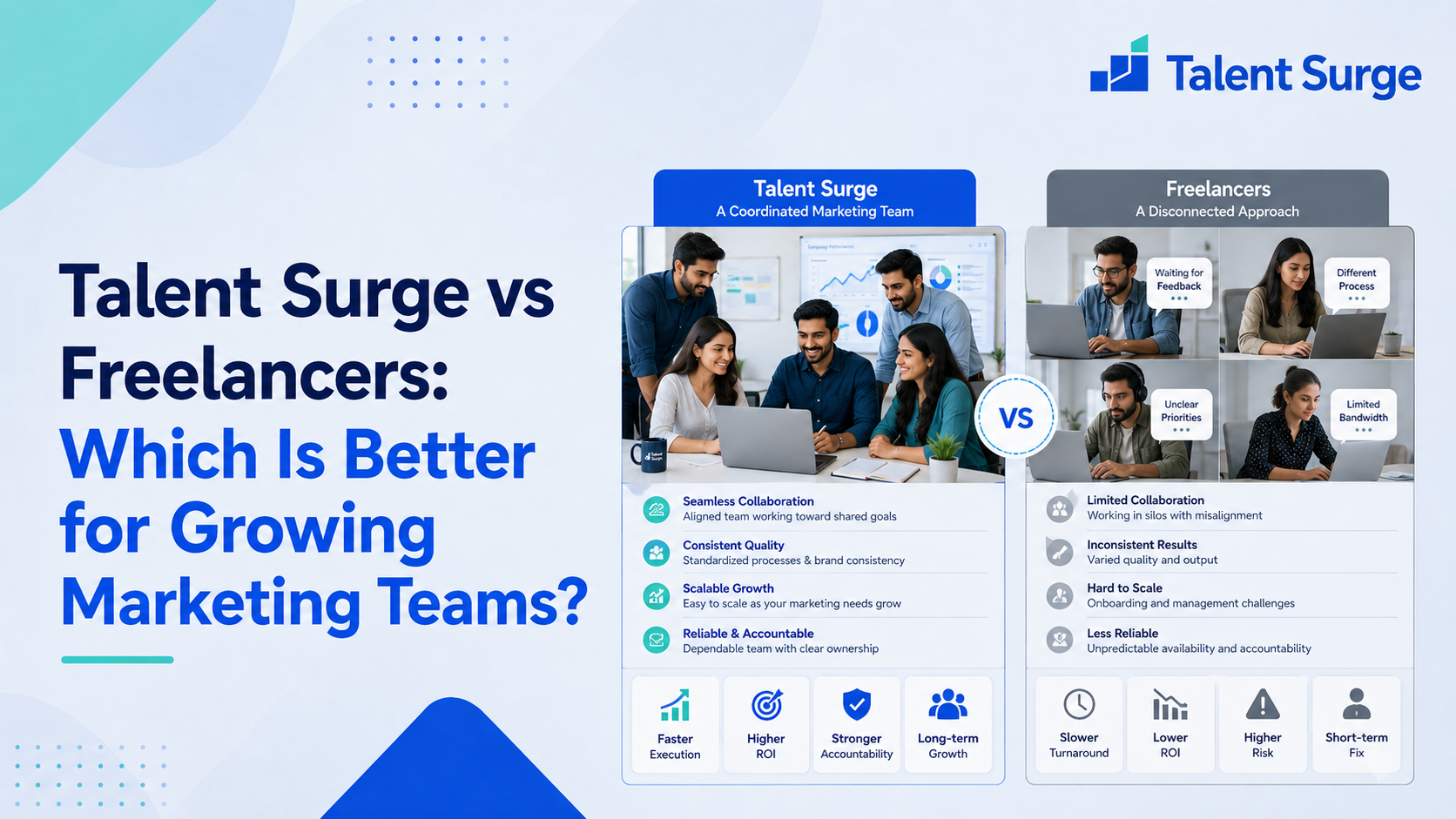
Talent Surge vs Freelancers: Which Is Better for Growing Marketing Teams?
Freelancers give flexibility for one-off work. Managed specialists give reliability, accountability, and scale for the roles you need filled every week. Here is the honest comparison for marketing teams, with cost, risk, and churn math.

What Does a Remote SEO Expert Actually Do for a Marketing Agency?
A remote SEO expert is not just someone who runs a keyword report. Here is exactly what one owns week to week - the tasks, tools, KPIs, and the 90-day impact curve - and how it differs from a generalist squeezing SEO in around other work.